## Diagram: Reinforcement Learning Training Process for Question Answering
### Overview
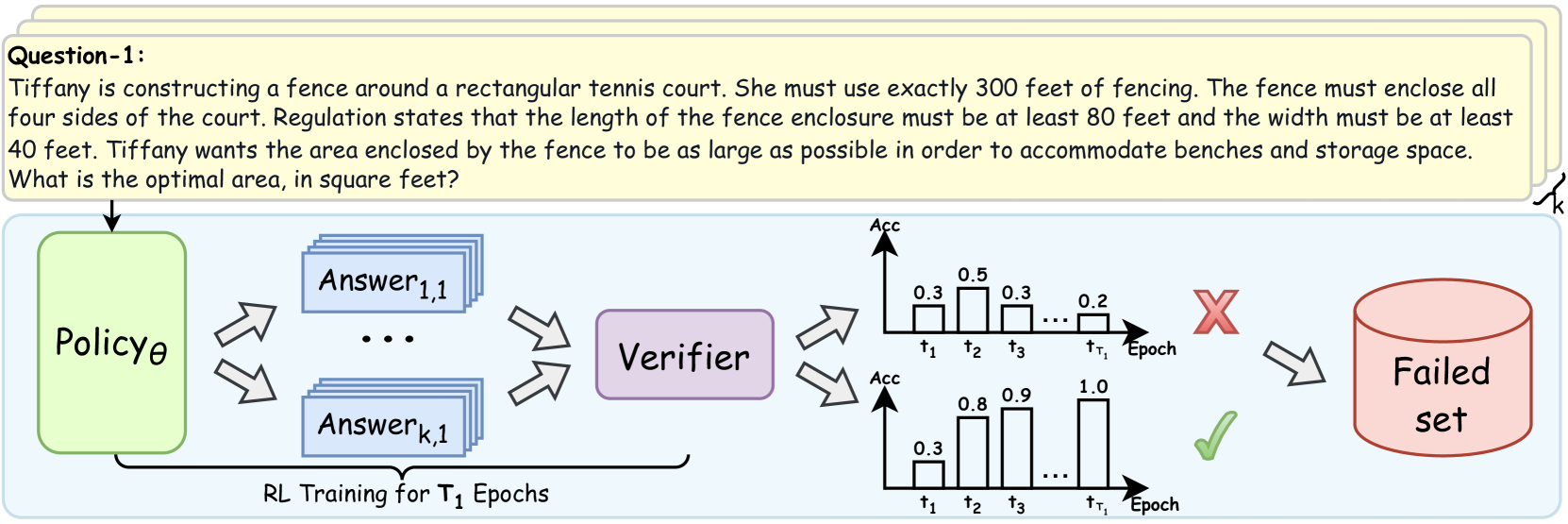
This diagram illustrates a Reinforcement Learning (RL) training process for a question-answering system. It begins with a question, followed by a policy that generates multiple answers. These answers are then verified, and based on the verification outcome (success or failure), they are either processed further or added to a "Failed set." The process is depicted as occurring over $T_1$ epochs.
### Components/Axes
**Header Section:**
* **Question-1:** A text block containing a word problem: "Tiffany is constructing a fence around a rectangular tennis court. She must use exactly 300 feet of fencing. The fence must enclose all four sides of the court. Regulation states that the length of the fence enclosure must be at least 80 feet and the width must be at least 40 feet. Tiffany wants the area enclosed by the fence to be as large as possible in order to accommodate benches and storage space. What is the optimal area, in square feet?"
* A curly brace labeled "k" is positioned to the right of the question block, indicating a potential multiplicity or range of answers.
**Main Diagram Section:**
* **Policy$\theta$:** A green rectangular block representing the policy network, parameterized by $\theta$. An arrow points from the question block to this component.
* **Answer$_{1,1}$ to Answer$_{k,1}$:** Multiple stacked blue rectangular blocks, representing a set of generated answers. The notation suggests $k$ answers, with the first answer indexed as $(1,1)$ and the last as $(k,1)$. Arrows from "Policy$\theta$" point towards these answer blocks.
* **Verifier:** A purple rectangular block, positioned to the right of the answer blocks. Arrows from the answer blocks point towards the "Verifier."
* **RL Training for $T_1$ Epochs:** Text below the "Policy$\theta$" and "Answer$_{k,1}$" blocks, indicating the scope of the training process. A bracket encompasses these elements.
* **Two Bar Charts:**
* **Top Chart:** Labeled "Acc" on the y-axis, representing accuracy. The x-axis is labeled "Epoch" and marked with time points $t_1, t_2, t_3, \dots, t_{T_1}$. The bars show accuracy values:
* At $t_1$: Approximately 0.3
* At $t_2$: Approximately 0.5
* At $t_3$: Approximately 0.3
* At $t_{T_1}$: Approximately 0.2
* **Bottom Chart:** Also labeled "Acc" on the y-axis and "Epoch" on the x-axis with the same time points. The bars show accuracy values:
* At $t_1$: Approximately 0.3
* At $t_2$: Approximately 0.8
* At $t_3$: Approximately 0.9
* At $t_{T_1}$: Approximately 1.0
* **Red Cross (X):** Positioned to the right of the top bar chart, indicating a failure or rejection. An arrow points from the top bar chart towards the red cross.
* **Green Checkmark ($\checkmark$):** Positioned to the right of the bottom bar chart, indicating success or acceptance. An arrow points from the bottom bar chart towards the green checkmark.
* **Failed set:** A pink cylindrical database icon, positioned to the right of the red cross. An arrow points from the red cross towards the "Failed set."
### Detailed Analysis or Content Details
The diagram depicts a process where a "Policy$\theta$" generates multiple answers to a given question. These answers are then evaluated by a "Verifier." The verification process is visualized using two bar charts, each representing accuracy ("Acc") over epochs ($t_1$ to $t_{T_1}$).
* **Top Bar Chart (Failure Scenario):** This chart shows a fluctuating accuracy trend. It starts at approximately 0.3, peaks at approximately 0.5 at $t_2$, drops to approximately 0.3 at $t_3$, and ends at approximately 0.2 at $t_{T_1}$. This trend, associated with a red cross, signifies a failed verification.
* **Bottom Bar Chart (Success Scenario):** This chart shows a generally increasing accuracy trend. It starts at approximately 0.3, rises to approximately 0.8 at $t_2$, further increases to approximately 0.9 at $t_3$, and reaches approximately 1.0 at $t_{T_1}$. This trend, associated with a green checkmark, signifies a successful verification.
* **Flow of Failed Answers:** Answers that lead to a failed verification (indicated by the red cross) are directed into a "Failed set" database.
The question posed in the header is a mathematical optimization problem. Let the length of the rectangular tennis court be $L$ and the width be $W$.
The perimeter is given by $2L + 2W = 300$ feet.
This simplifies to $L + W = 150$.
The constraints are $L \ge 80$ feet and $W \ge 40$ feet.
We want to maximize the area $A = L \times W$.
From $L + W = 150$, we can express $L$ as $L = 150 - W$.
Substituting this into the area formula: $A = (150 - W) \times W = 150W - W^2$.
To find the maximum area, we can take the derivative with respect to $W$ and set it to zero:
$dA/dW = 150 - 2W = 0$
$2W = 150$
$W = 75$ feet.
If $W = 75$ feet, then $L = 150 - 75 = 75$ feet.
Now let's check the constraints:
$L = 75 \ge 80$ (This constraint is violated).
$W = 75 \ge 40$ (This constraint is satisfied).
Since the unconstrained maximum occurs outside the feasible region, the maximum area must occur at one of the boundary points of the feasible region.
The feasible region for $W$ is determined by the constraints:
1. $W \ge 40$
2. $L \ge 80 \implies 150 - W \ge 80 \implies W \le 150 - 80 \implies W \le 70$.
So, the feasible range for $W$ is $40 \le W \le 70$.
The area function $A(W) = 150W - W^2$ is a downward-opening parabola. Its vertex is at $W=75$. Within the feasible range $[40, 70]$, the function is increasing. Therefore, the maximum area will occur at the largest possible value of $W$, which is $W=70$.
If $W = 70$ feet, then $L = 150 - 70 = 80$ feet.
Let's check the constraints:
$L = 80 \ge 80$ (Satisfied)
$W = 70 \ge 40$ (Satisfied)
The optimal area is $A = L \times W = 80 \times 70 = 5600$ square feet.
### Key Observations
* The diagram illustrates a typical RL training loop where a policy generates outputs (answers), which are then evaluated by a verifier.
* The verifier's performance is tracked over epochs, showing two distinct outcomes: one leading to failure and addition to a "Failed set," and another leading to success.
* The top bar chart shows a declining accuracy trend towards the end of training ($t_{T_1}$), suggesting potential overfitting or a policy that is not generalizing well in that scenario.
* The bottom bar chart shows a strong upward trend in accuracy, reaching a peak of approximately 1.0 at $t_{T_1}$, indicating a successful learning process for that branch.
* The question itself is a constrained optimization problem that can be solved analytically.
### Interpretation
This diagram visually represents a machine learning training pipeline, likely for a question-answering or problem-solving agent. The "Policy$\theta$" acts as the agent, generating potential solutions ("Answers"). The "Verifier" serves as the environment or reward function, assessing the quality of these answers. The two bar charts illustrate the learning progress of two different branches or configurations of the policy/verifier interaction. The top chart shows a scenario where the agent's performance degrades or fails to improve significantly, leading to its outputs being discarded into a "Failed set." The bottom chart depicts a successful learning trajectory, where the agent's accuracy consistently improves, culminating in a high score.
The inclusion of the word problem in the header suggests that the RL agent is being trained to solve such problems. The analytical solution to the word problem (optimal area of 5600 square feet) provides a ground truth against which the RL agent's performance could be measured. The diagram implies that the RL training process aims to find optimal solutions, and the "Verifier" is crucial in guiding this optimization by providing feedback. The "Failed set" component highlights the iterative nature of RL, where unsuccessful attempts are logged and potentially used for further refinement or analysis. The presence of $k$ answers and $T_1$ epochs suggests a scalable and iterative approach to learning.