## Flowchart: Computational Rule Interactions
### Overview
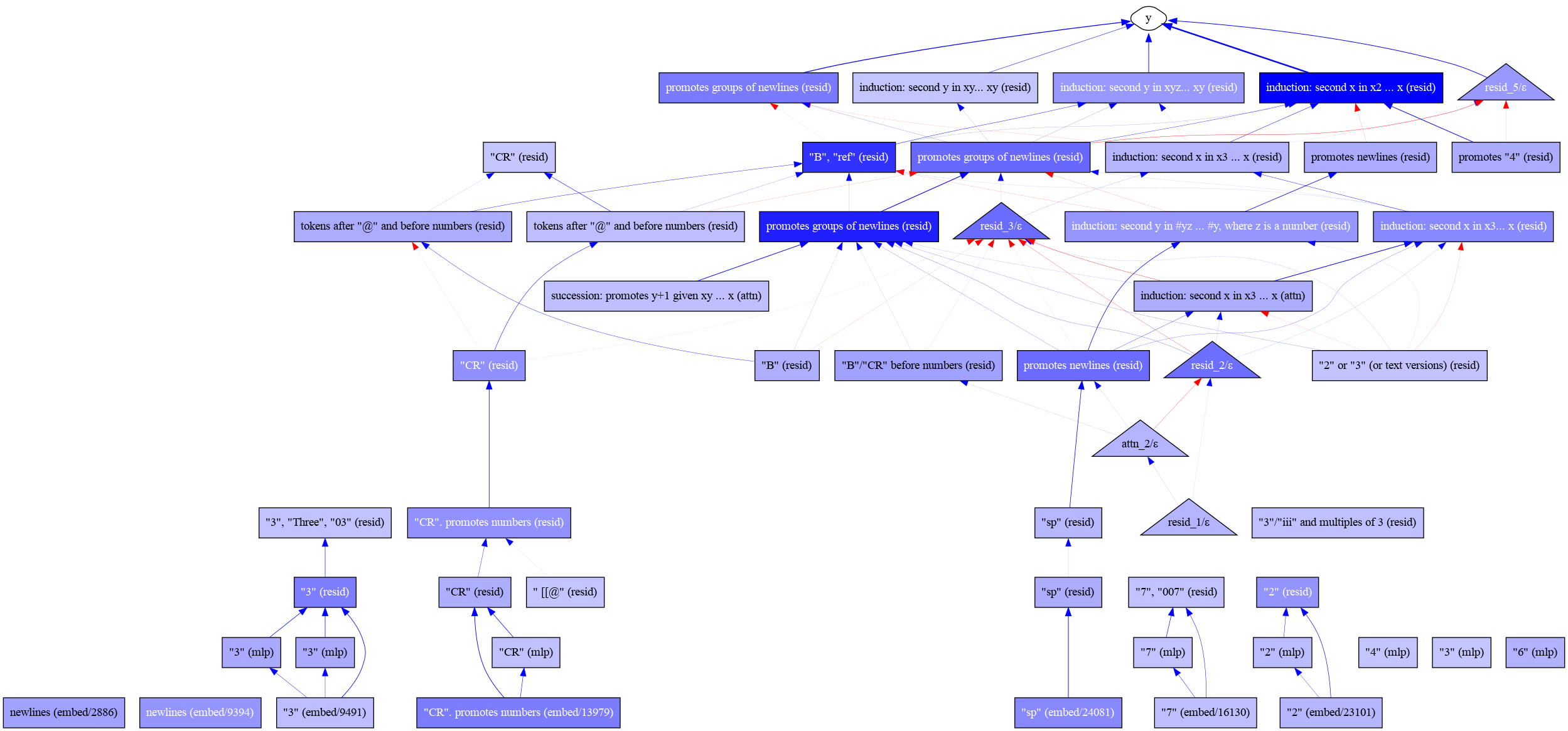
The flowchart depicts a hierarchical network of computational rules and their interactions, centered around a core node labeled "y". It illustrates dependencies between syntactic elements (e.g., "CR", "B"), numerical tokens, and embedded representations (e.g., "embed/2886"). Arrows indicate directional relationships, with red arrows highlighting exceptions or overrides.
### Components/Axes
- **Core Node**: "y" (central hub)
- **Primary Connections**:
- "promotes groups of newlines (resid)"
- "induction: second y in xy... xy (resid)"
- "induction: second x in x2... xy (resid)"
- **Secondary Nodes**:
- "B / CR before numbers (resid)"
- "promotes newlines (resid)"
- "induction: second x in x3... x (resid)"
- **Embedded Representations**:
- "newlines (embed/2886)"
- "newlines (embed/9394)"
- "3" (embed/9491)
- "2" (embed/23101)
- "7" (embed/16130)
- **Symbolic Nodes**:
- "sp" (embed/24081)
- "3" (mlp)
- "2" (mlp)
- "4" (mlp)
- "6" (mlp)
### Detailed Analysis
1. **Core Node "y"**:
- Connects to 5 primary nodes via blue arrows
- Governs induction rules (e.g., "second y in xy... xy")
- Links to "B / CR before numbers" and "promotes newlines"
2. **B / CR before numbers (resid)**:
- Branches into "B (resid)" and "promotes newlines"
- "B (resid)" connects to "B" and "promotes newlines"
3. **Numerical Tokens**:
- "3" has 3 representations: residue, MLP, and embedding
- "2" and "7" follow similar patterns with MLP/embedding variants
- "sp" connects to both residue and embedding forms
4. **CR (Contextual Rules)**:
- "CR" (resid) and "CR" (mlp) connect to "CR" (embed/13979)
- "CR" promotes numbers via residue and MLP pathways
5. **Embedding Patterns**:
- Numerical tokens have distinct embeddings (e.g., "3" embed/9491)
- Newlines have two embeddings (2886, 9394)
- Symbols like "sp" have dual representations
### Key Observations
- **Hierarchical Structure**: "y" acts as the root node with cascading dependencies
- **Redundancy**: Multiple pathways exist for numerical tokens (e.g., "3" has 3 representations)
- **Symbolic Complexity**: "sp" and "CR" nodes show layered processing
- **Embedding Diversity**: At least 5 distinct embeddings exist for numbers/symbols
### Interpretation
This flowchart likely represents a computational grammar or parser rule set, where:
1. **y** serves as the primary syntactic element governing induction rules
2. **B** and **CR** nodes handle contextual processing before numerical tokens
3. **Embeddings** suggest machine learning integration for token representation
4. **MLP** (Multi-Layer Perceptron) connections indicate neural network processing
5. **Red arrows** may represent exception cases or rule overrides
The system appears designed to process text through multiple representation layers (residue, MLP, embeddings) while maintaining syntactic relationships. The "promotes newlines" nodes suggest line-breaking rules, while induction rules handle variable substitution patterns (e.g., "second y in xy... xy").