## Line Graph: Accuracy vs Training Steps (10³)
### Overview
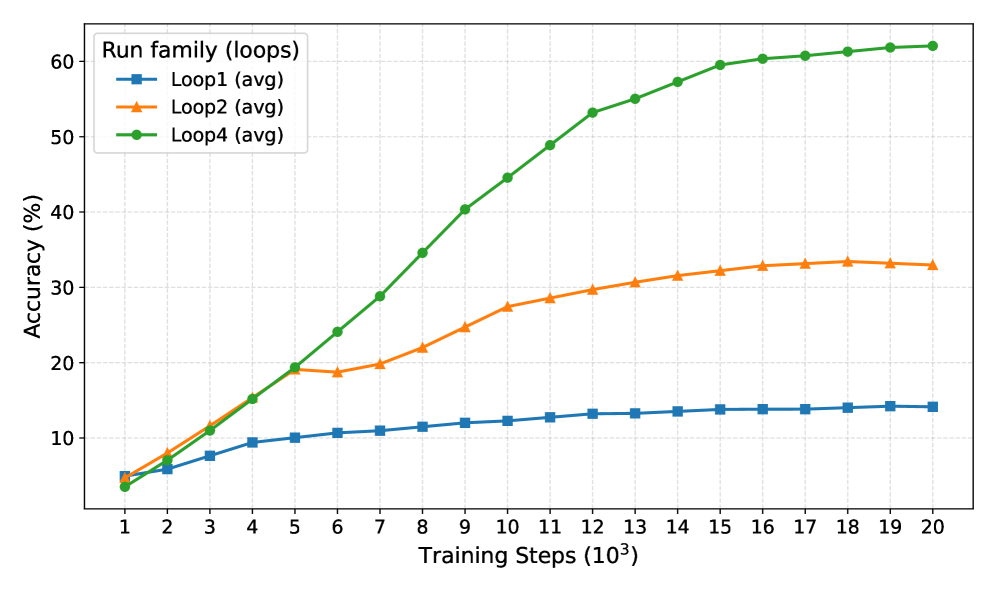
The image depicts a line graph comparing the accuracy (%) of three training loops (Loop1, Loop2, Loop4) across 20,000 training steps (10³ increments). Accuracy is plotted on the y-axis (0–60%), and training steps on the x-axis (1–20,000). The graph shows distinct performance trends for each loop, with Loop4 achieving the highest accuracy and Loop1 the lowest.
### Components/Axes
- **X-axis**: "Training Steps (10³)" labeled with integer markers (1, 2, ..., 20).
- **Y-axis**: "Accuracy (%)" labeled with increments of 10 (0–60%).
- **Legend**: Located in the top-left corner, with:
- **Loop1**: Blue squares (avg accuracy).
- **Loop2**: Orange triangles (avg accuracy).
- **Loop4**: Green circles (avg accuracy).
### Detailed Analysis
1. **Loop1 (Blue Squares)**:
- Starts at ~5% accuracy at step 1.
- Gradually increases to ~14% by step 20.
- Minimal growth after step 10 (~12–14% plateau).
2. **Loop2 (Orange Triangles)**:
- Begins at ~5% at step 1.
- Rises steadily to ~33% by step 20.
- Accelerates between steps 5–15, then plateaus.
3. **Loop4 (Green Circles)**:
- Starts at ~3% at step 1.
- Shows the steepest growth, reaching ~62% by step 20.
- Accelerates sharply between steps 5–15, then stabilizes.
### Key Observations
- **Loop4 dominates** in accuracy, achieving ~62% at step 20, far exceeding Loop2 (~33%) and Loop1 (~14%).
- **Loop1 plateaus early**, showing negligible improvement after step 10.
- **Loop2 demonstrates moderate growth**, with a ~28% increase from step 10 to 20.
- All loops exhibit diminishing returns after step 15, with Loop4 maintaining near-peak performance.
### Interpretation
The data suggests **Loop4 is the most effective training method**, achieving the highest accuracy with sustained growth. Loop2 outperforms Loop1 but lags behind Loop4, indicating potential inefficiencies in Loop1’s training dynamics. The plateauing trends across all loops after step 15 imply **diminishing returns** with extended training, highlighting the need for optimization beyond this threshold. Loop4’s rapid ascent suggests superior convergence properties, while Loop1’s stagnation may indicate underfitting or suboptimal hyperparameters.