TECHNICAL ASSET FINGERPRINT
72723b08007226b0b3438149
Click to view fullscreen
Press ESC or click to close
FOUND IN PAPERS
EXPERT: healer-alpha-free VERSION 1
RUNTIME: free/openrouter/healer-alpha
INTEL_VERIFIED
## Screenshot: Flight Preference Survey Interface
### Overview
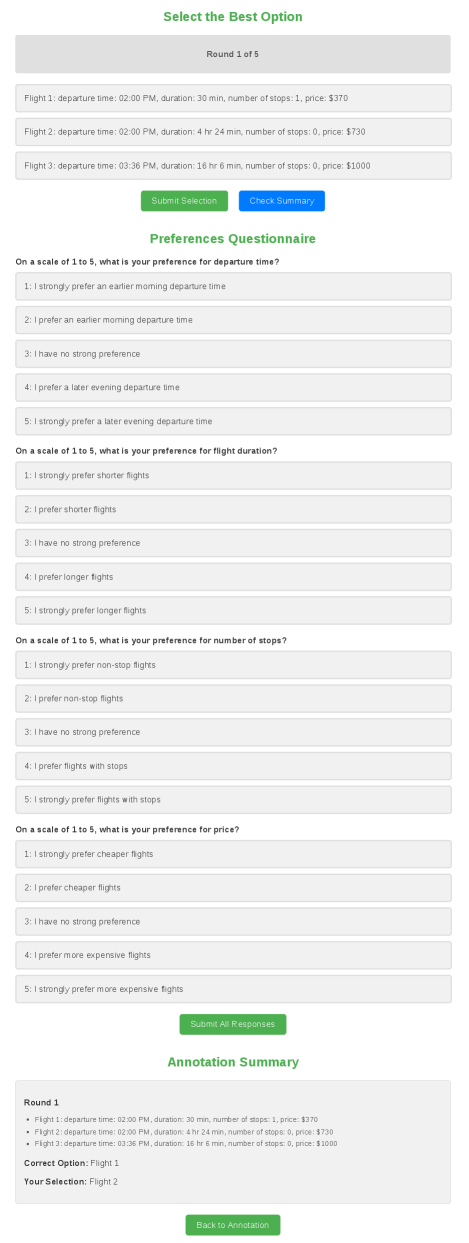
This image is a screenshot of a web-based survey or decision-making interface titled "Select the Best Option." It presents a user with a flight selection task (Round 1 of 5), followed by a preferences questionnaire, and concludes with an annotation summary showing the correct answer versus the user's selection. The interface is text-heavy with a clean, form-like layout using green and blue buttons.
### Components/Axes
The interface is structured vertically into distinct sections:
1. **Header Section:**
* Title: "Select the Best Option" (centered, green text).
* Sub-header: "Round 1 of 5" (centered, within a light gray bar).
2. **Flight Selection Section:**
* Three rectangular boxes, each describing a flight option.
* **Flight 1:** `departure time: 02:00 PM, duration: 30 min, number of stops: 1, price: $370`
* **Flight 2:** `departure time: 02:00 PM, duration: 4 hr 24 min, number of stops: 0, price: $730`
* **Flight 3:** `departure time: 03:36 PM, duration: 16 hr 6 min, number of stops: 0, price: $1000`
* Two buttons below the options:
* "Submit Selection" (green button, left).
* "Check Summary" (blue button, right).
3. **Preferences Questionnaire Section:**
* Section Title: "Preferences Questionnaire" (centered, green text).
* Contains four questions, each with a 5-point Likert scale. The options are presented as horizontal bars.
* **Question 1:** "On a scale of 1 to 5, what is your preference for departure time?"
* 1: I strongly prefer an earlier morning departure time
* 2: I prefer an earlier morning departure time
* 3: I have no strong preference
* 4: I prefer a later evening departure time
* 5: I strongly prefer a later evening departure time
* **Question 2:** "On a scale of 1 to 5, what is your preference for flight duration?"
* 1: I strongly prefer shorter flights
* 2: I prefer shorter flights
* 3: I have no strong preference
* 4: I prefer longer flights
* 5: I strongly prefer longer flights
* **Question 3:** "On a scale of 1 to 5, what is your preference for number of stops?"
* 1: I strongly prefer non-stop flights
* 2: I prefer non-stop flights
* 3: I have no strong preference
* 4: I prefer flights with stops
* 5: I strongly prefer flights with stops
* **Question 4:** "On a scale of 1 to 5, what is your preference for price?"
* 1: I strongly prefer cheaper flights
* 2: I prefer cheaper flights
* 3: I have no strong preference
* 4: I prefer more expensive flights
* 5: I strongly prefer more expensive flights
* A single button at the bottom of this section: "Submit All Responses" (green).
4. **Annotation Summary Section:**
* Section Title: "Annotation Summary" (centered, green text).
* A light gray box containing:
* "Round 1"
* The same three flight descriptions as listed in the Flight Selection Section.
* "Correct Option: Flight 1"
* "Your Selection: Flight 2"
* A final button at the bottom: "Back to Annotation" (green).
### Detailed Analysis
* **Flight Data Comparison:**
* **Departure Time:** Flights 1 and 2 depart at the same time (02:00 PM). Flight 3 departs later (03:36 PM).
* **Duration:** There is extreme variance. Flight 1 is very short (30 min), Flight 2 is medium (4 hr 24 min), and Flight 3 is very long (16 hr 6 min).
* **Stops:** Flight 1 has 1 stop. Flights 2 and 3 are non-stop (0 stops).
* **Price:** Directly correlates with duration and inversely with convenience (stops). Flight 1 is cheapest ($370), Flight 2 is mid-range ($730), and Flight 3 is most expensive ($1000).
* **Questionnaire Structure:** Each question uses a symmetric 5-point scale, with option 3 as the neutral midpoint. The wording for options 1/2 and 4/5 are mirrors of each other (e.g., "strongly prefer shorter" vs. "strongly prefer longer").
* **User Outcome:** The summary reveals a discrepancy. The system's "Correct Option" is Flight 1 (the shortest, cheapest, but with a stop). The user's "Selection" was Flight 2 (the non-stop, mid-priced, medium-duration flight).
### Key Observations
1. **Trade-off Design:** The flight options present a clear multi-attribute trade-off: time (duration) vs. cost vs. convenience (stops). There is no single "best" option across all attributes.
2. **Questionnaire Purpose:** The questionnaire is designed to elicit the user's personal weighting of these attributes (departure time, duration, stops, price) before or after they make a selection.
3. **Feedback Mechanism:** The "Annotation Summary" provides immediate feedback by showing the "correct" answer, suggesting this is part of a training, calibration, or research study where user preferences are being measured against a predefined optimal choice.
4. **Interface Flow:** The flow is linear: View Options -> (Optionally) Submit Selection -> Complete Preference Questionnaire -> Submit Preferences -> View Summary/Feedback.
### Interpretation
This interface is likely a component of a **decision-making study, user preference elicitation system, or a training module for travel booking algorithms**. Its purpose is to investigate or calibrate how individuals weigh conflicting attributes when making a choice.
The "Correct Option: Flight 1" is particularly revealing. From a purely mathematical or algorithmic perspective, Flight 1 might be deemed "correct" because it minimizes total travel time (30 min) and cost ($370), despite the inconvenience of one stop. The user's choice of Flight 2 (non-stop, but longer and more expensive) suggests a personal preference for convenience (non-stop) over raw speed and cost, or perhaps a distrust of short flights with connections.
The subsequent questionnaire aims to quantify this exact preference structure. By comparing the user's selections on the 1-5 scales with their initial flight choice, researchers can model the user's utility function. For instance, if the user selected "5: I strongly prefer non-stop flights" and chose Flight 2, their behavior is consistent. If they selected "1: I strongly prefer cheaper flights" but chose Flight 2 over Flight 1, it indicates a potential inconsistency or a more complex decision rule.
In essence, this screen captures a moment in a process designed to **decode human decision-making in the face of trade-offs**, with applications in personalized recommendation systems, behavioral economics research, or UX design for complex choice interfaces.
DECODING INTELLIGENCE...