\n
## Word Cloud: Spiritual Concepts
### Overview
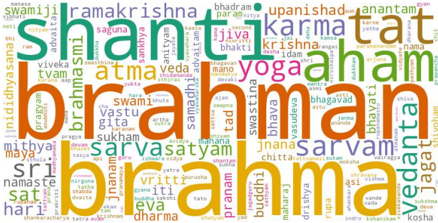
The image is a word cloud composed of terms related to Hindu philosophy and spirituality. The size of each word corresponds to its frequency within the source text used to generate the cloud. There are no axes or scales, and the arrangement appears random, though larger words are more centrally located.
### Components/Axes
There are no axes or scales present. The components are solely the words themselves, varying in size and color. The colors used are primarily shades of orange, yellow, and green.
### Detailed Analysis or Content Details
The following words are visible, with approximate size estimations based on visual prominence (larger = more frequent):
* **brahman** (very large, central, orange) - Appears multiple times, dominating the cloud.
* **shanti** (large, top-left, green)
* **atman** (large, center-left, yellow)
* **yoga** (medium-large, center, green)
* **karma** (medium, top-right, yellow)
* **vedanta** (medium, bottom-right, orange)
* **jnana** (medium, bottom-center, yellow)
* **aham** (medium, top-right, yellow)
* **sat** (medium, bottom-left, orange)
* **vasudeva** (small-medium, center-right, yellow)
* **bhagavan** (small-medium, center-right, yellow)
* **pranam** (small-medium, bottom-center, yellow)
* **dharma** (small-medium, bottom-center, orange)
* **sri** (small, bottom-left, orange)
* **mithya** (small, bottom-left, orange)
* **samadhi** (small, center-left, yellow)
* **sukham** (small, center-left, yellow)
* **vairagya** (small, center-left, yellow)
* **viveka** (small, top-left, orange)
* **tvam** (small, top-left, orange)
* **ramakrishna** (small, top-left, green)
* **upanishad** (small, top-right, green)
* **tat** (small, top-right, yellow)
* **jiva** (small, center, yellow)
* **bhakti** (small, center, yellow)
* **mano** (small, center, yellow)
* **swami** (small, center, yellow)
* **gita** (small, center, yellow)
* **vritti** (small, bottom-center, yellow)
* **iti** (small, bottom-center, yellow)
* **eva** (small, bottom-center, yellow)
* **advaita** (small, top-left, green)
* **sankhya** (small, top-left, green)
* **sarvasatyam** (small, center, yellow)
* **chitta** (small, bottom-center, yellow)
* **buddhi** (small, bottom-center, yellow)
* **maharaj** (small, bottom-right, yellow)
* **drishya** (small, bottom-right, yellow)
* **asi** (small, bottom-right, yellow)
* **vande** (small, bottom-right, orange)
* **kosha** (small, bottom-right, orange)
* **jagat** (small, bottom-right, orange)
* **swastina** (small, center-right, yellow)
* **bhadram** (small, top-right, green)
* **param** (small, top-right, green)
* **tantam** (small, top-right, yellow)
* **bhavat** (small, top-right, yellow)
There are also several smaller, less prominent words that are difficult to decipher with certainty.
### Key Observations
The most prominent words are "brahman," "shanti," "atman," "yoga," and "karma," suggesting these concepts are central to the source material. The color distribution doesn't appear to have a clear thematic organization. The repetition of "brahman" is striking.
### Interpretation
This word cloud visually represents the core vocabulary of Hindu philosophical discourse. The dominance of "brahman" indicates its fundamental importance as the ultimate reality. The presence of terms like "atman" (the self), "karma" (action and consequence), and "yoga" (union) highlights the paths and concepts used to understand and realize this ultimate reality. "Shanti" (peace) suggests a desired state of being achieved through these practices. The cloud's overall impression is one of interconnectedness and the pursuit of spiritual understanding. The use of a word cloud format itself suggests a holistic, non-linear approach to these concepts, emphasizing their interwoven nature rather than a strict hierarchical structure. The image does not provide any quantitative data, but rather a qualitative representation of thematic emphasis.