\n
## Diagram: Neural Network Architectures
### Overview
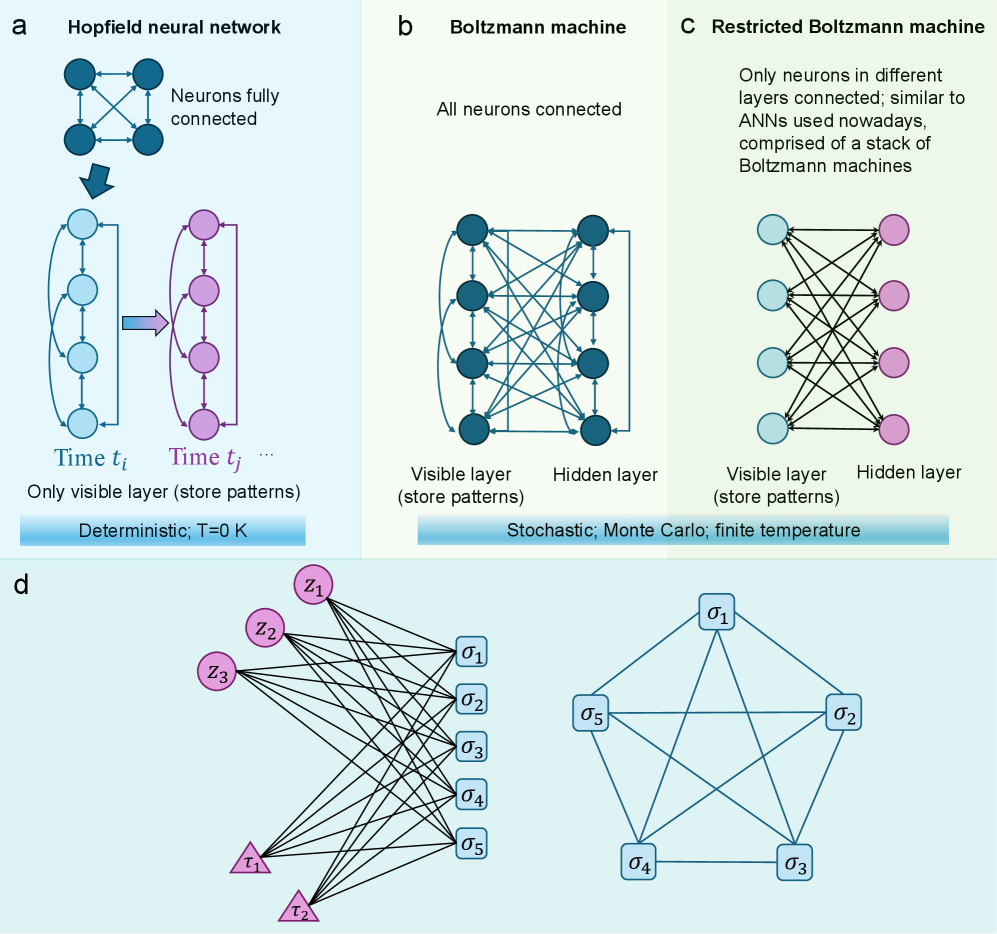
The image presents a comparative diagram illustrating four different neural network architectures: Hopfield neural network, Boltzmann machine, Restricted Boltzmann machine, and a detailed depiction of a specific network structure labeled 'd'. The diagram focuses on the connectivity and layer structure of each network type.
### Components/Axes
The diagram is divided into four sections labeled 'a', 'b', 'c', and 'd'. Each section represents a different neural network architecture.
- **a (Hopfield Neural Network):** Depicts a network evolving over time (t<sub>i</sub> to t<sub>j</sub>). It highlights a "visible layer" that stores patterns. The text indicates it is "Deterministic; T=0 K".
- **b (Boltzmann Machine):** Shows a network with "Visible layer" and "Hidden layer". The text indicates it is "Stochastic; Monte Carlo; finite temperature".
- **c (Restricted Boltzmann Machine):** Similar to the Boltzmann machine, with "Visible layer" and "Hidden layer", but with restricted connectivity. The text states it is "similar to ANNs used nowadays, comprised of a stack of Boltzmann machines".
- **d:** A more complex network with nodes labeled z<sub>1</sub>, z<sub>2</sub>, z<sub>3</sub>, τ<sub>1</sub>, τ<sub>2</sub> and σ<sub>1</sub>, σ<sub>2</sub>, σ<sub>3</sub>, σ<sub>4</sub>, σ<sub>5</sub>. Connections between nodes are indicated by lines with arrowheads.
### Detailed Analysis or Content Details
**a (Hopfield Neural Network):**
The network consists of interconnected nodes. At time t<sub>i</sub>, the network is in one state, and at time t<sub>j</sub>, it has evolved to a different state. The arrows indicate the direction of influence between neurons. The network is described as deterministic with a temperature of 0 Kelvin.
**b (Boltzmann Machine):**
The network has two layers: a visible layer and a hidden layer. All neurons are connected to each other. The network is described as stochastic, utilizing Monte Carlo methods, and operating at a finite temperature.
**c (Restricted Boltzmann Machine):**
Similar to the Boltzmann machine, it has a visible and hidden layer. However, the connections are restricted to only between different layers. It is described as being similar to modern Artificial Neural Networks (ANNs) and built from stacked Boltzmann machines.
**d:**
This network has two sets of input nodes (τ<sub>1</sub>, τ<sub>2</sub>) connected to a set of hidden nodes (z<sub>1</sub>, z<sub>2</sub>, z<sub>3</sub>). The hidden nodes are then connected to a set of output nodes (σ<sub>1</sub>, σ<sub>2</sub>, σ<sub>3</sub>, σ<sub>4</sub>, σ<sub>5</sub>). The connections are directional, indicated by the arrowheads. The network appears to be fully connected between the input and hidden layers, and between the hidden and output layers.
### Key Observations
- The diagram highlights the evolution of neural network architectures from the fully connected Hopfield network to the more restricted and layered Boltzmann and Restricted Boltzmann machines.
- The Boltzmann and Restricted Boltzmann machines introduce the concept of hidden layers, which are absent in the Hopfield network.
- The Restricted Boltzmann machine introduces a restriction on connectivity, which is a key difference from the Boltzmann machine.
- Diagram 'd' presents a specific network configuration with labeled nodes and directional connections, suggesting a particular implementation or model.
### Interpretation
The diagram illustrates the progression of neural network design, moving from simpler, fully connected networks (Hopfield) to more complex, layered architectures (Boltzmann, Restricted Boltzmann). The introduction of hidden layers and restricted connectivity in the Boltzmann and Restricted Boltzmann machines allows for more sophisticated pattern recognition and representation learning. The diagram suggests that the Restricted Boltzmann machine is a precursor to modern ANNs. The specific network in 'd' likely represents a particular application or model within the broader framework of neural networks, showcasing a detailed connection scheme between input, hidden, and output layers. The inclusion of temperature parameters (T=0 K for Hopfield) and stochastic methods (Monte Carlo for Boltzmann) indicates the consideration of thermodynamic principles in the design and operation of these networks.