## Line Chart: Surprisal vs. Training Steps
### Overview
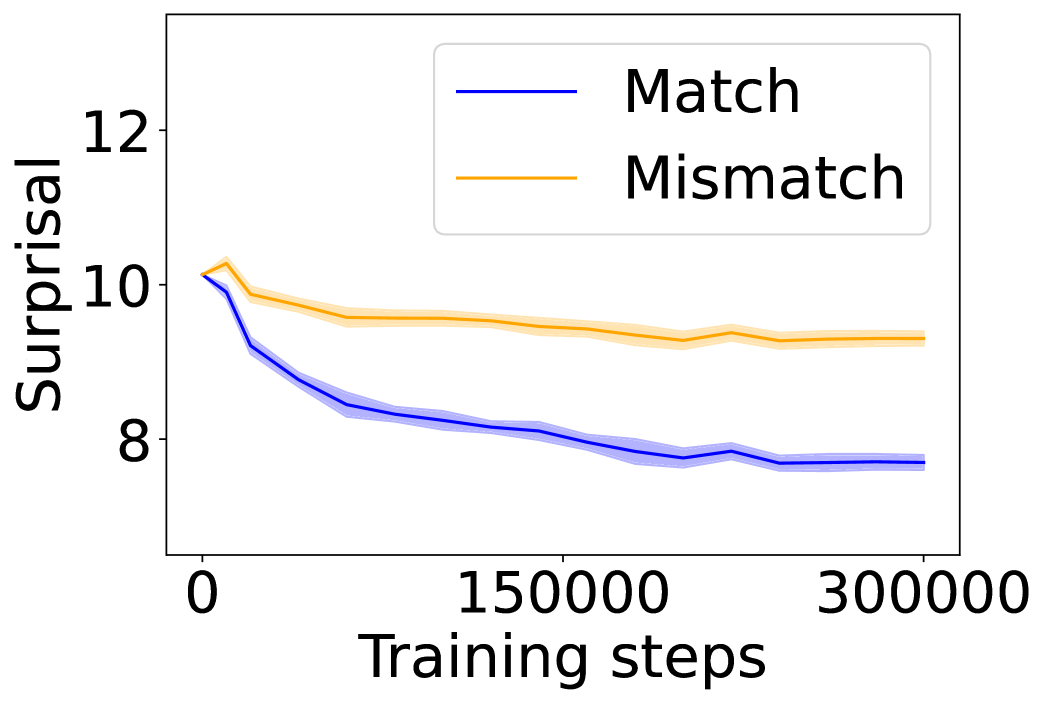
The image is a line chart comparing the "Surprisal" of two conditions, "Match" and "Mismatch," over a range of "Training steps." The chart displays how surprisal changes as the training progresses, with shaded regions indicating uncertainty or variability around the mean values.
### Components/Axes
* **X-axis:** "Training steps" ranging from 0 to 300000, with a marker at 150000.
* **Y-axis:** "Surprisal" ranging from 8 to 12.
* **Legend:** Located at the top-right of the chart.
* "Match": Represented by a blue line with a light blue shaded region.
* "Mismatch": Represented by an orange line with a light orange shaded region.
### Detailed Analysis
* **Match (Blue Line):**
* Trend: The "Match" line starts at approximately 10 surprisal and decreases rapidly initially, then gradually levels off.
* Data Points:
* At 0 training steps, surprisal is approximately 10.1.
* At 50000 training steps, surprisal is approximately 8.5.
* At 150000 training steps, surprisal is approximately 8.1.
* At 300000 training steps, surprisal is approximately 7.8.
* **Mismatch (Orange Line):**
* Trend: The "Mismatch" line starts at approximately 10.2 surprisal, decreases slightly, and then remains relatively stable.
* Data Points:
* At 0 training steps, surprisal is approximately 10.2.
* At 50000 training steps, surprisal is approximately 9.8.
* At 150000 training steps, surprisal is approximately 9.5.
* At 300000 training steps, surprisal is approximately 9.3.
### Key Observations
* The "Match" condition shows a more significant decrease in surprisal compared to the "Mismatch" condition.
* The shaded regions around the lines indicate the variability or standard deviation of the data.
* Both lines converge to a more stable surprisal level as the number of training steps increases.
### Interpretation
The chart suggests that as the model trains, the "Match" condition becomes less surprising, indicating that the model is learning to better predict or understand matching patterns. The "Mismatch" condition also shows a slight decrease in surprisal, but not as pronounced as the "Match" condition, suggesting that the model still finds mismatched patterns somewhat surprising even after training. The difference in surprisal between the two conditions decreases over time, implying that the model is becoming more adept at distinguishing between them.