## Hybrid AI Approaches: Neuro-Symbolic Integration
### Overview
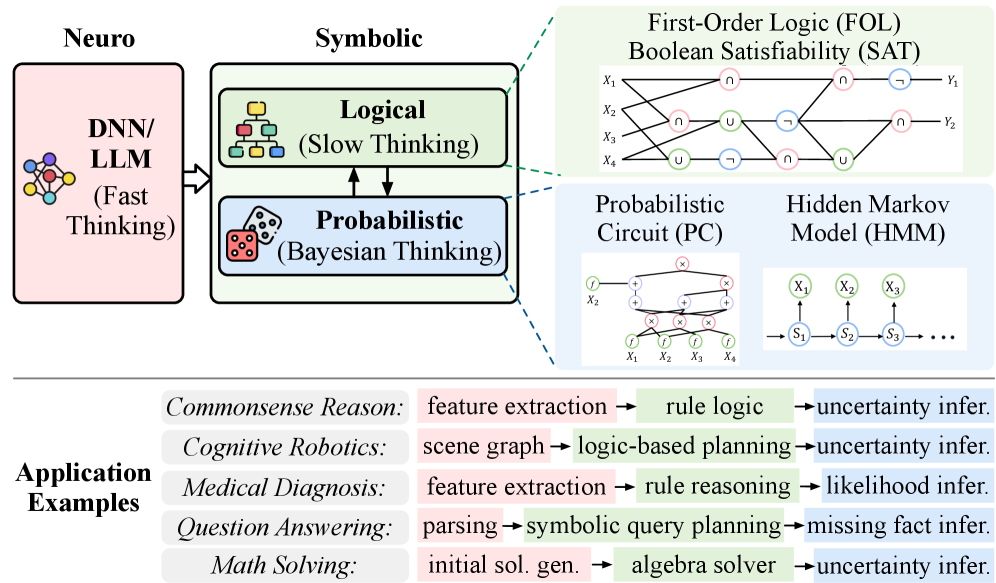
The image illustrates a hybrid AI approach that combines neural (Neuro) and symbolic (Symbolic) methods. It shows how deep neural networks (DNNs) and large language models (LLMs) can be integrated with logical and probabilistic reasoning for various applications. The diagram highlights the strengths of each approach and provides examples of their combined use in different domains.
### Components/Axes
* **Top-Left:** "Neuro" - Represents the neural approach to AI.
* "DNN/LLM (Fast Thinking)" - Indicates the use of Deep Neural Networks and Large Language Models for fast processing.
* **Top-Center:** "Symbolic" - Represents the symbolic approach to AI.
* "Logical (Slow Thinking)" - Indicates logical reasoning processes.
* "Probabilistic (Bayesian Thinking)" - Indicates probabilistic reasoning processes.
* **Top-Right:** Examples of symbolic representations.
* "First-Order Logic (FOL) Boolean Satisfiability (SAT)" - Shows a logical representation with variables x1, x2, x3, x4 and outputs y1, y2.
* "Probabilistic Circuit (PC)" - Illustrates a probabilistic circuit with variables x1, x2, x3, x4.
* "Hidden Markov Model (HMM)" - Depicts a Hidden Markov Model with states S1, S2, S3 and observations X1, X2, X3.
* **Bottom:** "Application Examples" - Lists various applications of the hybrid approach.
* "Commonsense Reason:" - Application example.
* "Cognitive Robotics:" - Application example.
* "Medical Diagnosis:" - Application example.
* "Question Answering:" - Application example.
* "Math Solving:" - Application example.
### Detailed Analysis or ### Content Details
**Neuro Component:**
* The "Neuro" component is represented by a pink box containing the text "DNN/LLM (Fast Thinking)". A network of interconnected nodes is shown to the left of the text.
**Symbolic Component:**
* The "Symbolic" component is divided into two sub-components: "Logical (Slow Thinking)" in a light green box and "Probabilistic (Bayesian Thinking)" in a light blue box.
* The "Logical" component contains a diagram of a tree-like structure.
* The "Probabilistic" component contains an image of dice.
**Symbolic Examples:**
* **First-Order Logic (FOL) Boolean Satisfiability (SAT):**
* Variables: x1, x2, x3, x4
* Outputs: y1, y2
* Logical gates: AND (∩), OR (∪), NOT (¬)
* The diagram shows a network of logical gates connecting the input variables to the output variables.
* **Probabilistic Circuit (PC):**
* Variables: x1, x2, x3, x4
* The diagram shows a circuit with addition (+) and multiplication (×) operations.
* **Hidden Markov Model (HMM):**
* States: S1, S2, S3, ...
* Observations: X1, X2, X3, ...
* The diagram shows a sequence of states connected by arrows, with each state emitting an observation.
**Application Examples:**
The application examples are structured as follows:
* **Commonsense Reason:** feature extraction -> rule logic -> uncertainty infer.
* **Cognitive Robotics:** scene graph -> logic-based planning -> uncertainty infer.
* **Medical Diagnosis:** feature extraction -> rule reasoning -> likelihood infer.
* **Question Answering:** parsing -> symbolic query planning -> missing fact infer.
* **Math Solving:** initial sol. gen. -> algebra solver -> uncertainty infer.
The application examples follow a pattern of:
1. Initial stage (pink box)
2. Intermediate stage (green box)
3. Final stage (blue box)
### Key Observations
* The diagram illustrates a clear distinction between neural and symbolic AI approaches.
* The application examples demonstrate how these approaches can be combined to solve complex problems.
* The symbolic examples provide concrete illustrations of logical and probabilistic reasoning.
### Interpretation
The image presents a high-level overview of hybrid AI systems, emphasizing the integration of neural and symbolic methods. The "Neuro" component, representing DNNs and LLMs, is characterized by "Fast Thinking," suggesting its efficiency in tasks like pattern recognition and data processing. In contrast, the "Symbolic" component, encompassing "Logical (Slow Thinking)" and "Probabilistic (Bayesian Thinking)," highlights the strengths of symbolic AI in reasoning, planning, and handling uncertainty.
The application examples demonstrate how these two approaches can be combined to leverage their respective strengths. For instance, in "Commonsense Reason," feature extraction (neural) is followed by rule logic (symbolic) and uncertainty inference (symbolic), showcasing a pipeline where neural networks extract relevant features, and symbolic methods perform reasoning based on those features.
The symbolic examples (FOL, PC, HMM) provide concrete illustrations of the types of representations and reasoning techniques used in symbolic AI. These examples highlight the ability of symbolic AI to represent knowledge explicitly and perform logical or probabilistic inference.
Overall, the image suggests that hybrid AI systems can offer a more robust and versatile approach to AI by combining the strengths of neural and symbolic methods. This integration allows for the development of systems that can not only learn from data but also reason, plan, and handle uncertainty in a more human-like manner.