## Diagram: Conceptual Architecture of Neuro-Symbolic AI
### Overview
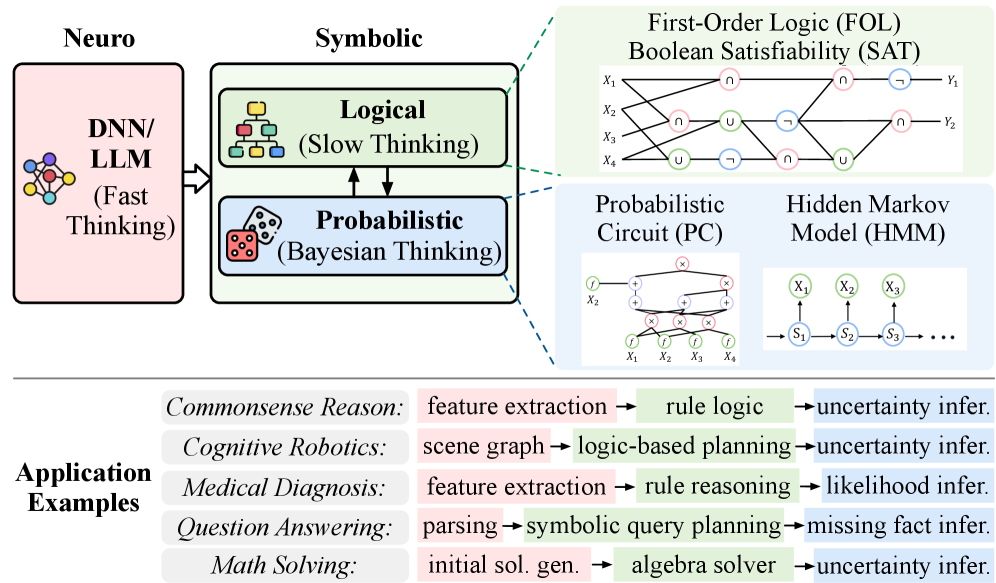
The image presents a conceptual framework for "Neuro-Symbolic" artificial intelligence. It contrasts "Neuro" systems (Neural Networks/Large Language Models) with "Symbolic" systems (Logical and Probabilistic reasoning). The diagram illustrates how these two paradigms interact and provides specific application examples showing a three-stage workflow (Neuro $\rightarrow$ Logical $\rightarrow$ Probabilistic).
### Components/Axes
#### 1. Architecture Diagram (Top Section)
* **Neuro (Left):** A pink-shaded box labeled "Neuro". Inside is the text "DNN/LLM (Fast Thinking)" accompanied by a neural network node-and-link icon.
* **Symbolic (Center):** A white box with a black border containing two stacked sub-components:
* **Logical (Slow Thinking):** A green-shaded box with a tree-structure icon.
* **Probabilistic (Bayesian Thinking):** A blue-shaded box with a dice icon.
* **Interaction:** Two vertical arrows between the Logical and Probabilistic boxes indicate bidirectional communication.
* **Symbolic Expansion (Right):** A large light-green area expanding from the "Symbolic" block, detailing the mathematical/logical foundations:
* **First-Order Logic (FOL) Boolean Satisfiability (SAT):** A logic gate diagram with inputs $X_1, X_2, X_3, X_4$ and outputs $Y_1, Y_2$, utilizing intersection ($\cap$), union ($\cup$), and negation ($\neg$) operators.
* **Probabilistic Circuit (PC):** A tree diagram with nodes labeled $f$, $+$, and $\times$, processing inputs $X_1, X_2, X_3, X_4$.
* **Hidden Markov Model (HMM):** A sequence diagram showing states $S_1 \to S_2 \to S_3 \dots$ with corresponding inputs $X_1, X_2, X_3$.
#### 2. Application Examples (Bottom Section)
A table-like structure listing five domains. Each row follows a three-stage pipeline:
* **Stage 1 (Pink background):** Neural/Feature extraction phase.
* **Stage 2 (Green background):** Logical/Reasoning phase.
* **Stage 3 (Blue background):** Probabilistic/Inference phase.
| Category | Stage 1 (Neuro) | Stage 2 (Logical) | Stage 3 (Probabilistic) |
| :--- | :--- | :--- | :--- |
| **Commonsense Reason** | feature extraction | rule logic | uncertainty infer. |
| **Cognitive Robotics** | scene graph | logic-based planning | uncertainty infer. |
| **Medical Diagnosis** | feature extraction | rule reasoning | likelihood infer. |
| **Question Answering** | parsing | symbolic query planning | missing fact infer. |
| **Math Solving** | initial sol. gen. | algebra solver | uncertainty infer. |
*(Note: "infer." is an abbreviation for "inference".)*
### Detailed Analysis
* **Neuro vs. Symbolic:** The diagram explicitly maps "Neuro" to "Fast Thinking" (intuitive, pattern-based) and "Symbolic" to "Slow Thinking" (deliberative, rule-based).
* **Symbolic Sub-types:** The "Symbolic" block is bifurcated into "Logical" (deterministic, rule-based) and "Probabilistic" (stochastic, Bayesian). The expansion on the right confirms that "Symbolic" AI in this context encompasses both discrete logic (FOL/SAT) and probabilistic models (PC/HMM).
* **Workflow Consistency:** Across all five application examples, the pipeline is consistent:
1. **Input/Extraction:** The "Neuro" component handles the raw data (parsing, feature extraction, scene graph generation).
2. **Processing:** The "Logical" component performs the heavy lifting (rule logic, planning, algebra solving).
3. **Output/Refinement:** The "Probabilistic" component handles the final output, specifically dealing with "uncertainty," "likelihood," or "missing facts."
### Key Observations
* **Color Coding:** The diagram uses a consistent color scheme: Pink for Neuro/Input, Green for Logical/Processing, and Blue for Probabilistic/Inference. This color coding is applied consistently across the architecture diagram and the application examples.
* **The "Neuro" Bottleneck:** The arrow pointing from the "Neuro" block to the "Symbolic" block suggests that the Neuro component acts as the front-end or "perception" layer for the Symbolic component.
* **Uncertainty Handling:** In 3 out of 5 application examples (Commonsense, Robotics, Math), the final stage is "uncertainty infer." This highlights that the primary role of the Probabilistic component is to manage the ambiguity inherent in the outputs of the Logical component.
### Interpretation
This diagram illustrates the **Neuro-Symbolic AI paradigm**, which seeks to combine the strengths of Deep Learning (DNN/LLM) with the strengths of Classical AI (Logic/Probability).
* **The "Why":** Deep Learning models (Neuro) are excellent at pattern recognition but struggle with reasoning, consistency, and explaining their decisions. Symbolic systems are excellent at reasoning but struggle with raw, unstructured data.
* **The Synthesis:** The diagram demonstrates a "System 1" (Fast) and "System 2" (Slow) architecture. The Neuro component acts as the "System 1" (intuitive, fast, feature extraction), while the Symbolic component acts as the "System 2" (deliberative, logical, planning).
* **Peircean Investigative View:** The flow suggests that the "Symbolic" block is the "interpreter" of the "Neuro" block. The Neuro block provides the *signs* (features/data), and the Symbolic block provides the *interpretants* (logic/rules/probability). The inclusion of "Probabilistic" alongside "Logical" acknowledges that real-world reasoning is rarely purely binary; it requires a bridge between rigid logic and the messy, uncertain nature of the real world. The diagram essentially argues that for AI to reach human-level reasoning, it must move beyond pure pattern matching and incorporate structured, probabilistic, and logical frameworks.