## Stacked Bar Chart: Number of Solved Levels vs. Algorithm
### Overview
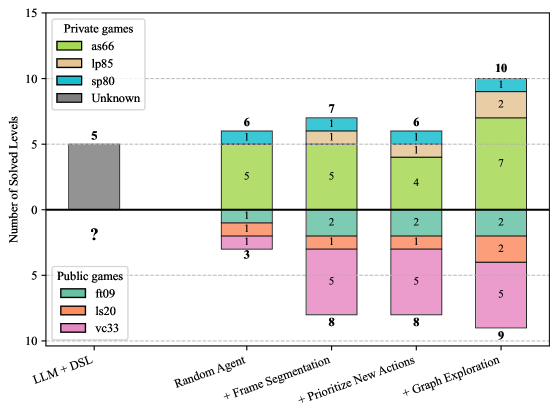
This is a stacked bar chart comparing the number of solved levels for different algorithms, categorized by game type (Private vs. Public). The x-axis represents the algorithms, and the y-axis represents the number of solved levels. Each bar is segmented to show the contribution of different game instances within each algorithm.
### Components/Axes
* **X-axis:** Algorithms: LLM + DSL, Random Agent, Random Agent + Frame Segmentation, Prioritize New Actions, Graph Exploration.
* **Y-axis:** Number of Solved Levels (Scale from 0 to 15).
* **Legend (Top-Left):**
* Private games (Green)
* as66 (Light Green)
* lp85 (Tan)
* sp80 (Dark Gray)
* Unknown (Gray)
* Public games (Pink/Red)
* ft09 (Dark Red)
* ls20 (Pink)
* vc33 (Red)
* A horizontal line at y=0 separates the Private and Public game data.
* A question mark (?) is placed at the bottom of the "Unknown" section of the first bar.
### Detailed Analysis
The chart consists of five stacked bars, one for each algorithm.
**1. LLM + DSL:**
* Total solved levels: 5
* All levels are from "Unknown" private games (Gray).
**2. Random Agent:**
* Total solved levels: 6
* as66 (Light Green): 5 levels
* lp85 (Tan): 1 level
* ft09 (Dark Red): 3 levels
* ls20 (Pink): 2 levels
**3. Random Agent + Frame Segmentation:**
* Total solved levels: 7
* as66 (Light Green): 5 levels
* lp85 (Tan): 1 level
* ft09 (Dark Red): 1 level
* ls20 (Pink): 5 levels
* vc33 (Red): 8 levels
**4. Prioritize New Actions:**
* Total solved levels: 6
* as66 (Light Green): 4 levels
* lp85 (Tan): 2 levels
* ft09 (Dark Red): 2 levels
* ls20 (Pink): 5 levels
* vc33 (Red): 8 levels
**5. Graph Exploration:**
* Total solved levels: 10
* as66 (Light Green): 7 levels
* lp85 (Tan): 2 levels
* sp80 (Dark Gray): 1 level
* ft09 (Dark Red): 2 levels
* ls20 (Pink): 5 levels
* vc33 (Red): 9 levels
### Key Observations
* The "Graph Exploration" algorithm solves the most levels overall (10).
* The "LLM + DSL" algorithm only solves levels from "Unknown" private games.
* The contribution of private games (as66, lp85, sp80) is generally higher in the "Graph Exploration" and "Random Agent" algorithms.
* Public games (ft09, ls20, vc33) contribute significantly to the solved levels in the "Random Agent + Frame Segmentation", "Prioritize New Actions", and "Graph Exploration" algorithms.
* The "vc33" public game consistently contributes a large number of solved levels across the latter three algorithms.
### Interpretation
The chart demonstrates the effectiveness of different algorithms in solving game levels, distinguishing between private and public game types. The "Graph Exploration" algorithm appears to be the most successful overall. The fact that "LLM + DSL" only solves "Unknown" levels suggests it may be limited to a specific subset of games or requires further refinement. The increasing number of solved levels as algorithms become more complex (from "Random Agent" to "Graph Exploration") indicates that incorporating techniques like frame segmentation, prioritizing new actions, and graph exploration improves performance. The consistent high contribution of the "vc33" public game suggests it may be a relatively easier game to solve or that the algorithms are particularly well-suited to its characteristics. The question mark next to the "Unknown" levels suggests a lack of information about the specific game instances solved by the "LLM + DSL" algorithm. This could be a data collection issue or a deliberate obfuscation of game details.