TECHNICAL ASSET FINGERPRINT
76140701313562d6e4b99414
Click to view fullscreen
Press ESC or click to close
FOUND IN PAPERS
EXPERT: healer-alpha-free VERSION 1
RUNTIME: free/openrouter/healer-alpha
INTEL_VERIFIED
\n
## Puzzle Game Thumbnail Collection: Technical Document Extraction
### Overview
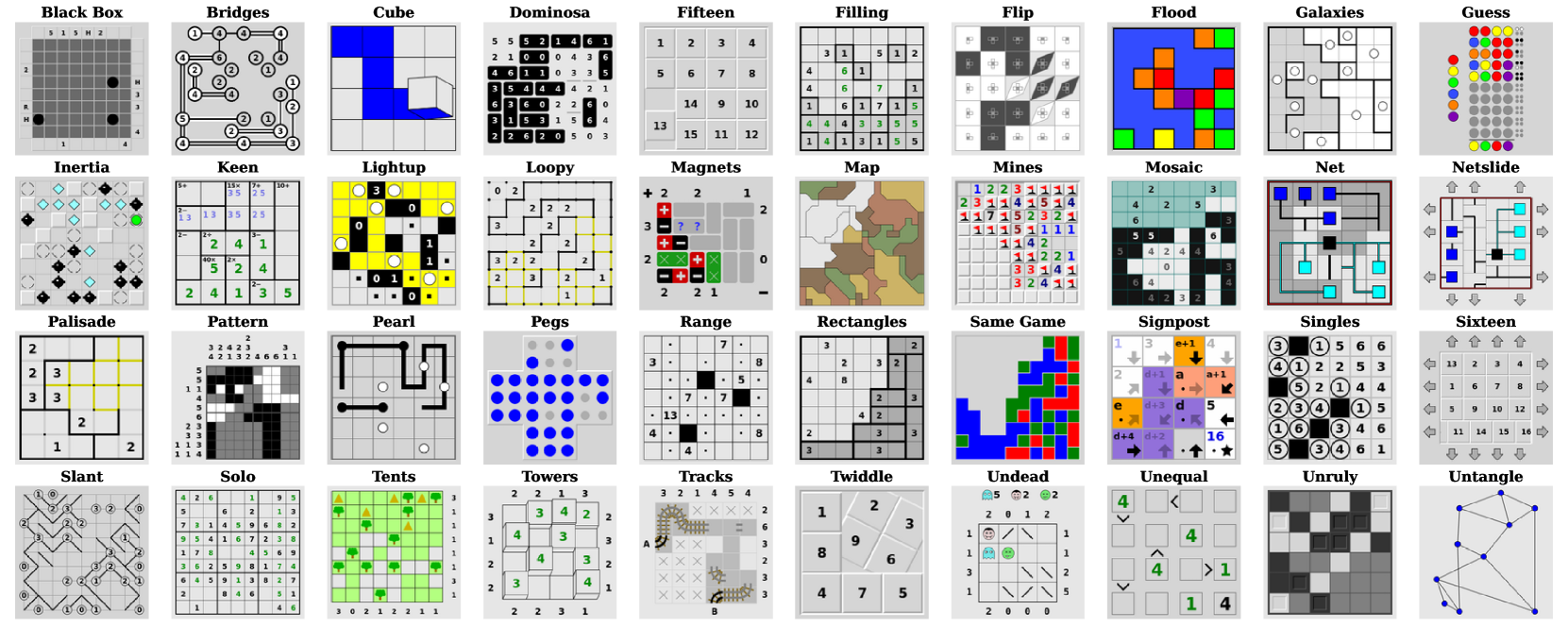
The image is a composite grid displaying 40 distinct logic and puzzle game interfaces, arranged in 4 rows and 10 columns. Each cell contains a thumbnail screenshot of a puzzle in progress, with the game's title displayed in a consistent, centered, sans-serif font above the thumbnail. The overall aesthetic is functional and clean, with a light gray background separating the cells. The purpose is to showcase a diverse collection of single-player, grid-based, or spatial reasoning puzzles.
### Components/Axes
* **Structure:** A 4x10 grid of rectangular cells.
* **Labels:** Each cell has a title label at the top, centered horizontally. The font is black, sans-serif, and of uniform size.
* **Thumbnails:** Each thumbnail is a square or near-square image depicting a game state. They vary in visual style, color palette, and UI elements.
* **Legend:** There is no unified legend for the entire image. Each puzzle thumbnail contains its own internal legend, symbols, and UI elements specific to that game's rules.
### Detailed Analysis
The following is a systematic extraction of all visible titles and a description of the key visual components within each thumbnail, processed row by row, from left to right.
**Row 1 (Top Row):**
1. **Black Box:** A dark gray grid with numbered edges (1-4 on bottom, 1-5 on left). Contains black dots and a single white dot.
2. **Bridges:** A light grid with numbered islands (circles containing numbers like 4, 3, 2, 1). Lines (bridges) connect some islands.
3. **Cube:** A blue and white isometric grid showing a 3D cube structure.
4. **Dominosa:** A grid of domino tiles with numbers. The top row shows: 5 5, 3 2, 1 4, 6 1. The second row: 2 1, 0 0, 0 4, 3 6. Some tiles are highlighted in black.
5. **Fifteen:** A 4x4 grid of numbered tiles (1-15) in a scrambled state. The empty space is in the bottom-right.
6. **Filling:** A grid with numbers in some cells (e.g., 3, 1, 5, 1, 2 in the top row). Some cells are shaded gray.
7. **Flip:** A grid of black and white tiles with arrow symbols (↻, ↺) indicating rotation.
8. **Flood:** A colorful grid of interconnected blocks in blue, red, yellow, green, and orange.
9. **Galaxies:** A gray grid with black dots (galaxies) and white lines dividing the grid into regions.
10. **Guess:** A Mastermind-style game. A column of colored pegs (red, yellow, green, blue, etc.) on the left, and a column of black and white key pegs on the right for feedback.
**Row 2:**
1. **Inertia:** A grid with gray walls, green start/end points, and black diamond-shaped obstacles.
2. **Keen:** A grid with arithmetic clues in the top-left of cells (e.g., "6+", "13x", "35÷"). The grid contains numbers (e.g., 2, 4, 1 in the second row).
3. **Lightup:** A yellow and black grid. Yellow cells contain numbers (0, 1, 2, 3). Black cells are walls. White circles (bulbs) are placed in some white cells.
4. **Loopy:** A grid of dots with numbered clues (e.g., 2, 2, 2). A continuous black line loops through the grid.
5. **Magnets:** A grid with red (+) and blue (-) magnets, and gray blocks. Numbers (e.g., 2, 2, 1) are on the edges.
6. **Map:** A map divided into colored regions (brown, green, tan, gray).
7. **Mines:** A Minesweeper grid. Revealed cells show numbers (e.g., 1, 2, 3, 1, 1, 1 in the top row). Some cells are flagged.
8. **Mosaic:** A grid of colored squares (teal, black, white) with numbers inside (e.g., 4, 2, 5, 3 in the top row).
9. **Net:** A grid with blue and black squares. A red line traces a path connecting the blue squares.
10. **Netslide:** A sliding tile puzzle with blue and cyan tiles on a gray grid. Arrows indicate slide directions.
**Row 3:**
1. **Palisade:** A grid with numbers on the edges (e.g., 2, 2, 3, 3 on the left). Yellow lines divide the grid.
2. **Pattern:** A grid with numbers along the top and left edges (e.g., top: 2 3 2 4 2 3, left: 3 2 1 3 2 6 3 1). Some cells are filled black.
3. **Pearl:** A gray grid with a black line forming a loop. White circles (pearls) are inside the loop.
4. **Pegs:** A cross-shaped grid of blue and gray pegs. Some pegs are missing.
5. **Range:** A grid with numbers in some cells (e.g., 7, 5, 8 in the top row). Black squares are present.
6. **Rectangles:** A grid with numbers in some cells (e.g., 3, 2, 2 in the top row). Lines form rectangles.
7. **Same Game:** A grid of colored blocks (blue, green, red). Some blocks are grouped.
8. **Signpost:** A grid with arrows and letters (e.g., a, b, d, e). Numbers (1, 2, 3, 4, 5, 16) are also present.
9. **Singles:** A grid with circled numbers (e.g., ③, ①, ⑤, ⑥, ⑥ in the top row). Some numbers are black, some are white.
10. **Sixteen:** A 4x4 sliding tile puzzle with numbers (e.g., 13, 2, 3, 4 in the top row). Arrows indicate slide directions.
**Row 4 (Bottom Row):**
1. **Slant:** A grid with diagonal lines (/ and \) in cells. Numbers (e.g., ①, ②, ③) are at some intersections.
2. **Solo:** A Sudoku grid. The top-left 3x3 box contains: 4, 2, 6, 1, 9, 5. Other numbers are filled throughout.
3. **Tents:** A grid with green trees. Numbers are on the edges (e.g., 3, 0, 2, 1, 2, 2, 1, 1 on the bottom). Tents (small squares) are placed next to some trees.
4. **Towers:** A grid with numbers on the edges (e.g., 2, 2, 1, 3 on the top). Some cells contain numbers (3, 4, 2 in the top row).
5. **Tracks:** A grid with train track pieces. Letters A and B mark endpoints. Numbers (3, 2, 1, 4, 5, 4) are on the top edge.
6. **Twiddle:** A 3x3 grid of numbered tiles (1-9) in a scrambled state.
7. **Undead:** A grid with ghost icons (👻), vampire icons (🧛), and zombie icons (🧟). Numbers (e.g., 5, 2, 2) are on the edges.
8. **Unequal:** A grid with inequality symbols (<, >) between cells. Some cells contain numbers (e.g., 4, 4, 1, 4).
9. **Unruly:** A black and white grid with no numbers or symbols, just a pattern of filled and empty cells.
10. **Untangle:** A set of blue dots connected by black lines, forming a tangled graph.
### Key Observations
* **Genre Diversity:** The collection spans multiple puzzle genres: number logic (Solo, Fifteen), spatial reasoning (Cube, Untangle), pathfinding (Loopy, Net), arithmetic (Keen), and deduction (Mines, Guess).
* **Visual Language:** Each game uses a distinct visual vocabulary: grids, numbers, colors, symbols (arrows, magnets, icons), and lines.
* **State Representation:** All thumbnails show mid-game states, not title screens, providing a direct view of the puzzle mechanics.
* **Consistent Labeling:** The titling format is perfectly consistent across all 40 items, aiding in clear identification.
### Interpretation
This image serves as a visual catalog or menu for a puzzle game suite. It demonstrates a wide spectrum of cognitive challenges, suggesting the collection is designed to appeal to different problem-solving preferences—from the numerical rigor of Sudoku and KenKen-style puzzles to the spatial planning of bridge-building and loop-drawing games.
The side-by-side presentation allows for immediate comparison of visual complexity and rule density. For instance, **Mines** and **Mosaic** present dense numerical information, while **Unruly** and **Flood** rely purely on color and pattern. **Untangle** and **Cube** introduce non-grid-based spatial reasoning.
The absence of any branding, score, or menu UI within the thumbnails focuses the viewer entirely on the puzzle logic itself. This is a technical showcase of game mechanics, likely intended for an audience familiar with logic puzzles or for documentation purposes within a game development or software context. The variety implies a robust engine capable of handling diverse rule sets and visual representations.
DECODING INTELLIGENCE...