## Diagram: Grid Transformation Puzzle
### Overview
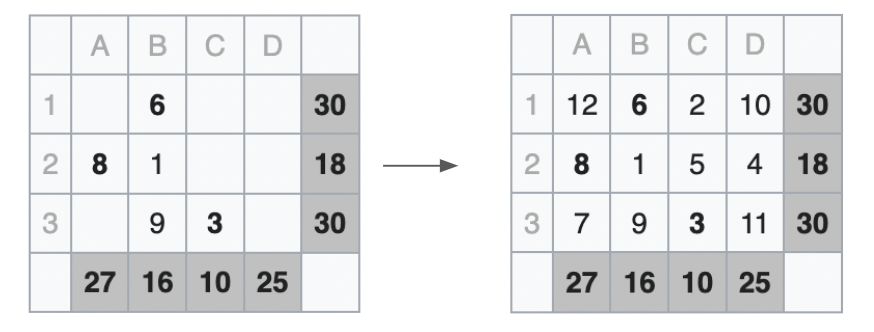
The image displays a side-by-side comparison of two 3x4 grids (tables) with an arrow pointing from the left grid to the right grid, indicating a transformation or solution process. The grids have rows labeled 1, 2, 3 and columns labeled A, B, C, D. The final column (after D) and the bottom row are shaded gray and contain numbers, which appear to be row and column totals, respectively. The left grid shows a partially filled set of cells, while the right grid shows the same grid with all cells filled in, satisfying the given totals.
### Components/Axes
- **Grid Structure**: Both grids are identical in layout.
- **Rows**: Labeled 1, 2, 3 on the left side.
- **Columns**: Labeled A, B, C, D at the top.
- **Shaded Cells**: The rightmost column (unlabeled, but after column D) and the bottom row (unlabeled, but below row 3) are shaded gray and contain numbers.
- **Arrow**: A black arrow points from the center of the left grid to the center of the right grid, indicating a directional relationship (e.g., problem to solution).
- **Labels**: All row and column labels (1,2,3 and A,B,C,D) are in a light gray font.
### Detailed Analysis
#### Left Grid (Initial State)
This grid contains some pre-filled numbers and blank cells. The shaded totals are provided.
| | A | B | C | D | **Total (Shaded)** |
|-----|-----|-----|-----|-----|-------------------|
| **1** | | **6** | | | **30** |
| **2** | **8** | **1** | | | **18** |
| **3** | | **9** | **3** | | **30** |
| **Total (Shaded)** | **27** | **16** | **10** | **25** | |
*Missing Cells*: A1, C1, D1, C2, D2, A3, D3. (7 cells total)
#### Right Grid (Final State)
This grid is completely filled. All shaded totals remain identical to the left grid, confirming they are constraints.
| | A | B | C | D | **Total (Shaded)** |
|-----|-----|-----|-----|-----|-------------------|
| **1** | **12** | **6** | **2** | **10** | **30** |
| **2** | **8** | **1** | **5** | **4** | **18** |
| **3** | **7** | **9** | **3** | **11** | **30** |
| **Total (Shaded)** | **27** | **16** | **10** | **25** | |
*Verification of Totals*:
- **Row Sums**:
- Row 1: 12 + 6 + 2 + 10 = 30 ✓
- Row 2: 8 + 1 + 5 + 4 = 18 ✓
- Row 3: 7 + 9 + 3 + 11 = 30 ✓
- **Column Sums**:
- Column A: 12 + 8 + 7 = 27 ✓
- Column B: 6 + 1 + 9 = 16 ✓
- Column C: 2 + 5 + 3 = 10 ✓
- Column D: 10 + 4 + 11 = 25 ✓
### Key Observations
1. **Constraint Consistency**: The shaded totals (row and column sums) are identical in both grids, acting as fixed constraints for the puzzle.
2. **Unique Solution**: The left grid's partial data, combined with the totals, leads to a single, consistent solution shown in the right grid. All missing values are positive integers.
3. **Spatial Layout**: The legend (shaded totals) is positioned at the right and bottom edges of each grid. The arrow is centrally placed between the two grids.
4. **Data Integrity**: Every number in the right grid precisely satisfies the row and column sum constraints from the left grid. No outliers or inconsistencies are present.
### Interpretation
This diagram illustrates a classic **grid-filling puzzle** or a **system of linear equations** with integer solutions. The left grid presents a problem: given some initial numbers and the required sums for each row and column, find the missing values. The right grid provides the solution.
The puzzle demonstrates how constraints (the totals) propagate through the grid to determine unknown values uniquely. For example:
- The value in cell A1 (12) is derived from the column A total (27) minus the known values in A2 (8) and A3 (7).
- Similarly, cell D1 (10) comes from the row 1 total (30) minus the known B1 (6) and the derived A1 (12) and C1 (2).
This type of puzzle is often used in logic games, educational settings to teach arithmetic and algebra, or as a constraint satisfaction problem in computer science. The transformation from left to right visually confirms that the solution is correct and complete, with all constraints satisfied. The absence of negative numbers or fractions suggests the puzzle is designed for simplicity and clarity.