## Diagram: 6x9 Number Grid Puzzle with Shaded Regions
### Overview
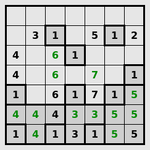
The image displays a rectangular grid composed of 6 rows and 9 columns, forming a puzzle layout. The grid is subdivided by thicker lines into six 3x3 boxes (arranged in 2 rows and 3 columns of boxes). Certain cells contain single-digit numbers (1-7), while others are blank. A distinct light green shading is applied to specific cells, primarily within the bottom-left and bottom-right 3x3 boxes. There are no titles, axis labels, or legends present; the content is purely a numerical grid.
### Components/Axes
* **Grid Structure**: 6 rows × 9 columns.
* **Subdivisions**: Thick lines delineate six 3x3 boxes.
* **Cell Content**: Contains integers (1, 2, 3, 4, 5, 6, 7) or is blank.
* **Shading**: A light green background color is applied to select cells, indicating a specific region or given clues.
### Detailed Analysis
The grid content is transcribed below. Row and column numbering starts from 1 at the top-left. `(G)` denotes a green-shaded cell.
| Row | Col 1 | Col 2 | Col 3 | Col 4 | Col 5 | Col 6 | Col 7 | Col 8 | Col 9 |
| :-- | :---- | :---- | :---- | :---- | :---- | :---- | :---- | :---- | :---- |
| **1** | 3 | 1 | | | 5 | 1 | 2 | | |
| **2** | 4 | 6 | 1 | | | | | | |
| **3** | 4 | 6 | | | 7 | | | 1 | |
| **4** | 1 (G) | 6 (G) | 1 (G) | 7 | | | 1 (G) | 5 (G) | |
| **5** | 4 (G) | 4 (G) | 4 (G) | 3 | 3 | | 5 (G) | 5 (G) | |
| **6** | 1 (G) | 4 (G) | 1 (G) | 3 | 1 | | 5 (G) | 5 (G) | |
**Shading Pattern:**
* **Bottom-Left 3x3 Box** (Rows 4-6, Cols 1-3): All 9 cells are shaded green and contain numbers.
* **Bottom-Right 3x3 Box** (Rows 4-6, Cols 7-9): Only the cells containing numbers (Cols 7 & 8) are shaded green. Column 9 cells are blank and unshaded.
* **All Other Boxes** (Top row of boxes and Bottom-Middle box): No cells are shaded green.
### Key Observations
1. **Number Distribution**: The numbers 1, 4, 5, and 6 appear most frequently. The number 7 appears only once (Row 3, Col 5). The number 2 appears only once (Row 1, Col 7).
2. **Concentration in Shaded Regions**: The green-shaded cells in the bottom-left box contain a dense cluster of numbers, with no blanks. The bottom-right shaded region also has a high density of numbers in its first two columns.
3. **Blank Cell Pattern**: Blank cells are concentrated in the top half of the grid and the rightmost column of the bottom-right box.
4. **Repetition within Boxes**: Within the green-shaded bottom-left box, the number 4 appears three times in a row in Row 5 (Cols 1-3). Similarly, the number 5 appears twice in Rows 5 and 6 within the shaded part of the bottom-right box.
### Interpretation
This image represents a logic-based number puzzle, likely a variant of Sudoku or a similar constraint-satisfaction game. The green shading almost certainly denotes the "given" or "starting" numbers provided to the solver. The unshaded cells are the ones to be filled.
The puzzle's structure suggests specific rules:
* The 6x9 format and 3x3 box divisions imply that each 3x3 box must contain unique numbers, similar to standard Sudoku. However, the standard Sudoku rule set uses a 9x9 grid with numbers 1-9. The presence of only numbers 1-7 here indicates a modified rule set, possibly requiring each number to appear a specific number of times per row, column, or box.
* The heavy concentration of givens in the bottom shaded regions versus the sparsity in the top unshaded region suggests the puzzle's difficulty or solving path may start from the bottom and work upwards. The cluster of 4s in Row 5, Col 1-3 is a strong initial constraint that would heavily influence the possibilities for the surrounding cells.
* The single instances of 2 and 7 are critical clues, as their placement will have broad implications for the rows, columns, and boxes they occupy.
In essence, the image provides the complete initial state of a puzzle. To solve it, one would need to deduce the placement of numbers in all blank cells according to the puzzle's specific (but unstated) rules, using the given green-shaded numbers as the foundation.