## Grouped Bar Chart: Package Usage Percentage by Category for Two Methods
### Overview
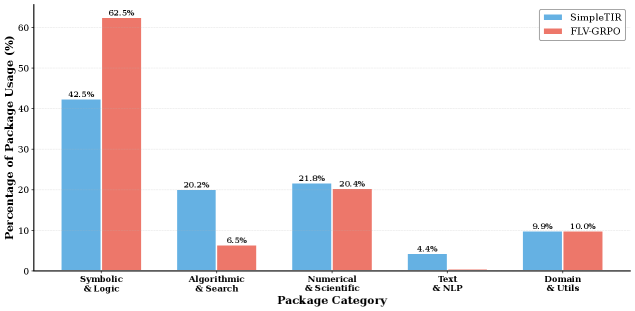
The image displays a grouped bar chart comparing the percentage of package usage across five distinct categories for two different methods or models: **SimpleTIR** (blue bars) and **FLV-GRPO** (red bars). The chart visually contrasts the distribution of package dependencies or usage patterns between these two approaches.
### Components/Axes
* **Chart Type:** Grouped (clustered) bar chart.
* **Y-Axis:** Labeled "Percentage of Package Usage (%)". The scale runs from 0 to 60, with major tick marks at intervals of 10 (0, 10, 20, 30, 40, 50, 60).
* **X-Axis:** Labeled "Package Category". It lists five categorical groups.
* **Legend:** Positioned in the top-right corner of the chart area. It defines the two data series:
* **SimpleTIR:** Represented by blue bars.
* **FLV-GRPO:** Represented by red (salmon-colored) bars.
* **Data Labels:** Each bar has its exact percentage value displayed directly above it.
### Detailed Analysis
The chart presents the following data points for each package category:
1. **Symbolic & Logic**
* **SimpleTIR (Blue):** 42.5%
* **FLV-GRPO (Red):** 62.5%
* *Trend:* This category shows the highest usage for both methods, with FLV-GRPO having a substantially higher percentage.
2. **Algorithmic & Search**
* **SimpleTIR (Blue):** 20.2%
* **FLV-GRPO (Red):** 6.5%
* *Trend:* SimpleTIR shows significantly higher usage in this category compared to FLV-GRPO.
3. **Numerical & Scientific**
* **SimpleTIR (Blue):** 21.0%
* **FLV-GRPO (Red):** 20.4%
* *Trend:* Usage is nearly identical between the two methods, with a negligible difference of 0.6 percentage points.
4. **Text & NLP**
* **SimpleTIR (Blue):** 4.4%
* **FLV-GRPO (Red):** 0.0% (No red bar is visible, indicating a value of 0 or near 0).
* *Trend:* SimpleTIR has a small but measurable usage here, while FLV-GRPO shows no discernible usage.
5. **Domain & Utils**
* **SimpleTIR (Blue):** 9.9%
* **FLV-GRPO (Red):** 10.0%
* *Trend:* Usage is virtually identical between the two methods.
### Key Observations
* **Dominant Category:** "Symbolic & Logic" is the dominant package category for both methods, accounting for the largest share of usage in each case.
* **Method Specialization:** FLV-GRPO appears highly specialized, with over 62% of its usage concentrated in "Symbolic & Logic" and very low usage in "Algorithmic & Search" and "Text & NLP".
* **Method Balance:** SimpleTIR shows a more balanced distribution. While "Symbolic & Logic" is still its largest category (42.5%), it maintains significant usage in "Algorithmic & Search" (20.2%) and "Numerical & Scientific" (21.0%).
* **Identical Usage:** The "Numerical & Scientific" and "Domain & Utils" categories show nearly identical usage percentages between the two methods.
* **Absence in Category:** FLV-GRPO has no recorded usage in the "Text & NLP" category.
### Interpretation
This data suggests a fundamental difference in the architectural or operational focus of the two methods. **FLV-GRPO** demonstrates a strong, specialized reliance on symbolic reasoning and logic packages, potentially indicating a design optimized for tasks within that domain. Its minimal usage of algorithmic, search, and text/NLP packages implies these are not core to its function.
In contrast, **SimpleTIR** exhibits a more general-purpose or hybrid profile. It leverages symbolic packages heavily but also incorporates a substantial suite of algorithmic, search, and numerical/scientific packages. This broader dependency profile suggests SimpleTIR may be designed to handle a wider variety of problem types or employ a different problem-solving strategy that integrates multiple computational paradigms.
The near-perfect overlap in "Numerical & Scientific" and "Domain & Utils" usage is notable. It indicates that for core numerical computation and general utility functions, both methods rely on the same underlying tools to an equal degree. The stark contrast in the other categories, therefore, highlights their divergent approaches to higher-level reasoning and problem decomposition.