## Scatter Plot: Accuracy vs. Time-to-Answer for Different k-Values
### Overview
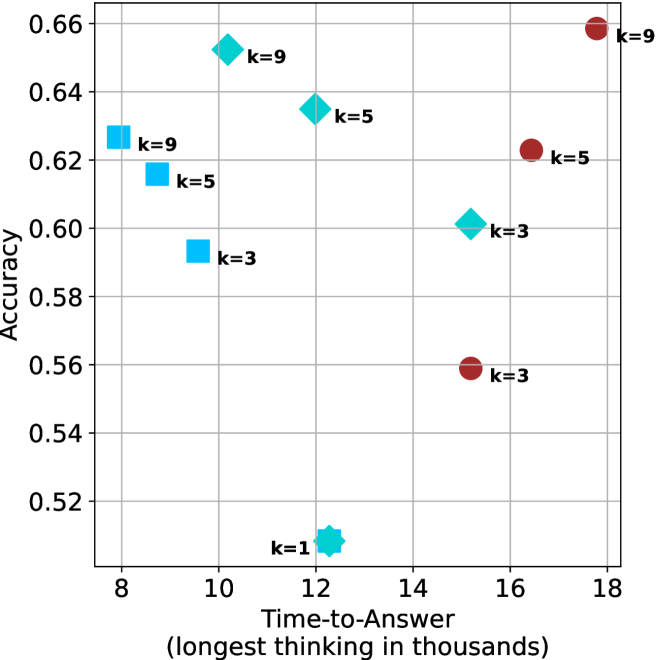
The image is a scatter plot comparing the performance of different models or configurations, parameterized by a variable `k`. It plots "Accuracy" on the vertical axis against "Time-to-Answer" on the horizontal axis. The data points are distinguished by three different marker shapes and colors, each associated with specific `k` values. The chart illustrates a trade-off between accuracy and computational time.
### Components/Axes
* **X-Axis:** Labeled "Time-to-Answer (longest thinking in thousands)". The scale runs from approximately 8 to 18, with major grid lines at intervals of 2 (8, 10, 12, 14, 16, 18). The unit is "thousands," implying the values represent thousands of some time unit (e.g., milliseconds, steps).
* **Y-Axis:** Labeled "Accuracy". The scale runs from approximately 0.52 to 0.66, with major grid lines at intervals of 0.02 (0.52, 0.54, 0.56, 0.58, 0.60, 0.62, 0.64, 0.66).
* **Data Series & Legend:** There is no separate legend box. The series are identified by marker shape, color, and direct labels (`k=1`, `k=3`, `k=5`, `k=9`) placed next to each point.
* **Series 1 (Cyan Squares):** Labeled with `k=3`, `k=5`, `k=9`.
* **Series 2 (Cyan Diamonds):** Labeled with `k=1`, `k=3`, `k=5`, `k=9`.
* **Series 3 (Red Circles):** Labeled with `k=3`, `k=5`, `k=9`.
### Detailed Analysis
**Data Point Extraction (Approximate Coordinates):**
* **Cyan Square Series:**
* `k=9`: Position ~ (8.0, 0.627). Top-left quadrant.
* `k=5`: Position ~ (8.5, 0.615). Left of center.
* `k=3`: Position ~ (9.5, 0.593). Left of center, lower than k=5.
* **Cyan Diamond Series:**
* `k=9`: Position ~ (10.2, 0.652). Top-center. Highest accuracy point for cyan markers.
* `k=5`: Position ~ (12.0, 0.635). Center.
* `k=3`: Position ~ (15.0, 0.600). Right of center.
* `k=1`: Position ~ (12.2, 0.505). Bottom-center. This is the lowest accuracy point on the entire chart.
* **Red Circle Series:**
* `k=9`: Position ~ (17.8, 0.658). Top-right corner. Highest accuracy point on the chart.
* `k=5`: Position ~ (16.5, 0.622). Right of center.
* `k=3`: Position ~ (15.0, 0.558). Right of center, significantly lower than its k=5 and k=9 points.
**Trend Verification:**
* **Cyan Squares:** As `k` increases from 3 to 9, both Time-to-Answer (increases from ~9.5 to ~8.0? *Note: This appears counterintuitive; the point labeled k=9 is leftmost, suggesting lower time. This may indicate a different model family or an anomaly.*) and Accuracy (increases from ~0.593 to ~0.627) change. The trend is not strictly monotonic in time.
* **Cyan Diamonds:** As `k` increases from 1 to 9, Accuracy shows a clear upward trend (from ~0.505 to ~0.652). Time-to-Answer also generally increases, with the `k=1` point being an outlier at a moderate time (~12.2) but very low accuracy.
* **Red Circles:** As `k` increases from 3 to 9, Accuracy increases sharply (from ~0.558 to ~0.658). Time-to-Answer also increases consistently (from ~15.0 to ~17.8).
### Key Observations
1. **Accuracy vs. k:** For both the Cyan Diamond and Red Circle series, higher `k` values are strongly associated with higher accuracy.
2. **Time Cost:** Higher `k` values generally require more Time-to-Answer, most clearly seen in the Red Circle series. The Cyan Square series is an exception, where the highest accuracy point (`k=9`) has the lowest time.
3. **Performance Tiers:** The Red Circle series at `k=9` achieves the highest overall accuracy (~0.658) but at the highest time cost (~17.8). The Cyan Diamond series at `k=9` is a close second in accuracy (~0.652) with significantly lower time (~10.2).
4. **Outlier:** The Cyan Diamond `k=1` point is a major outlier, showing drastically lower accuracy (~0.505) than all other points, despite having a moderate Time-to-Answer (~12.2).
5. **Clustering:** Points with the same `k` value but different markers (shapes/colors) are often far apart. For example, the three `k=9` points are in completely different regions of the plot, indicating that the marker type represents a fundamental difference in model or method, not just the `k` parameter.
### Interpretation
This chart visualizes the **efficiency-accuracy frontier** for different algorithmic approaches (represented by marker shape/color). The data suggests:
* **Method Comparison:** The method represented by **Cyan Diamonds** appears to be the most efficient for high accuracy. It reaches near-peak accuracy (`k=9`) at a Time-to-Answer of ~10.2, which is much faster than the Red Circle method's peak.
* **Scalability:** The **Red Circle** method scales poorly with `k` in terms of time; increasing `k` yields accuracy gains but at a steep, linear increase in computational cost.
* **The `k` Parameter:** Within each method, increasing `k` (which could represent model size, number of reasoning steps, or ensemble size) reliably improves accuracy, confirming its role as a key performance lever.
* **Anomaly Investigation:** The Cyan Square `k=9` point's position (high accuracy, low time) is suspicious and warrants investigation. It could represent a breakthrough configuration, a measurement error, or a different experimental condition. Similarly, the catastrophic failure of the Cyan Diamond method at `k=1` suggests a minimum complexity threshold for that approach to function effectively.
* **Practical Implication:** A user must choose a method and `k` value based on their priority. For real-time applications with strict time limits, the Cyan Square or lower-`k` Cyan Diamond methods are preferable. For offline tasks where maximum accuracy is critical, the Red Circle `k=9` or Cyan Diamond `k=9` are the best candidates, with the latter being more time-efficient.