## Scatter Plot: Accuracy vs. Time-to-Answer
### Overview
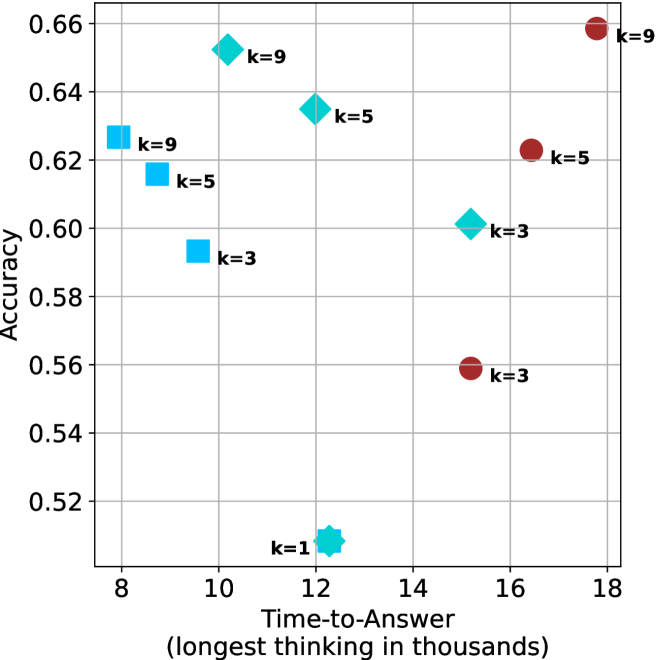
The image is a scatter plot showing the relationship between "Accuracy" and "Time-to-Answer" (longest thinking in thousands). The plot displays data points for different values of 'k' (k=1, k=3, k=5, k=9), represented by different shapes and colors. The cyan data points are squares, diamonds, and stars, while the red data points are circles.
### Components/Axes
* **X-axis:** "Time-to-Answer (longest thinking in thousands)". The scale ranges from approximately 8 to 18, with gridlines at integer values.
* **Y-axis:** "Accuracy". The scale ranges from 0.52 to 0.66, with gridlines at intervals of 0.02.
* **Data Points:**
* Cyan Squares: k=9, k=5, k=3
* Cyan Diamonds: k=9, k=5, k=3
* Cyan Star: k=1
* Red Circles: k=9, k=5, k=3
### Detailed Analysis
* **Cyan Data Points (Squares, Diamonds, Star):**
* k=9 (Square): Accuracy ~0.625, Time-to-Answer ~8.5
* k=5 (Square): Accuracy ~0.615, Time-to-Answer ~9.5
* k=3 (Square): Accuracy ~0.595, Time-to-Answer ~10
* k=1 (Star): Accuracy ~0.51, Time-to-Answer ~12
* k=9 (Diamond): Accuracy ~0.655, Time-to-Answer ~11
* k=5 (Diamond): Accuracy ~0.635, Time-to-Answer ~13
* k=3 (Diamond): Accuracy ~0.60, Time-to-Answer ~15
* **Red Data Points (Circles):**
* k=3 (Circle): Accuracy ~0.56, Time-to-Answer ~15.5
* k=5 (Circle): Accuracy ~0.625, Time-to-Answer ~16
* k=9 (Circle): Accuracy ~0.66, Time-to-Answer ~17.5
### Key Observations
* There are two distinct sets of data points, cyan and red, for k=3, k=5, and k=9.
* The cyan data points (squares, diamonds, star) generally show an increase in accuracy with increasing 'k' values, but also an increase in time-to-answer.
* The red data points (circles) show a similar trend of increasing accuracy with increasing 'k' values and increasing time-to-answer.
* The k=1 data point (cyan star) has the lowest accuracy and a moderate time-to-answer.
### Interpretation
The scatter plot illustrates the trade-off between accuracy and time-to-answer for different values of 'k'. The presence of two distinct sets of data points (cyan and red) for k=3, k=5, and k=9 suggests that there are two different methods or configurations being compared. The cyan data points (squares, diamonds, star) generally have lower time-to-answer values compared to the red data points (circles) for the same 'k' value, but also tend to have lower accuracy. The k=1 data point (cyan star) appears to be an outlier, with the lowest accuracy and a moderate time-to-answer. Overall, the plot suggests that increasing 'k' generally leads to higher accuracy but also requires more time-to-answer.