\n
## Line Chart: WebShop Success Rate
### Overview
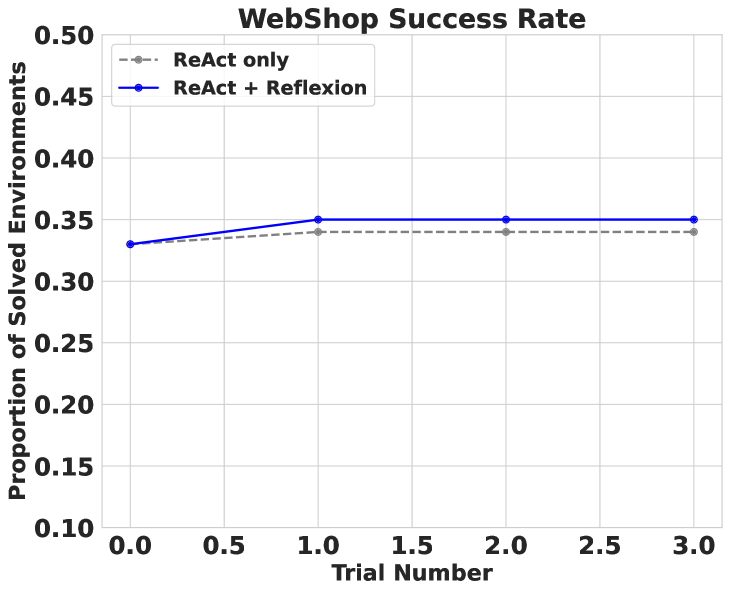
This line chart depicts the success rate of two different approaches – “ReAct only” and “ReAct + Reflexion” – across three trial numbers in a WebShop environment. The y-axis represents the proportion of solved environments, while the x-axis represents the trial number.
### Components/Axes
* **Title:** WebShop Success Rate
* **X-axis Label:** Trial Number (Scale: 0.0 to 3.0, increments of 0.5)
* **Y-axis Label:** Proportion of Solved Environments (Scale: 0.10 to 0.50, increments of 0.05)
* **Legend:**
* ReAct only (Grey dashed line with circle markers)
* ReAct + Reflexion (Blue solid line with circle markers)
### Detailed Analysis
**ReAct only (Grey dashed line):**
The line starts at approximately 0.32 at Trial Number 0.0, increases to approximately 0.34 at Trial Number 1.0, and then slightly decreases to approximately 0.33 at Trial Number 2.0 and 3.0. The trend is relatively flat, showing minimal improvement across trials.
* Trial 0.0: 0.32
* Trial 0.5: 0.33
* Trial 1.0: 0.34
* Trial 1.5: 0.34
* Trial 2.0: 0.33
* Trial 2.5: 0.33
* Trial 3.0: 0.33
**ReAct + Reflexion (Blue solid line):**
The line begins at approximately 0.32 at Trial Number 0.0, increases to approximately 0.36 at Trial Number 1.0, decreases to approximately 0.35 at Trial Number 2.0, and remains at approximately 0.35 at Trial Number 3.0. This line shows an initial improvement followed by stabilization.
* Trial 0.0: 0.32
* Trial 0.5: 0.34
* Trial 1.0: 0.36
* Trial 1.5: 0.36
* Trial 2.0: 0.35
* Trial 2.5: 0.35
* Trial 3.0: 0.35
### Key Observations
* The "ReAct + Reflexion" approach consistently outperforms the "ReAct only" approach across all trial numbers.
* The "ReAct + Reflexion" approach shows an initial improvement in success rate during the first trial, but then plateaus.
* The "ReAct only" approach shows very little change in success rate across all trials.
* Both approaches have a success rate between 0.32 and 0.36.
### Interpretation
The data suggests that incorporating "Reflexion" into the "ReAct" framework improves the success rate in the WebShop environment, at least initially. However, the improvement appears to plateau after the first trial, indicating that the benefits of "Reflexion" may diminish with continued use or that further refinements are needed to sustain improvement. The relatively low overall success rates (between 32% and 36%) for both approaches suggest that the WebShop environment presents a significant challenge, and there is room for further improvement in both methodologies. The flat trend of the "ReAct only" approach indicates that it does not adapt or learn from experience within this environment. The initial boost from "Reflexion" suggests that self-evaluation and iterative refinement can be beneficial, but the plateau suggests that the current implementation of "Reflexion" may have limitations.