## Flowchart: LLM Reasoning Process for Mathematical Problem Solving
### Overview
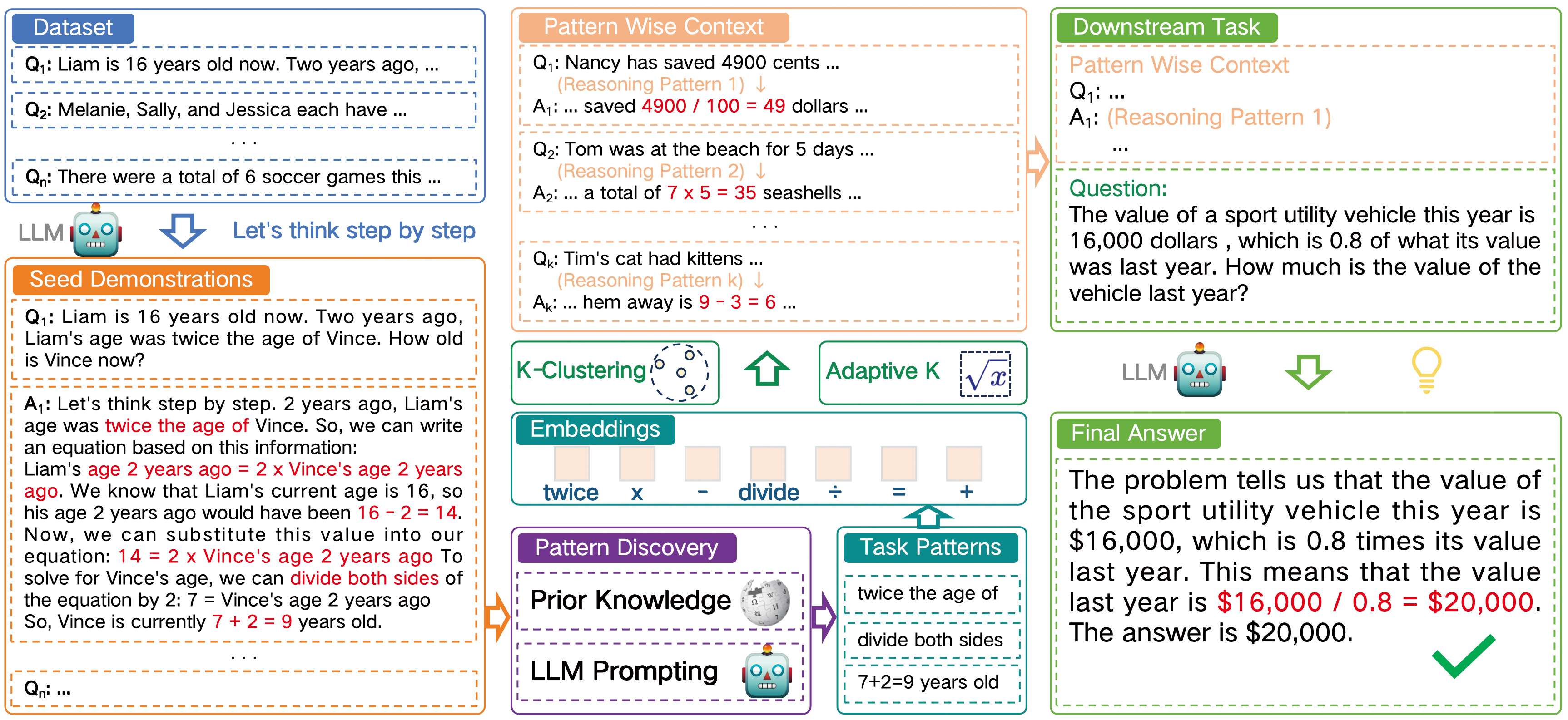
The image depicts a multi-stage flowchart illustrating how a Large Language Model (LLM) processes and solves mathematical problems through pattern recognition, contextual reasoning, and step-by-step deduction. The diagram integrates text, symbolic representations, and visual metaphors to demonstrate the model's cognitive pipeline.
### Components/Axes
1. **Left Column (Input/Context)**
- **Dataset**: Contains three question-answer pairs (Q1, Q2, Qn) with contextual information about ages, savings, and soccer games.
- **Pattern Wise Context**: Shows reasoning patterns (e.g., division for currency conversion, multiplication for counting objects).
- **Seed Demonstrations**: Step-by-step solution for an age-related problem involving Liam and Vince.
2. **Center Column (Processing)**
- **K-Clustering & Adaptive K**: Symbolic representations of clustering algorithms with mathematical operations (√x, x).
- **Embeddings**: Boxes labeled "twice," "x," "divide," "=", and "+" representing mathematical operations.
- **Pattern Discovery**: Combines prior knowledge (globe icon) and LLM prompting (robot icon) to identify reasoning patterns.
3. **Right Column (Output)**
- **Downstream Task**: Presents a vehicle value problem with contextual information.
- **Final Answer**: Solution to the vehicle value problem ($20,000) with a green checkmark.
### Detailed Analysis
1. **Dataset Section**
- Q1: Liam's current age (16) and age two years ago.
- Q2: Three individuals (Melanie, Sally, Jessica) with unspecified quantities.
- Qn: Total soccer games (6) with unspecified distribution.
2. **Pattern Wise Context**
- Q1: Nancy's savings (4900 cents) converted to dollars (4900/100 = 49).
- Q2: Tom's beach visit duration (5 days) multiplied by seashells per day (7×5=35).
- Qk: Cat kittens problem with subtraction (9-3=6).
3. **Seed Demonstrations**
- Step-by-step solution for Liam's age problem:
- Current age: 16
- Two years ago: 16-2=14
- Equation: 14 = 2×Vince's age two years ago
- Solution: Vince's current age = 9
4. **Embeddings & Task Patterns**
- Mathematical operations visualized as boxes:
- "twice" (multiplication)
- "divide" (division)
- "=" (equality)
- "+" (addition)
- Task Patterns list:
- "twice the age of"
- "divide both sides"
- "7+2=9 years old"
5. **Final Answer**
- Vehicle value problem:
- Current value: $16,000 (0.8×last year's value)
- Calculation: $16,000 / 0.8 = $20,000
### Key Observations
1. The flowchart demonstrates hierarchical reasoning, moving from raw data (Dataset) to abstract patterns (Pattern Discovery) and finally to concrete solutions (Final Answer).
2. Mathematical operations are visually represented through labeled boxes in the Embeddings section.
3. The robot icon in LLM Prompting suggests anthropomorphic representation of the model's reasoning process.
4. The globe icon in Prior Knowledge implies integration of external information sources.
### Interpretation
This diagram illustrates how LLMs transform unstructured problems into structured reasoning chains. The Embeddings section acts as a symbolic representation of mathematical operations, while Task Patterns show the model's ability to identify and apply reasoning templates. The Final Answer demonstrates successful application of these patterns to solve novel problems, highlighting the model's capacity for:
- Pattern recognition across different problem types
- Contextual adaptation (e.g., unit conversion in Pattern Wise Context)
- Step-by-step logical deduction (Seed Demonstrations)
- Integration of prior knowledge with new information (Pattern Discovery)
The visual metaphors (robot, globe) suggest personification of the model's cognitive processes, while the mathematical operations emphasize the algorithmic nature of the reasoning. The flowchart effectively communicates the LLM's problem-solving methodology through a combination of textual examples and symbolic representations.