## Diagram: Crafting System Perturbation Analysis
### Overview
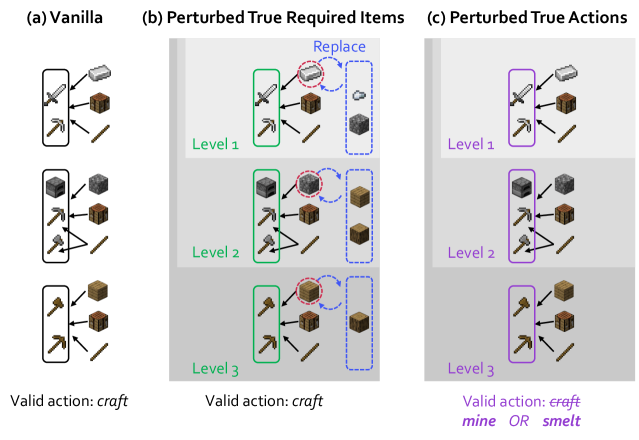
The image is a technical diagram comparing three variations of a crafting system, likely from a game or simulation environment. It illustrates how "perturbations" (modifications) to either the required items or the allowed actions affect the validity of crafting recipes across three difficulty levels. The diagram is divided into three vertical panels labeled (a), (b), and (c).
### Components/Axes
The diagram is organized into three main panels, each with a header and a footer containing text.
**Panel Headers (Top of each column):**
* **(a) Vanilla**
* **(b) Perturbed True Required Items**
* **(c) Perturbed True Actions**
**Panel Footers (Bottom of each column):**
* **(a) Valid action: craft**
* **(b) Valid action: craft**
* **(c) Valid action: craft, mine OR smelt**
**Internal Structure:**
* **Panel (a):** Contains three vertically stacked rows of item diagrams. Each row shows a set of input items (e.g., swords, pickaxes, blocks) connected by arrows to a central crafting grid (a 2x2 square), indicating a recipe.
* **Panel (b):** Contains three rows, each labeled with a level on the left side: **Level 1**, **Level 2**, **Level 3**. Each row shows a modified version of the corresponding recipe from panel (a). Modifications are indicated by:
* **Green solid-line boxes:** Enclose the original, required items.
* **Blue dashed-line boxes:** Enclose the "perturbed" or replacement items.
* **Red dashed circles and arrows:** Highlight the specific item being replaced and point to its substitute.
* The word **"Replace"** is written in blue text at the top of the panel, with an arrow pointing to the first replacement example.
* **Panel (c):** Contains three rows, also labeled **Level 1**, **Level 2**, **Level 3**. Each row shows the same item sets as in panel (a), but the entire set of input items is enclosed in a **purple solid-line box**.
### Detailed Analysis
**Panel (a) - Vanilla:**
* **Level 1 Recipe:** Inputs appear to be a stone sword, a stone pickaxe, and a cobblestone block. They point to a crafting grid.
* **Level 2 Recipe:** Inputs appear to be a stone block, a stone pickaxe, and a cobblestone block.
* **Level 3 Recipe:** Inputs appear to be a stone pickaxe, a wooden pickaxe, and a wooden plank block.
* **Commonality:** All three recipes are valid for the single action: **craft**.
**Panel (b) - Perturbed True Required Items:**
* **Level 1:** The cobblestone block (in the green box) is replaced by a different block (possibly a furnace, in the blue box). The recipe remains valid only for **craft**.
* **Level 2:** The stone block (in the green box) is replaced by a different block (possibly a crafting table, in the blue box). The recipe remains valid only for **craft**.
* **Level 3:** The cobblestone block (in the green box) is replaced by a different block (possibly a chest, in the blue box). The recipe remains valid only for **craft**.
* **Trend:** The perturbation involves substituting one of the required material blocks with an alternative block, while the core action (**craft**) remains unchanged.
**Panel (c) - Perturbed True Actions:**
* **Levels 1, 2, and 3:** The item sets are visually identical to the vanilla recipes in panel (a). The key difference is the purple bounding box and the expanded list of valid actions in the footer.
* **Valid Actions:** The system now accepts **craft**, **mine**, **OR smelt** as valid actions for these item sets. This suggests the same configuration of items can be interpreted as the starting point for multiple different processes.
### Key Observations
1. **Action vs. Item Perturbation:** The diagram contrasts two types of system modifications. Panel (b) changes *what* is needed (the items), while panel (c) changes *what you can do* (the actions).
2. **Level Progression:** The three levels likely represent increasing complexity or different stages within the system, though the specific nature of the progression (e.g., difficulty, resource tier) is not explicitly defined.
3. **Visual Coding:** The diagram uses a consistent visual language: green for original/required elements, blue for perturbed items, red for the change operation, and purple for perturbed action sets.
4. **Action Generalization:** Panel (c) demonstrates a significant generalization where a single set of items becomes valid for multiple, distinct actions, increasing the flexibility or ambiguity of the system.
### Interpretation
This diagram is a conceptual model for analyzing the robustness or flexibility of a rule-based system, such as a game's crafting mechanic or an AI planning environment.
* **What it demonstrates:** It shows how the definition of a "valid" state (a craftable recipe) can be altered. In the vanilla state (a), validity is strict: specific items for one specific action. Perturbations can either relax the *input requirements* (b) by allowing substitutions, or relax the *output/action mapping* (c) by allowing the same inputs to trigger different processes.
* **Relationship between elements:** The three panels are directly comparable. Each row across the panels represents the same conceptual "level" or problem instance under different rule sets. The arrows and boxes explicitly map the transformation from the vanilla state to the perturbed states.
* **Implications:** This type of analysis is crucial for designing systems that are either **resilient** (can handle incorrect or substituted inputs, as in b) or **versatile** (can support multiple outcomes from the same starting point, as in c). It could be used to test AI agents, balance game difficulty, or study how changes to rules affect problem-solving strategies. The "Perturbed True" phrasing suggests these are intentional, known modifications to a ground-truth system, likely for experimental or diagnostic purposes.