## Timeline Diagram: Multi-Agent Behavior Sequences
### Overview
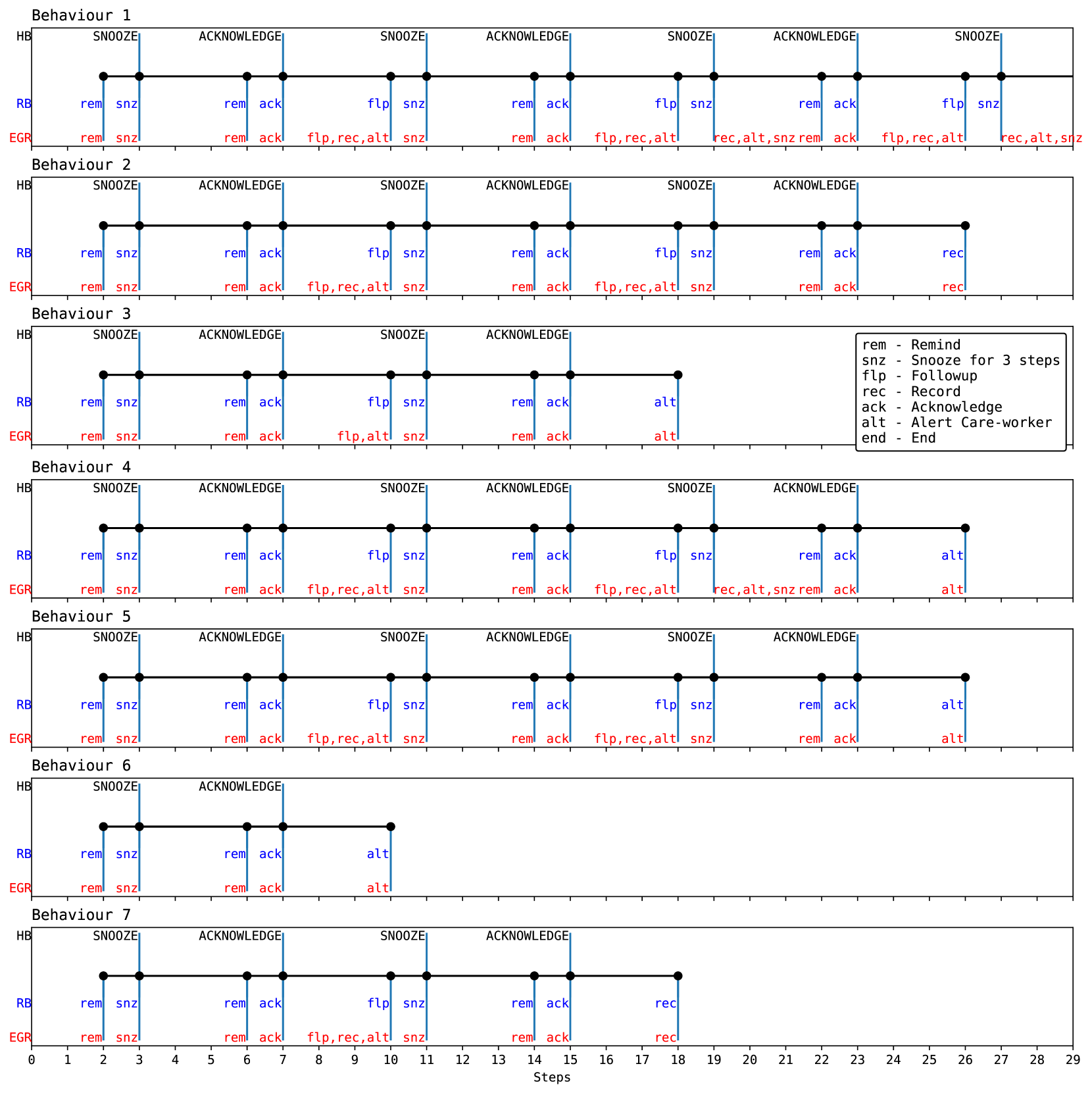
The image displays seven distinct behavioral timelines (labeled Behaviour 1 through 7) for a system involving three components: HB, RB, and EGR. Each timeline plots events over a sequence of discrete "Steps" (0-29). The diagram illustrates different sequences of actions and responses, likely representing scenarios in a reminder or alert system for care-work. A legend defines the action abbreviations used.
### Components/Axes
* **X-Axis:** Labeled "Steps" at the bottom center. It is a linear scale marked with integers from 0 to 29.
* **Y-Axis (Per Behavior):** Each of the seven behavior panels has three horizontal lines representing different agents or components:
* **HB (Top Line):** Black line with black circular markers at event points. Events are labeled in uppercase (e.g., SNOOZE, ACKNOWLEDGE).
* **RB (Middle Line):** Blue line with blue text labels below the HB events.
* **EGR (Bottom Line):** Red line with red text labels below the RB events.
* **Legend:** A box located within the "Behaviour 3" panel (top-right) defines the abbreviations:
* `rem` - Remind
* `snz` - Snooze for 3 steps
* `flp` - Followup
* `rec` - Record
* `ack` - Acknowledge
* `alt` - Alert Care-worker
* `end` - End
### Detailed Analysis
**Behaviour 1**
* **Sequence:** The longest sequence, spanning steps 2 to 27.
* **HB Events:** SNOOZE (step 2), ACKNOWLEDGE (6), SNOOZE (10), ACKNOWLEDGE (14), SNOOZE (18), ACKNOWLEDGE (22), SNOOZE (26).
* **RB Actions:** Corresponding to each HB event: `rem snz`, `rem ack`, `flp snz`, `rem ack`, `flp snz`, `rem ack`, `flp snz`.
* **EGR Actions:** `rem snz`, `rem ack`, `flp,rec,alt snz`, `rem ack`, `flp,rec,alt rec,alt,snz`, `rem ack`, `flp,rec,alt rec,alt,snz`. The EGR actions become more complex in later steps, combining multiple commands (`flp,rec,alt`).
**Behaviour 2**
* **Sequence:** Spans steps 2 to 26.
* **HB Events:** SNOOZE (2), ACKNOWLEDGE (6), SNOOZE (10), ACKNOWLEDGE (14), SNOOZE (18), ACKNOWLEDGE (22).
* **RB Actions:** `rem snz`, `rem ack`, `flp snz`, `rem ack`, `flp snz`, `rem ack`, `rec`. The final RB action is `rec` (Record), not an HB event.
* **EGR Actions:** `rem snz`, `rem ack`, `flp,rec,alt snz`, `rem ack`, `flp,rec,alt snz`, `rem ack`, `rec`.
**Behaviour 3**
* **Sequence:** Shorter, spanning steps 2 to 15.
* **HB Events:** SNOOZE (2), ACKNOWLEDGE (6), SNOOZE (10), ACKNOWLEDGE (14).
* **RB Actions:** `rem snz`, `rem ack`, `flp snz`, `rem ack`, `alt`. The sequence ends with an `alt` (Alert Care-worker) action.
* **EGR Actions:** `rem snz`, `rem ack`, `flp,alt snz`, `rem ack`, `alt`.
**Behaviour 4**
* **Sequence:** Long, spanning steps 2 to 26.
* **HB Events:** SNOOZE (2), ACKNOWLEDGE (6), SNOOZE (10), ACKNOWLEDGE (14), SNOOZE (18), ACKNOWLEDGE (22).
* **RB Actions:** `rem snz`, `rem ack`, `flp snz`, `rem ack`, `flp snz`, `rem ack`, `alt`.
* **EGR Actions:** `rem snz`, `rem ack`, `flp,rec,alt snz`, `rem ack`, `flp,rec,alt rec,alt,snz`, `rem ack`, `alt`.
**Behaviour 5**
* **Sequence:** Identical to Behaviour 4 in structure and length (steps 2-26).
* **HB Events:** SNOOZE (2), ACKNOWLEDGE (6), SNOOZE (10), ACKNOWLEDGE (14), SNOOZE (18), ACKNOWLEDGE (22).
* **RB Actions:** `rem snz`, `rem ack`, `flp snz`, `rem ack`, `flp snz`, `rem ack`, `alt`.
* **EGR Actions:** `rem snz`, `rem ack`, `flp,rec,alt snz`, `rem ack`, `flp,rec,alt snz`, `rem ack`, `alt`. (Note: The 5th EGR action differs from Behaviour 4's equivalent step).
**Behaviour 6**
* **Sequence:** Very short, spanning steps 2 to 10.
* **HB Events:** SNOOZE (2), ACKNOWLEDGE (6).
* **RB Actions:** `rem snz`, `rem ack`, `alt`.
* **EGR Actions:** `rem snz`, `rem ack`, `alt`.
**Behaviour 7**
* **Sequence:** Spans steps 2 to 18.
* **HB Events:** SNOOZE (2), ACKNOWLEDGE (6), SNOOZE (10), ACKNOWLEDGE (14).
* **RB Actions:** `rem snz`, `rem ack`, `flp snz`, `rem ack`, `rec`.
* **EGR Actions:** `rem snz`, `rem ack`, `flp,rec,alt snz`, `rem ack`, `rec`.
### Key Observations
1. **Common Initiation:** All seven behaviors begin identically at step 2 with an HB `SNOOZE` event, accompanied by RB and EGR `rem snz` actions.
2. **Pattern of Interaction:** A core pattern emerges: an HB event (SNOOZE or ACKNOWLEDGE) triggers a corresponding RB action (`snz` or `ack`), which is then followed by an EGR action that often mirrors or expands upon the RB action.
3. **Divergence Points:** Behaviors diverge based on:
* **Termination Action:** They end with different final RB/EGR actions: `snz` (Behaviour 1), `rec` (Behaviours 2, 7), or `alt` (Behaviours 3, 4, 5, 6).
* **Sequence Length:** The number of SNOOZE/ACKNOWLEDGE cycles varies from 1 (Behaviour 6) to 3.5 (Behaviour 1).
* **EGR Complexity:** The EGR line shows increasing complexity in mid-to-late steps for longer sequences (e.g., `flp,rec,alt`), suggesting more system logging or parallel actions.
4. **Identical vs. Unique:** Behaviours 4 and 5 are nearly identical, differing only in the fifth EGR action (`flp,rec,alt rec,alt,snz` vs. `flp,rec,alt snz`).
### Interpretation
This diagram models the possible execution traces of a multi-agent system designed for task reminders, likely in a healthcare or assisted living context. The HB (perhaps "Human Behavior" or "Host Behavior") represents the user's or primary system's state changes (Snooze/Acknowledge). The RB ("Reminder Bot") and EGR ("Event/Alert Generation & Recording") are automated agents responding to these state changes.
The data suggests a system with escalating response protocols. Initial non-responses trigger simple reminders (`rem`). Continued non-response leads to follow-ups (`flp`) and concurrent recording/alerting (`rec,alt`). The final action (`rec` or `alt`) indicates the outcome: either the event was logged as completed (`rec`) or a human care-worker was alerted (`alt`) due to persistent non-acknowledgment. The varying sequence lengths model different user response latencies. The existence of seven distinct behaviors implies the system is designed to handle a wide range of user interaction patterns, from prompt acknowledgment to complete non-response, with corresponding escalation in automated intervention.