## Box Plot: Acoustic Scene Analysis
### Overview
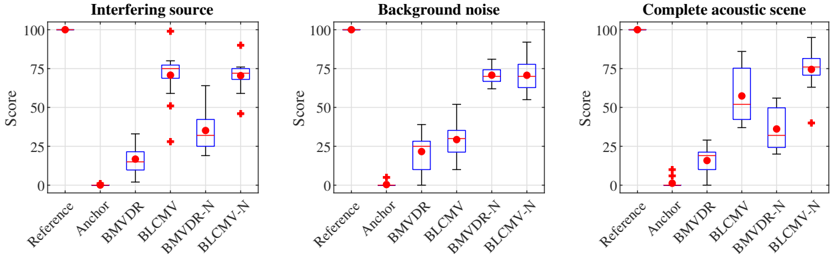
The image presents three box plots comparing the performance of different audio processing techniques (BMVDR, BLCMV, BMVDR-N, BLCMV-N) against a Reference and an Anchor. The plots analyze the "Interfering source", "Background noise", and "Complete acoustic scene" based on a "Score" metric. Each box plot displays the distribution of scores for each technique, including the median, quartiles, and outliers.
### Components/Axes
* **X-axis:** Categorical, representing the audio processing techniques: "Reference", "Anchor", "BMVDR", "BLCMV", "BMVDR-N", "BLCMV-N".
* **Y-axis:** Numerical, labeled "Score", ranging from 0 to 100 in increments of 25.
* **Box Plots:** Each box plot represents the distribution of scores for a given technique. The box indicates the interquartile range (IQR), the line within the box represents the median, and the whiskers extend to the furthest data point within 1.5 times the IQR. Outliers are marked as red plus signs (+).
* **Titles:** Each plot has a title indicating the acoustic condition being analyzed: "Interfering source", "Background noise", and "Complete acoustic scene".
### Detailed Analysis
#### Interfering Source
* **Reference:** Score consistently at 100.
* **Anchor:** Score consistently at 0.
* **BMVDR:** The box spans from approximately 10 to 25, with a median around 17.5. There are outliers near 0 and 35.
* **BLCMV:** The box spans from approximately 60 to 75, with a median around 70. There are outliers near 27 and 100.
* **BMVDR-N:** The box spans from approximately 25 to 40, with a median around 35. There are outliers near 50.
* **BLCMV-N:** The box spans from approximately 65 to 75, with a median around 72. There are outliers near 45 and 92.
#### Background Noise
* **Reference:** Score consistently at 100.
* **Anchor:** Score consistently at 0.
* **BMVDR:** The box spans from approximately 15 to 35, with a median around 25.
* **BLCMV:** The box spans from approximately 25 to 45, with a median around 37.5.
* **BMVDR-N:** The box spans from approximately 65 to 80, with a median around 72.5.
* **BLCMV-N:** The box spans from approximately 65 to 80, with a median around 75.
#### Complete Acoustic Scene
* **Reference:** Score consistently at 100.
* **Anchor:** Score consistently at 0.
* **BMVDR:** The box spans from approximately 10 to 25, with a median around 17.5. There are outliers near 0 and 10.
* **BLCMV:** The box spans from approximately 40 to 75, with a median around 57.5. There is an outlier near 100.
* **BMVDR-N:** The box spans from approximately 25 to 50, with a median around 37.5.
* **BLCMV-N:** The box spans from approximately 70 to 90, with a median around 75. There is an outlier near 40.
### Key Observations
* The "Reference" consistently scores 100 across all three acoustic conditions, while the "Anchor" consistently scores 0.
* BLCMV and BLCMV-N generally outperform BMVDR and BMVDR-N in all three conditions.
* The performance of BMVDR-N and BLCMV-N is significantly better than BMVDR and BLCMV in the "Background noise" condition.
* The "Interfering source" condition shows the most variability in performance across the different techniques.
### Interpretation
The box plots provide a comparative analysis of different audio processing techniques under varying acoustic conditions. The "Reference" and "Anchor" serve as benchmarks, representing ideal and baseline performance, respectively. The data suggests that BLCMV and BLCMV-N are generally more effective at handling both interfering sources and background noise compared to BMVDR and BMVDR-N. The addition of noise reduction (indicated by the "-N" suffix) appears to significantly improve performance in the presence of background noise. The variability in scores for the "Interfering source" condition suggests that the effectiveness of these techniques may be highly dependent on the specific characteristics of the interfering source. Overall, the plots highlight the strengths and weaknesses of each technique, providing valuable insights for selecting the most appropriate audio processing method for a given acoustic environment.