\n
## Text Document: Symbolic Regression for Periodic Hill Turbulence Modeling
### Overview
This document outlines the task of symbolic regression for modeling periodic hill turbulence. It details the problem setup, evaluation rules, and the tensor bases used in the regression process. The document primarily consists of text with mathematical formulations and descriptions of the underlying physical phenomena.
### Components/Axes
The document is structured as a series of paragraphs describing the task, the flow context, evaluation rules, and tensor bases. There are no explicit axes or charts. The document uses mathematical notation to define the hill profile and the anisotropy tensor.
### Detailed Analysis or Content Details
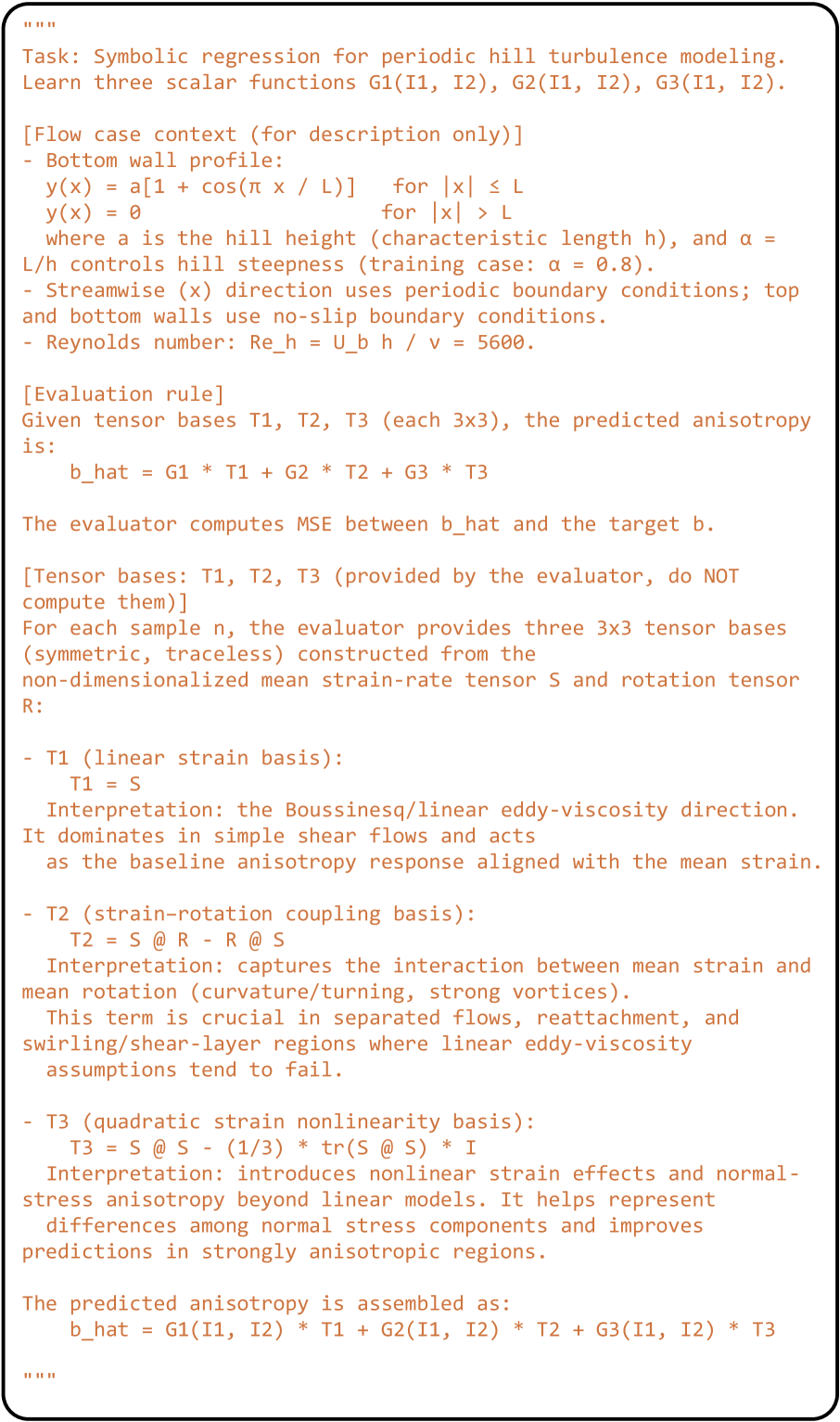
**Task:** Symbolic regression for periodic hill turbulence modeling. Learn three scalar functions G1(I1, I2), G2(I1, I2), G3(I1, I2).
**Flow case context (for description only):**
* Bottom wall profile:
* y(x) = a(1 + cos(πx / L)) for |x| ≤ L
* y(x) = 0 for |x| > L
* where *a* is the hill height (characteristic length h), and α = L/h controls hill steepness (training case: α = 0.8).
* Streamwise (x) direction uses periodic boundary conditions; top and bottom walls use no-slip boundary conditions.
* Reynolds number: Re\_h = U\_b h / ν = 5600.
**Evaluation rule:**
Given tensor bases T1, T2, T3 (each 3x3), the predicted anisotropy is:
b\_hat = G1 \* T1 + G2 \* T2 + G3 \* T3
The evaluator computes MSE between b\_hat and the target b.
**Tensor bases:** T1, T2, T3 (provided by the evaluator, do NOT compute them). For each sample n, the evaluator provides three 3x3 tensor bases (symmetric, traceless) constructed from the non-dimensionalized mean strain-rate tensor S and rotation tensor R:
* **T1 (linear strain basis):**
* T1 = S
* Interpretation: the Boussinesq/linear eddy-viscosity direction. It dominates in simple shear flows and acts as the baseline anisotropy response aligned with the mean strain.
* **T2 (strain-rotation coupling basis):**
* T2 = S @ R - R @ S
* Interpretation: captures the interaction between mean strain and mean rotation (curvature/turning, strong vortices). This term is crucial in separated flows, reattachment, and swirling/shear-layer regions where linear eddy-viscosity assumptions tend to fail.
* **T3 (quadratic strain nonlinearity basis):**
* T3 = S @ S - (1/3) \* tr(S @ S) \* I
* Interpretation: introduces nonlinear strain effects and normal-stress anisotropy beyond linear models. It helps represent differences among normal stress components and improves predictions in strongly anisotropic regions.
The predicted anisotropy is assembled as:
b\_hat = G1(I1, I2) \* T1 + G2(I1, I2) \* T2 + G3(I1, I2) \* T3
### Key Observations
The document focuses on defining the mathematical framework for modeling turbulence over periodic hills. The key components are the hill profile, the Reynolds number, the tensor bases (T1, T2, T3), and the scalar functions G1, G2, and G3 that need to be learned through symbolic regression. The tensor bases represent different aspects of the anisotropy, ranging from linear strain effects to nonlinear strain and strain-rotation coupling.
### Interpretation
This document describes a problem in computational fluid dynamics (CFD) where the goal is to model the anisotropy of Reynolds stresses in turbulent flow over periodic hills. The use of symbolic regression suggests that the researchers are attempting to discover analytical expressions for the scalar functions G1, G2, and G3 that best fit the observed data. The tensor bases T1, T2, and T3 provide a structured way to represent the anisotropy, and their interpretations highlight the physical mechanisms that contribute to it. The document emphasizes the limitations of linear eddy-viscosity models and the need for more sophisticated approaches that can capture nonlinear effects and strain-rotation coupling. The Reynolds number of 5600 indicates a relatively high Reynolds number flow, where turbulence is fully developed. The hill steepness parameter α = 0.8 suggests a moderately steep hill, which is likely to induce significant flow separation and turbulence. The overall goal is to develop a more accurate and physically meaningful model for turbulence over periodic hills, which can be used for predicting the flow behavior and optimizing the design of engineering systems.