\n
## Line Chart: Loss vs. Iterations
### Overview
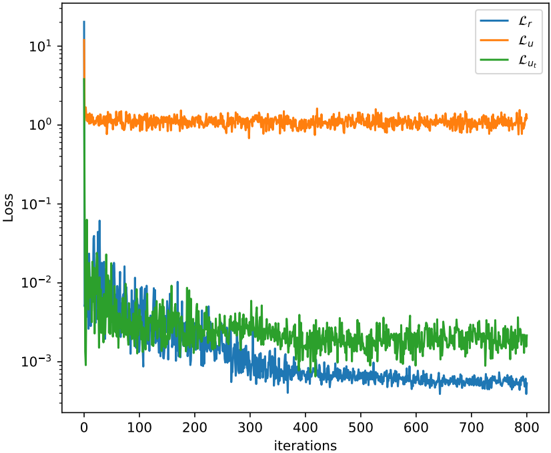
The image presents a line chart illustrating the relationship between 'Loss' and 'Iterations' for three different loss functions: *L<sub>r</sub>*, *L<sub>u</sub>*, and *L<sub>v</sub>*. The chart displays how these loss values change as the number of iterations increases. The y-axis is on a logarithmic scale.
### Components/Axes
* **X-axis:** 'iterations' ranging from approximately 0 to 800.
* **Y-axis:** 'Loss' on a logarithmic scale, ranging from approximately 10<sup>-3</sup> to 10<sup>1</sup> (1 to 100). The scale is marked with values 10<sup>-2</sup>, 10<sup>-1</sup>, 10<sup>0</sup>, 10<sup>1</sup>.
* **Legend:** Located in the top-right corner, identifying the three lines:
* Blue line: *L<sub>r</sub>*
* Orange line: *L<sub>u</sub>*
* Green line: *L<sub>v</sub>*
### Detailed Analysis
* **L<sub>r</sub> (Blue Line):** The blue line starts at approximately 10<sup>0</sup> (10) at iteration 0 and rapidly decreases to approximately 10<sup>-2</sup> (0.01) by iteration 50. It then fluctuates around this value, with some oscillations, until iteration 800, remaining relatively stable.
* **L<sub>u</sub> (Orange Line):** The orange line begins at approximately 10<sup>0</sup> (10) at iteration 0 and remains relatively constant, fluctuating around 10<sup>0</sup> (10) throughout the entire range of iterations (0 to 800). There is some minor fluctuation, but it does not show a clear decreasing trend.
* **L<sub>v</sub> (Green Line):** The green line starts at approximately 10<sup>-1</sup> (0.1) at iteration 0 and decreases to approximately 10<sup>-2</sup> (0.01) by iteration 50. It then fluctuates around this value, with more pronounced oscillations than the blue line, until iteration 800. It appears to stabilize around 10<sup>-2</sup> (0.01) but with higher variance than *L<sub>r</sub>*.
### Key Observations
* *L<sub>r</sub>* exhibits the most significant decrease in loss, converging to a relatively stable value.
* *L<sub>u</sub>* shows minimal change in loss throughout the iterations, indicating it may not be effectively learning or converging.
* *L<sub>v</sub>* decreases initially but exhibits more fluctuation than *L<sub>r</sub>*, suggesting a less stable learning process.
* All three loss functions start at different initial loss values.
### Interpretation
The chart likely represents the training process of a machine learning model, where 'Loss' quantifies the error between the model's predictions and the actual values. 'Iterations' represent the number of times the model's parameters are updated during training.
The differing behaviors of the three loss functions (*L<sub>r</sub>*, *L<sub>u</sub>*, and *L<sub>v</sub>*) suggest they may be measuring different aspects of the model's performance or represent different components of the overall loss function. *L<sub>r</sub>*’s convergence indicates successful learning for that component. *L<sub>u</sub>*'s stagnation suggests a potential issue with that component, such as a poor learning rate or a non-informative feature. *L<sub>v</sub>*'s fluctuating behavior suggests instability or sensitivity to the training data.
The logarithmic scale on the y-axis is crucial for visualizing the changes in loss, especially when the loss values vary significantly in magnitude. The initial differences in loss values suggest that these loss functions are measuring different aspects of the model's performance, and their relative magnitudes are important for understanding the model's overall behavior. The fact that *L<sub>u</sub>* remains high throughout the training process could indicate a problem with the corresponding part of the model or the data used to calculate that loss.