## Line Chart: Accuracy vs. Varying Maximum Depth
### Overview
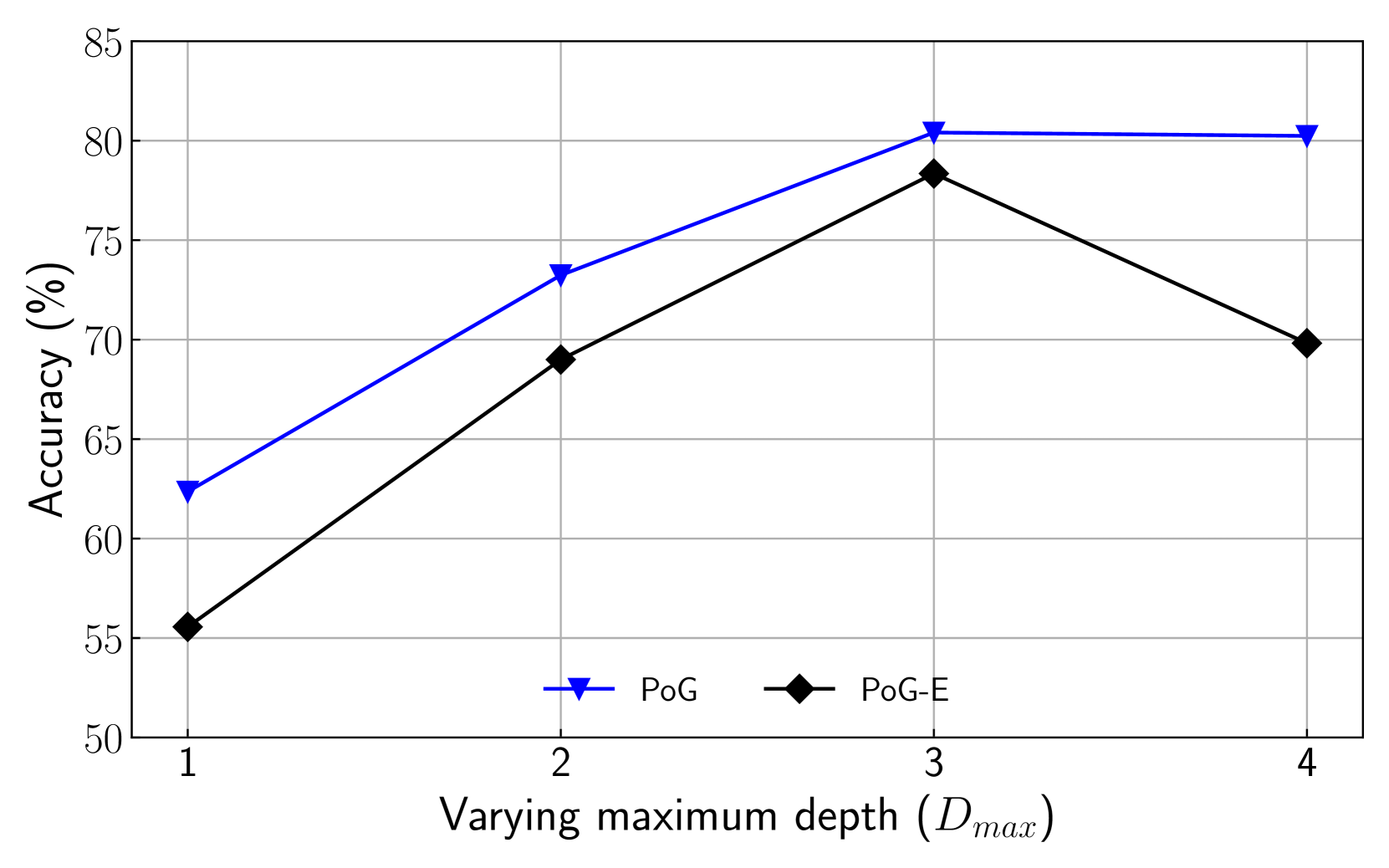
This image displays a line chart illustrating the accuracy (%) of two different methods, "PoG" and "PoG-E", as a function of varying maximum depth ($D_{max}$). The chart shows how the accuracy changes for each method across different depth values.
### Components/Axes
* **Y-axis Title**: "Accuracy (%)"
* **Scale**: Ranges from 50 to 85, with major grid lines at intervals of 5 (50, 55, 60, 65, 70, 75, 80, 85).
* **X-axis Title**: "Varying maximum depth ($D_{max}$)"
* **Scale**: Ranges from 1 to 4, with major grid lines at integer values (1, 2, 3, 4).
* **Legend**: Located in the bottom-center of the chart.
* "PoG": Represented by blue upward-pointing triangles.
* "PoG-E": Represented by black diamonds.
### Detailed Analysis
**Data Series: PoG (Blue Upward-Triangles)**
* **Trend**: The "PoG" line shows an upward trend from $D_{max}=1$ to $D_{max}=3$, and then plateaus from $D_{max}=3$ to $D_{max}=4$.
* **Data Points**:
* At $D_{max}=1$: Accuracy is approximately 63%.
* At $D_{max}=2$: Accuracy is approximately 74%.
* At $D_{max}=3$: Accuracy is approximately 81%.
* At $D_{max}=4$: Accuracy is approximately 81%.
**Data Series: PoG-E (Black Diamonds)**
* **Trend**: The "PoG-E" line shows an upward trend from $D_{max}=1$ to $D_{max}=3$, and then a downward trend from $D_{max}=3$ to $D_{max}=4$.
* **Data Points**:
* At $D_{max}=1$: Accuracy is approximately 55%.
* At $D_{max}=2$: Accuracy is approximately 69%.
* At $D_{max}=3$: Accuracy is approximately 78%.
* At $D_{max}=4$: Accuracy is approximately 70%.
### Key Observations
* Both "PoG" and "PoG-E" methods show an increase in accuracy as the maximum depth increases from 1 to 3.
* The "PoG" method achieves a higher accuracy than "PoG-E" at $D_{max}=1$ and $D_{max}=2$.
* At $D_{max}=3$, "PoG" reaches its peak accuracy of approximately 81%, while "PoG-E" reaches approximately 78%.
* The "PoG" method maintains its peak accuracy from $D_{max}=3$ to $D_{max}=4$.
* The "PoG-E" method experiences a significant drop in accuracy from $D_{max}=3$ to $D_{max}=4$, falling to approximately 70%.
### Interpretation
The data suggests that increasing the maximum depth ($D_{max}$) generally improves the accuracy of both "PoG" and "PoG-E" methods, up to a certain point. The "PoG" method appears to be more robust to increasing depth, reaching a plateau and maintaining its performance. In contrast, the "PoG-E" method shows signs of overfitting or diminishing returns beyond a depth of 3, as its accuracy decreases significantly at $D_{max}=4$. This indicates that for the "PoG-E" method, a maximum depth of 3 might be optimal, while for "PoG", a depth of 3 or 4 yields the best results. The "PoG" method consistently outperforms "PoG-E" at lower depths and maintains a higher accuracy at the optimal depth.