\n
## Line Chart: HotPotQA Success Rate
### Overview
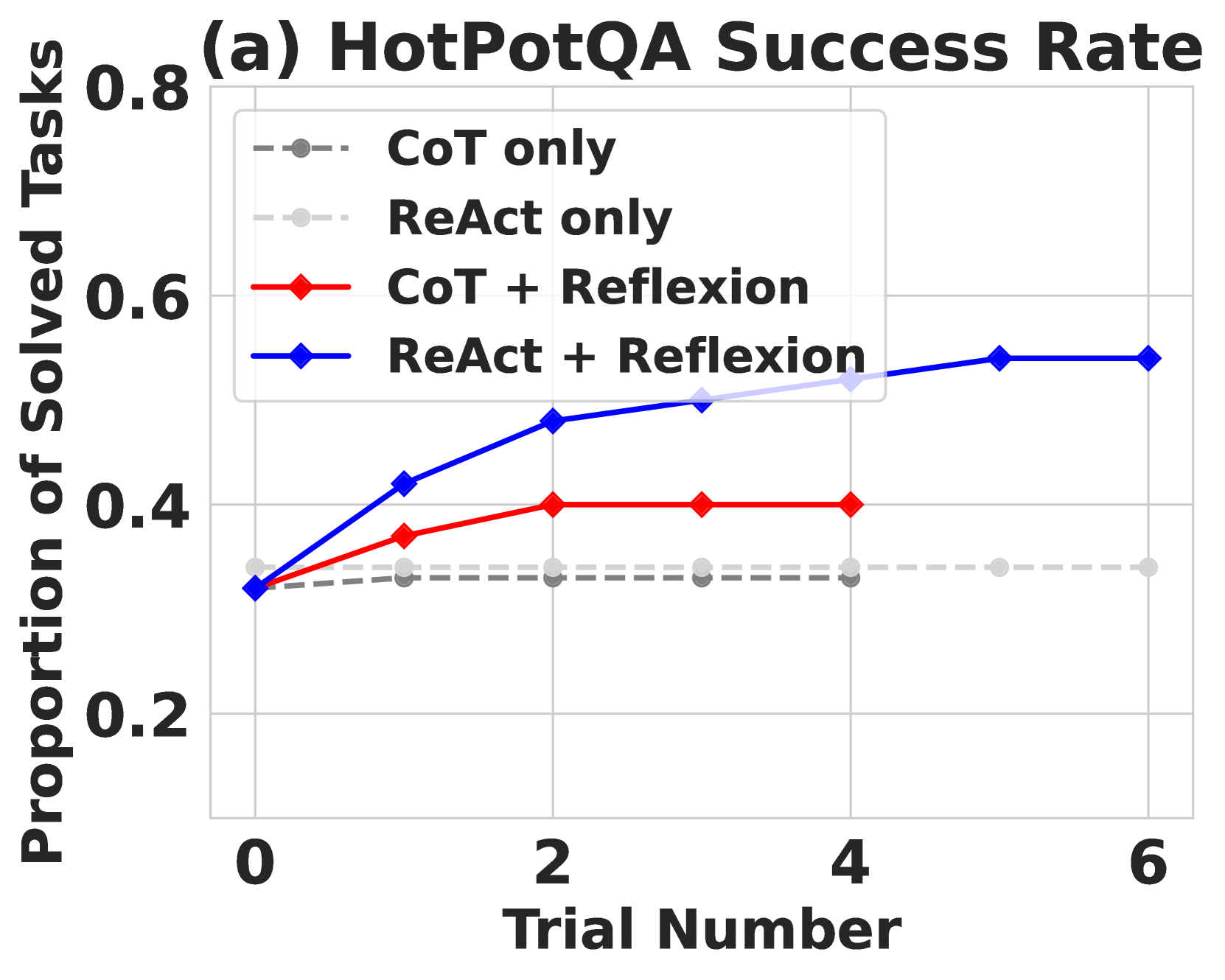
This line chart displays the success rate of different approaches on the HotPotQA task, measured as the proportion of solved tasks across multiple trials. The chart compares four methods: CoT only, ReAct only, CoT + Reflexion, and ReAct + Reflexion. The x-axis represents the trial number, and the y-axis represents the proportion of solved tasks.
### Components/Axes
* **Title:** (a) HotPotQA Success Rate (top-center)
* **X-axis Label:** Trial Number (bottom-center)
* Scale: 0 to 6, with markers at 0, 2, 4, and 6.
* **Y-axis Label:** Proportion of Solved Tasks (left-center)
* Scale: 0.2 to 0.8, with markers at 0.2, 0.4, 0.6, and 0.8.
* **Legend:** Located in the top-right corner.
* CoT only (gray dashed line)
* ReAct only (light gray dashed line)
* CoT + Reflexion (red solid line)
* ReAct + Reflexion (blue solid line)
### Detailed Analysis
* **CoT only (gray dashed line):** The line is relatively flat, starting at approximately 0.33 at Trial 0 and increasing slightly to around 0.36 by Trial 6.
* **ReAct only (light gray dashed line):** This line also remains relatively flat, starting at approximately 0.32 at Trial 0 and increasing slightly to around 0.35 by Trial 6.
* **CoT + Reflexion (red solid line):** This line shows an upward trend. It starts at approximately 0.36 at Trial 0, increases to around 0.44 at Trial 2, plateaus around 0.48 at Trial 4, and remains at approximately 0.48 at Trial 6.
* **ReAct + Reflexion (blue solid line):** This line exhibits the most significant upward trend. It begins at approximately 0.34 at Trial 0, rises sharply to around 0.48 at Trial 2, continues to increase to approximately 0.55 at Trial 4, and plateaus around 0.56 at Trial 6.
### Key Observations
* The "ReAct + Reflexion" method consistently outperforms the other three methods across all trials.
* The "CoT only" and "ReAct only" methods show minimal improvement with increasing trial numbers.
* Both "CoT + Reflexion" and "ReAct + Reflexion" demonstrate a clear positive correlation between trial number and success rate, indicating learning or improvement over time.
* The gap between "ReAct + Reflexion" and the other methods widens as the trial number increases.
### Interpretation
The data suggests that incorporating Reflexion into both CoT and ReAct approaches significantly improves performance on the HotPotQA task. The consistent upward trend of the "CoT + Reflexion" and "ReAct + Reflexion" lines indicates that the Reflexion mechanism enables these models to learn from their mistakes and improve their problem-solving abilities over time. The relatively flat lines for "CoT only" and "ReAct only" suggest that these methods lack the ability to adapt and improve with experience. The superior performance of "ReAct + Reflexion" compared to "CoT + Reflexion" suggests that the ReAct framework, combined with Reflexion, is particularly well-suited for the HotPotQA task. The plateauing of the "ReAct + Reflexion" line after Trial 4 might indicate that the model is approaching its maximum performance level or that further trials do not yield significant improvements. This data highlights the importance of iterative refinement and self-reflection in enhancing the capabilities of language models for complex reasoning tasks.