## Flowchart Diagram: Two-Stage System Architecture
### Overview
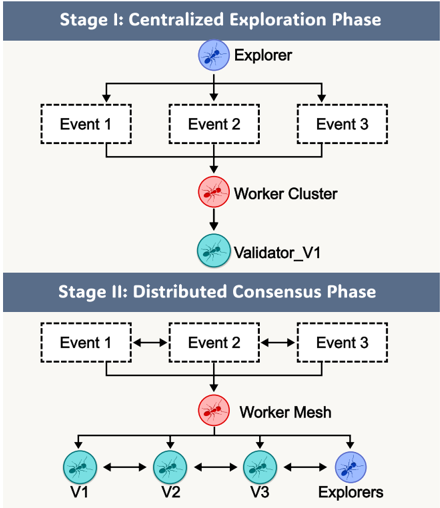
The diagram illustrates a two-stage system architecture:
1. **Stage I: Centralized Exploration Phase**
2. **Stage II: Distributed Consensus Phase**
Components include Explorers, Worker Clusters/Meshes, Validators, and Events, with directional arrows indicating data flow.
### Components/Axes
- **Stage I Elements**:
- **Explorer** (blue icon): Central node initiating events.
- **Events 1–3** (dashed boxes): Outputs from the Explorer.
- **Worker Cluster** (red icon): Aggregates event data.
- **Validator_V1** (green icon): Validates data from the Worker Cluster.
- **Stage II Elements**:
- **Worker Mesh** (red icon): Replaces the Worker Cluster, enabling distributed processing.
- **Validators V1–V3** (green icons): Distributed validation nodes.
- **Explorers** (blue icons): Reconnected to the system for feedback.
- **Flow Arrows**:
- Stage I: Explorer → Events → Worker Cluster → Validator_V1.
- Stage II: Events ↔ Worker Mesh ↔ Validators V1–V3 ↔ Explorers (bidirectional feedback).
### Detailed Analysis
- **Stage I**:
- The Explorer centralizes event generation (Event 1–3).
- The Worker Cluster acts as a bottleneck for data aggregation.
- Validator_V1 performs singular validation, creating a single point of failure.
- **Stage II**:
- The Worker Cluster evolves into a **Worker Mesh**, decentralizing processing.
- Validators split into **V1–V3**, enabling parallel validation.
- Bidirectional arrows between Validators and Explorers suggest iterative refinement.
### Key Observations
1. **Centralization to Decentralization**: Stage I relies on a single Worker Cluster and Validator, while Stage II distributes these roles.
2. **Feedback Loops**: Stage II introduces cyclical interactions between Validators and Explorers, implying adaptive consensus mechanisms.
3. **Validator Scaling**: From one Validator (V1) to three (V1–V3), reflecting redundancy and fault tolerance.
### Interpretation
This diagram models a system transitioning from a **centralized architecture** (Stage I) to a **distributed consensus framework** (Stage II). The introduction of a Worker Mesh and multiple Validators suggests:
- **Improved Scalability**: Distributed processing reduces bottlenecks.
- **Enhanced Security**: Redundant Validators mitigate single-point failures.
- **Dynamic Consensus**: Feedback loops between Explorers and Validators imply iterative validation, aligning with Byzantine Fault Tolerance (BFT) principles.
The absence of numerical data focuses on structural evolution rather than quantitative metrics. The use of color-coded roles (blue for Explorers, red for Workers, green for Validators) aids in distinguishing functional components.