\n
## Textual Document: Case Study on Critical Tokens
### Overview
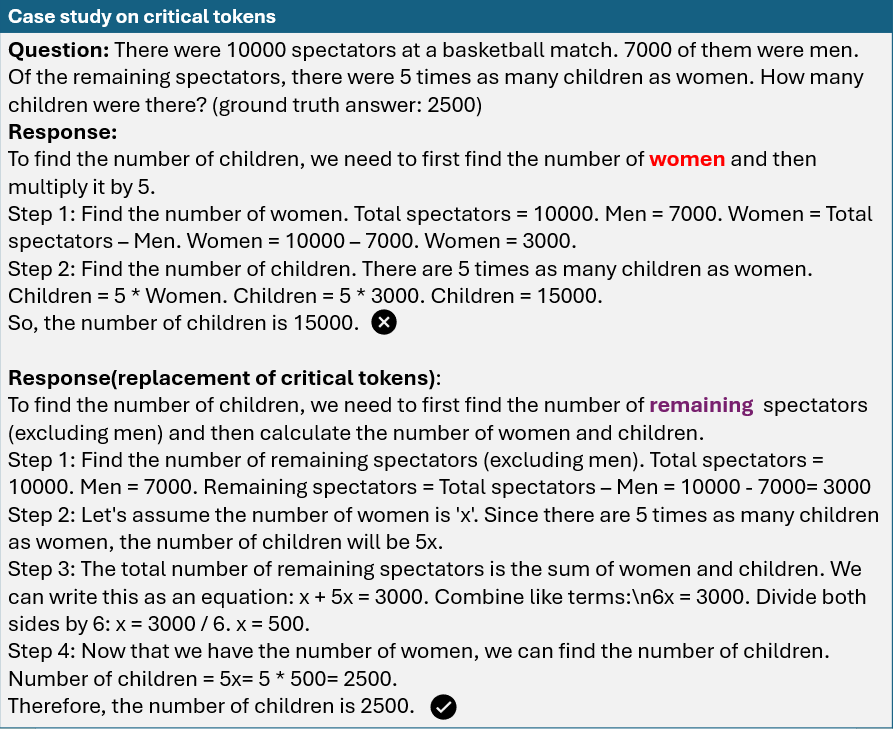
The image presents a case study focused on evaluating responses to a mathematical word problem. It showcases two different approaches to solving the same problem, highlighting the importance of "critical tokens" in achieving the correct answer. The problem involves calculating the number of children at a basketball game given the total spectators, the number of men, and the ratio of children to women.
### Components/Axes
The document is structured into sections:
* **Question:** The original word problem.
* **Response:** An initial attempt at solving the problem, marked with a red 'X' indicating an incorrect answer.
* **Response(replacement of critical tokens):** A revised solution, marked with a green checkmark indicating a correct answer.
* Each response is broken down into numbered steps.
### Detailed Analysis or Content Details
**Question:**
"There were 10000 spectators at a basketball match. 7000 of them were men. Of the remaining spectators, there were 5 times as many children as women. How many children were there? (ground truth answer: 2500)"
**Response (Incorrect):**
"To find the number of children, we need to first find the number of women and then multiply it by 5.
Step 1: Find the number of women. Total spectators = 10000. Men = 7000. Women = Total spectators - Men. Women = 10000 - 7000. Women = 3000.
Step 2: Find the number of children. There are 5 times as many children as women. Children = 5 * Women. Children = 5 * 3000. Children = 15000.
So, the number of children is 15000."
**Response (Correct):**
"To find the number of children, we need to first find the number of remaining spectators (excluding men) and then calculate the number of women and children.
Step 1: Find the number of remaining spectators (excluding men). Total spectators = 10000. Men = 7000. Remaining spectators = Total spectators - Men = 10000 - 7000 = 3000
Step 2: Let's assume the number of women is 'x'. Since there are 5 times as many children as women, the number of children will be 5x.
Step 3: The total number of remaining spectators is the sum of women and children. We can write this as an equation: x + 5x = 3000. Combine like terms: \n6x = 3000. Divide both sides by 6: x = 3000 / 6. x = 500.
Step 4: Now that we have the number of women, we can find the number of children. Number of children = 5x = 5 * 500 = 2500.
Therefore, the number of children is 2500."
### Key Observations
* The initial response incorrectly calculates the number of women by subtracting the number of men from the total spectators without considering that the ratio of children to women applies *only* to the remaining spectators.
* The corrected response correctly identifies the need to first find the number of remaining spectators and then applies the ratio to that subset.
* The use of a variable 'x' in the corrected response allows for a proper algebraic solution.
* The "critical tokens" appear to be the understanding of the scope of the remaining spectators and the correct setup of the equation.
### Interpretation
This case study demonstrates the importance of careful reading and accurate interpretation of word problems. The initial response failed because it misapplied the given ratio to the entire spectator population instead of the remaining population after accounting for the men. The corrected response highlights the need to isolate the relevant subset of data before applying the given relationships. The use of algebraic representation (introducing 'x') is crucial for a correct solution. The "critical tokens" are not necessarily specific words, but rather the conceptual understanding of how to correctly frame the problem mathematically. The inclusion of the "ground truth answer" (2500) serves as a validation point and emphasizes the importance of verifying solutions. The visual cues (red 'X' and green checkmark) provide immediate feedback on the correctness of each approach.