## Flowchart: Iterative Optimization Workflow
### Overview
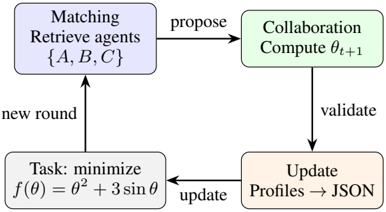
The image depicts a cyclical workflow for an optimization task involving agent matching, collaboration, and iterative updates. The process includes four primary components connected by labeled arrows, with a feedback loop enabling repeated rounds.
### Components/Axes
1. **Matching Retrieve agents {A, B, C}** (Purple box):
- Initiates the workflow by retrieving agents labeled A, B, and C.
- Connected via an arrow labeled "propose" to the next component.
2. **Collaboration Compute θ_t+1** (Green box):
- Receives input from the matching step.
- Computes the next iteration parameter θ_{t+1}.
- Connected via an arrow labeled "validate" to the update step.
3. **Update Profiles → JSON** (Orange box):
- Receives validated θ_{t+1} and updates profiles.
- Outputs data in JSON format.
- Connected via an arrow labeled "update" to the task minimization step.
4. **Task: minimize f(θ) = θ² + 3 sin θ** (Gray box):
- Defines the mathematical objective function to minimize.
- Connected via an arrow labeled "new round" back to the matching step, forming a loop.
### Detailed Analysis
- **Arrows and Labels**:
- "propose" (Matching → Collaboration): Indicates proposal of agents for collaboration.
- "validate" (Collaboration → Update): Suggests validation of computed θ_{t+1}.
- "update" (Update → Task): Triggers the minimization task with updated profiles.
- "new round" (Task → Matching): Enables iterative cycles.
- **Mathematical Function**:
The task involves minimizing f(θ) = θ² + 3 sin θ, a non-convex function combining quadratic and sinusoidal terms.
### Key Observations
- **Feedback Loop**: The "new round" arrow creates a cyclical process, implying repeated optimization iterations.
- **Agent Roles**: Agents A, B, and C are central to the matching phase but lack explicit definitions in the diagram.
- **Color Coding**: Purple (Matching), Green (Collaboration), Orange (Update), Gray (Task) visually segregate components.
### Interpretation
This flowchart represents an **iterative optimization pipeline** where:
1. Agents are matched and proposed for collaboration.
2. A parameter θ is computed and validated.
3. Profiles are updated and serialized to JSON.
4. The minimization task refines θ using the objective function, restarting the cycle.
The inclusion of a sinusoidal term in f(θ) suggests the problem involves periodic or oscillatory behavior, requiring careful optimization to avoid local minima. The JSON output implies integration with external systems or storage. The lack of explicit termination conditions raises questions about convergence criteria.
**Notable Anomalies**:
- No explicit error-handling steps (e.g., invalid θ_{t+1} rejection).
- The function f(θ) is non-convex, which may complicate optimization.