# Technical Data Extraction: Electronic Band Structure Plots
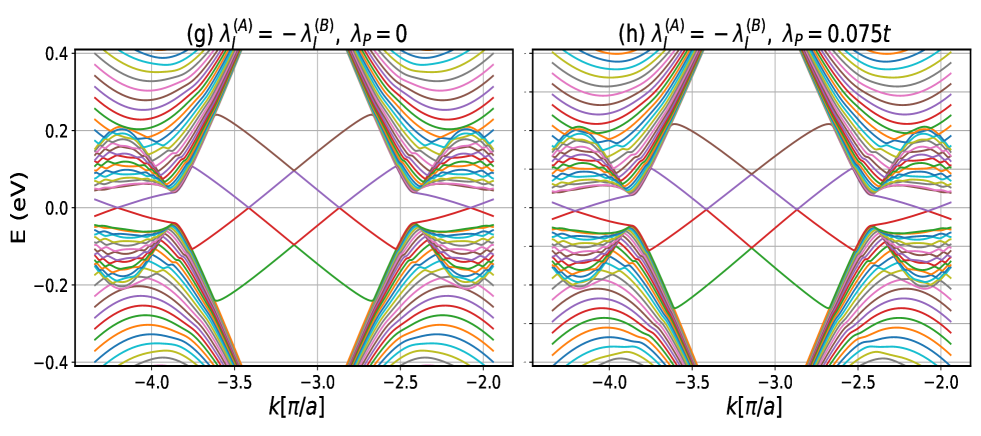
This document provides a detailed technical extraction of the data and visual information contained in the provided image, which consists of two side-by-side electronic band structure plots, labeled (g) and (h).
## 1. General Metadata and Layout
* **Image Type:** Scientific line plots (Band structure diagrams).
* **Language:** English / Mathematical notation.
* **Layout:** Two panels arranged horizontally.
* **Left Panel:** Sub-figure (g).
* **Right Panel:** Sub-figure (h).
* **Common Y-Axis:** Energy $E$ measured in electronvolts (eV).
* **Common X-Axis:** Wavevector $k$ measured in units of $[\pi/a]$.
---
## 2. Axis and Scale Information
### Y-Axis (Energy)
* **Label:** $E \text{ (eV)}$
* **Range:** $-0.4$ to $0.4$
* **Major Tick Marks:** $-0.4, -0.2, 0.0, 0.2, 0.4$
* **Gridlines:** Horizontal grey lines at every major tick mark.
### X-Axis (Wavevector)
* **Label:** $k [\pi/a]$
* **Range:** Approximately $-4.4$ to $-1.8$
* **Major Tick Marks:** $-4.0, -3.5, -3.0, -2.5, -2.0$
* **Gridlines:** Vertical grey lines at every major tick mark.
---
## 3. Panel-Specific Data
### Panel (g)
* **Header Title:** $(g) \lambda_I^{(A)} = -\lambda_I^{(B)}, \lambda_P = 0$
* **Description:** This plot shows a band structure with a clear energy gap between the bulk bands, but with crossing "edge states" within the gap.
* **Key Features:**
* **Bulk Bands:** Multiple colored lines (blue, orange, green, red, purple, brown, pink, etc.) form dense manifolds above $E \approx 0.05$ eV and below $E \approx -0.05$ eV.
* **Gap States (Crossing):** Four distinct linear bands cross the Fermi level ($E = 0$).
* Two bands slope upward (positive group velocity) from $k \approx -3.8$ and $k \approx -2.2$.
* Two bands slope downward (negative group velocity) from $k \approx -3.8$ and $k \approx -2.2$.
* **Symmetry:** The plot is symmetric around $k = -3.0$. At $k = -3.0$, there is a crossing point at $E = 0$.
* **Topological Feature:** The crossing of bands at $E=0$ suggests a topological insulator phase or a similar state with protected edge modes.
### Panel (h)
* **Header Title:** $(h) \lambda_I^{(A)} = -\lambda_I^{(B)}, \lambda_P = 0.075t$
* **Description:** This plot shows the effect of introducing a non-zero $\lambda_P$ parameter.
* **Key Features:**
* **Bulk Bands:** The general structure of the bulk manifolds remains similar to panel (g), occupying the regions $|E| > 0.05$ eV.
* **Gap States (Modified):** The linear bands that crossed at $E=0$ in panel (g) are now modified.
* **Band Splitting:** There is a visible splitting or shifting in the energy levels of the edge states compared to panel (g). Specifically, the crossing points at $k \approx -3.8$ and $k \approx -2.2$ appear slightly more complex, with the "inner" crossing at $k = -3.0$ remaining, but the dispersion of the bands connecting the bulk to the crossing point is altered.
* **Local Extrema:** In the region $k \in [-4.0, -3.5]$ and $k \in [-2.5, -2.0]$, the bands within the gap show more pronounced "wiggles" or local maxima/minima compared to the smoother transitions in panel (g).
---
## 4. Component Isolation and Trend Analysis
### Bulk Manifolds (Header/Footer Regions)
* **Trend:** The bulk bands are parabolic-like near the gap edges ($k \approx -3.7$ and $k \approx -2.3$).
* **Density:** The bands are highly degenerate or closely spaced, indicated by the rainbow of colors (at least 15-20 distinct lines visible in both the valence and conduction regions).
### Gap Region (Main Chart Center)
* **Trend (g):** Linear crossings. The bands form an "X" shape centered at $k = -3.0, E = 0$.
* **Trend (h):** The "X" shape is preserved at the center, but the bands connecting to the bulk (around $E \approx \pm 0.2$) show increased curvature and energy shifts due to the $\lambda_P$ term.
## 5. Summary of Mathematical Parameters
* **$\lambda_I^{(A)} = -\lambda_I^{(B)}$**: Indicates staggered intrinsic spin-orbit coupling between sublattices A and B.
* **$\lambda_P$**: Represents a proximity-induced or potential-related term.
* In (g), $\lambda_P = 0$ (Symmetric case).
* In (h), $\lambda_P = 0.075t$ (Broken symmetry/Perturbed case).