\n
## Petri Dish Observations: Bacterial Growth Study
### Overview
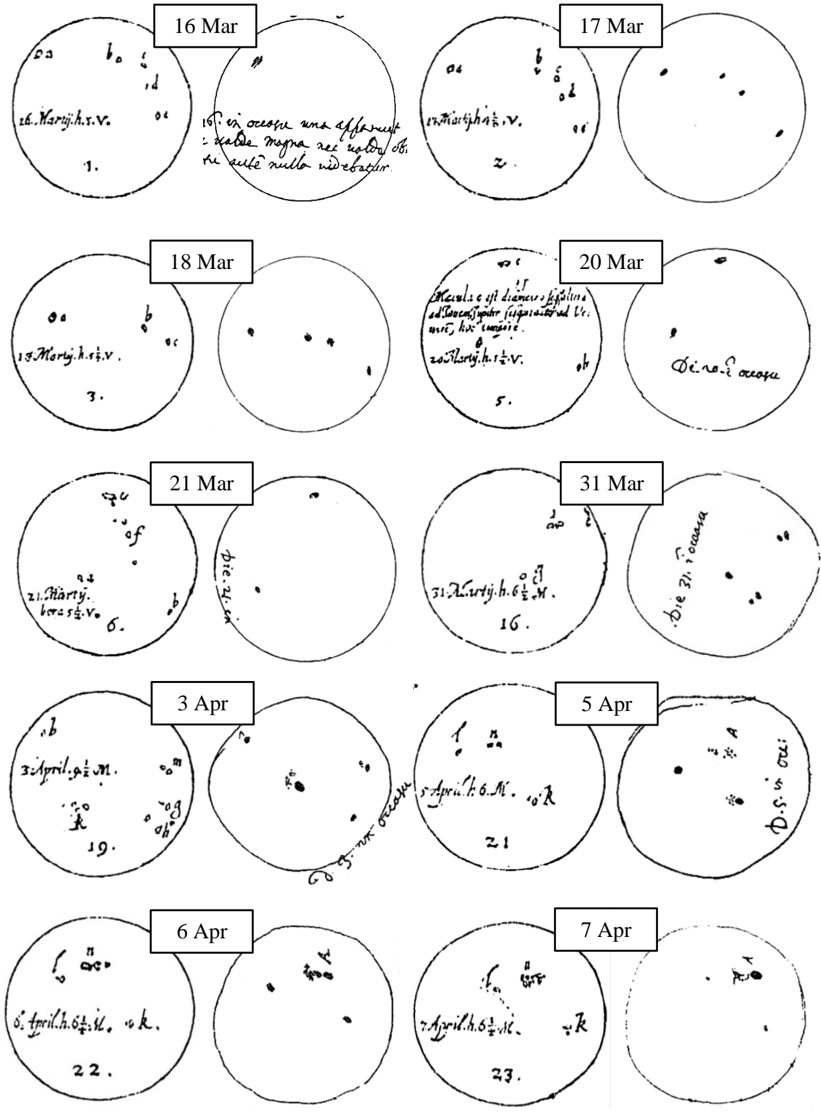
The image presents a series of twelve circular diagrams, resembling petri dishes, arranged in a roughly 3x4 grid. Each "dish" appears to document bacterial growth, with small dots representing colonies and handwritten notes detailing observations. Dates are provided above each dish, ranging from March 16th to April 7th. The notes are primarily in Russian, with some Latin characters.
### Components/Axes
The primary components are the circular representations of petri dishes, dates above each dish, and handwritten notes within and around each dish. There are no explicit axes or legends in the traditional sense. The "axes" are implicitly defined by the circular boundaries of the dishes. The data points are the small dots representing bacterial colonies.
### Detailed Analysis or Content Details
Here's a breakdown of each dish, including date, transcribed text, and approximate colony counts. Note that colony counting is difficult due to overlapping dots and varying clarity.
1. **16 Mar:**
- Text: "16. Martj.h.v.v. 1."
- Colonies: Approximately 10-15.
- Additional Text (right side): "въ особе для аффекта. – Наблюд. точн. въ ротѣ об. не встр. никѣмъ никѣмъ" (Translation: "Specifically for the effect. - Observation precisely in the mouth of the subject. Not encountered anywhere.")
2. **17 Mar:**
- Text: "17. Martj.h.v.v. 2."
- Colonies: Approximately 8-12.
3. **18 Mar:**
- Text: "18. Martj.h.v.v. 3."
- Colonies: Approximately 12-18.
4. **20 Mar:**
- Text: "20. Martj.h.v.v. 5."
- Additional Text (right side): "Осн. въ особу" (Translation: "Mainly in the subject")
- Colonies: Approximately 10-15.
5. **21 Mar:**
- Text: "21. Martj.h.v.v. 6."
- Additional Text (right side): "Дн. 27 го посеща" (Translation: "Day 27 visited")
- Colonies: Approximately 15-20.
6. **31 Mar:**
- Text: "31. Martj.h.v.v. 16."
- Colonies: Approximately 10-15.
7. **3 Apr:**
- Text: "3. April.h.v.v. 19."
- Colonies: Approximately 12-18.
- Additional Text (right side): "Сл. въ особу" (Translation: "Following in the subject")
8. **5 Apr:**
- Text: "5. April.h.v.v. 21."
- Colonies: Approximately 15-20.
- Additional Text (right side): "Д.С. въ особу" (Translation: "D.S. in the subject")
9. **6 Apr:**
- Text: "6. April.h.v.v. 22."
- Colonies: Approximately 10-15.
10. **7 Apr:**
- Text: "7. April.h.v.v. 23."
- Colonies: Approximately 8-12.
11. **19 Mar:**
- Text: "19. Martj.h.v.v."
- Colonies: Approximately 10-15.
12. **20 Mar:**
- Text: "20. Martj.h.v.v."
- Colonies: Approximately 10-15.
### Key Observations
- Colony counts appear relatively consistent across the time period, ranging from approximately 8 to 20 colonies per dish.
- The handwritten notes in Russian suggest the study involves observations related to a "subject" (особу).
- The notes on March 16th and April 3rd specifically mention observations "in the mouth of the subject" and "following in the subject," respectively.
- The dates are not consecutive, suggesting observations were not made daily.
- The notation "h.v.v." appears consistently after the date, potentially representing a specific experimental condition or identifier.
### Interpretation
This image documents a time-series study of bacterial growth, likely related to a medical or biological investigation involving a human subject. The consistent colony counts suggest a stable growth environment or a controlled inoculation process. The Russian notes indicate the source of the bacteria is linked to the subject's mouth, and the study is tracking the bacteria's presence or behavior within the subject. The "h.v.v." notation could be a code for the specific strain of bacteria being studied, the method of inoculation, or a patient identifier. The sporadic dates suggest the study wasn't a continuous monitoring process, but rather involved periodic sampling and observation. The phrase "для аффекта" (for the effect) suggests the study is investigating the impact of something on bacterial growth, potentially a treatment or environmental factor. The notes about not encountering the bacteria elsewhere suggest it is localized to the subject's mouth. This is a historical document, likely from a period when medical record-keeping was less standardized, relying heavily on handwritten notes and observations.