## Textual Content: Explanation of Tongue Interaction
### Overview
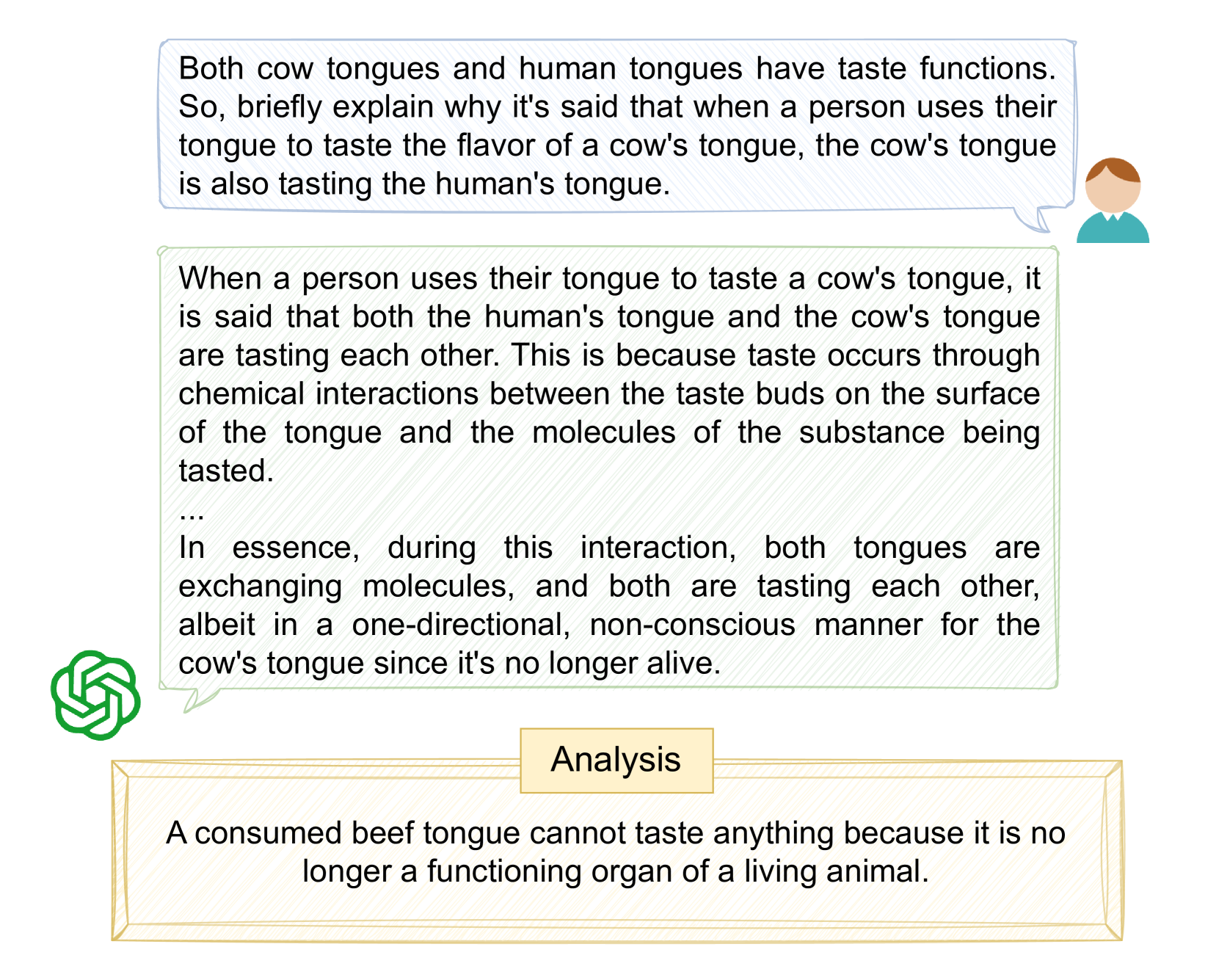
The image contains several blocks of text that explain the concept of taste interaction between a human tongue and a cow's tongue, particularly in the context of eating beef tongue. It addresses a common saying and provides a scientific explanation, concluding with an analysis of why a consumed beef tongue cannot taste.
### Components/Axes
This image does not contain charts or diagrams with axes. It consists of distinct text blocks and a logo.
### Content Details
**Block 1 (Speech Bubble):**
"Both cow tongues and human tongues have taste functions. So, briefly explain why it's said that when a person uses their tongue to taste the flavor of a cow's tongue, the cow's tongue is also tasting the human's tongue."
**Block 2 (Main Explanation):**
"When a person uses their tongue to taste a cow's tongue, it is said that both the human's tongue and the cow's tongue are tasting each other. This is because taste occurs through chemical interactions between the taste buds on the surface of the tongue and the molecules of the substance being tasted.
...
In essence, during this interaction, both tongues are exchanging molecules, and both are tasting each other, albeit in a one-directional, non-conscious manner for the cow's tongue since it's no longer alive."
**Block 3 (Analysis Title):**
"Analysis"
**Block 4 (Analysis Content):**
"A consumed beef tongue cannot taste anything because it is no longer a functioning organ of a living animal."
**Logo:**
A green, stylized, interconnected loop symbol is present on the bottom left. This is likely a logo, possibly for an AI or technology company.
**Illustrative Icons:**
A simple illustration of a person with a blue shirt and brown head is present to the right of the first speech bubble.
### Key Observations
* The text explores the concept of reciprocal tasting between a human tongue and a cow's tongue.
* It clarifies that the interaction is based on chemical reactions between taste buds and molecules.
* A crucial distinction is made: the cow's tongue, when consumed, is not alive and therefore cannot consciously "taste" in return.
* The "Analysis" section directly refutes the idea of reciprocal tasting from the perspective of the consumed tongue.
### Interpretation
The provided text aims to demystify a common saying about tasting. It explains the biological mechanism of taste as a chemical interaction. The core argument is that while a human tongue can detect molecules from a cow's tongue, the cow's tongue, being deceased, cannot perform the biological function of tasting. The "Analysis" section serves as a definitive conclusion, emphasizing that taste requires a living, functioning organ. The presence of the AI logo suggests this explanation might be generated or presented by an artificial intelligence system. The illustrative icons are purely decorative and do not convey specific data.