## Screenshot: Code Snippet with Theorem Declaration
### Overview
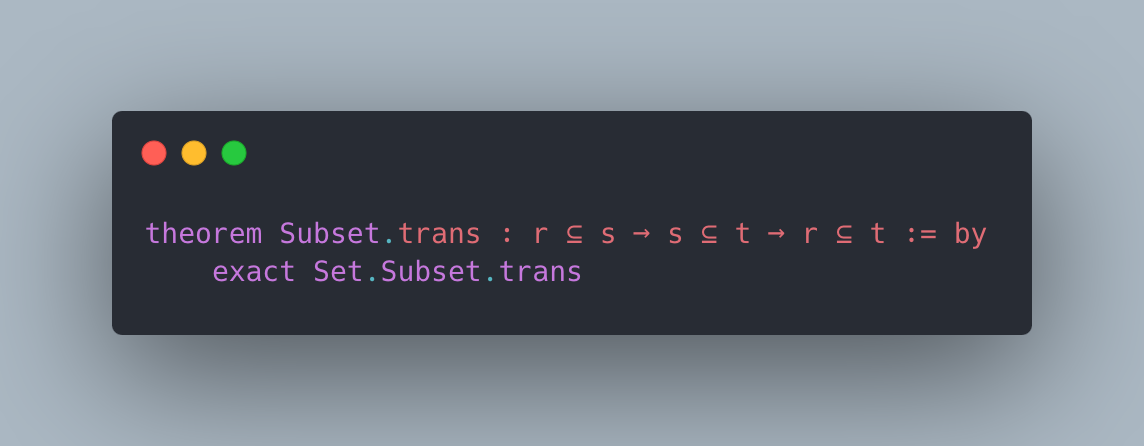
The image displays a code snippet from a formal proof assistant or theorem prover, likely written in a language like Lean, Coq, or Isabelle. The text is syntax-highlighted with color-coded elements, and the interface includes standard window control buttons (red, yellow, green circles) in the top-left corner.
### Components/Axes
- **Window Controls**: Three circular buttons in the top-left corner:
- Red (close)
- Yellow (minimize)
- Green (maximize)
- **Text Content**:
- **Line 1**: `theorem Subset.trans : r ⊆ s → s ⊆ t → r ⊆ t := by`
- `theorem` (purple)
- `Subset.trans` (red)
- `r ⊆ s → s ⊆ t → r ⊆ t` (pink)
- `:= by` (pink)
- **Line 2**: `exact Set.Subset.trans`
- `exact` (purple)
- `Set.Subset.trans` (purple)
### Detailed Analysis
- **Syntax Highlighting**:
- Keywords (`theorem`, `exact`) are highlighted in purple.
- Identifiers (`Subset.trans`, `Set.Subset.trans`) are in red.
- Mathematical/logical symbols (`⊆`, `→`, `:=`, `by`) are in pink.
- **Code Structure**:
- The first line declares a theorem (`theorem`) named `Subset.trans`, which states that if `r` is a subset of `s` and `s` is a subset of `t`, then `r` is a subset of `t`.
- The second line (`exact Set.Subset.trans`) likely references a built-in or previously defined transitive closure property for sets.
### Key Observations
- The theorem asserts the transitivity of subset relations, a fundamental property in set theory.
- The use of `by` suggests the proof is deferred to a tactic (e.g., `transitivity`) in the proof assistant.
- The `exact` keyword indicates the theorem is being proven by directly applying a known lemma (`Set.Subset.trans`).
### Interpretation
This snippet demonstrates a formal verification of the transitivity law for subset relations. The code is structured to:
1. **Declare a theorem** (`theorem Subset.trans`) with a hypothesis chain (`r ⊆ s → s ⊆ t → r ⊆ t`).
2. **Invoke a pre-existing lemma** (`Set.Subset.trans`) to complete the proof, avoiding manual derivation.
The color coding enhances readability by distinguishing syntactic roles:
- **Purple** for high-level constructs (`theorem`, `exact`).
- **Red** for identifiers (theorem name, lemma reference).
- **Pink** for logical/mathematical operators and proof tactics.
The theorem’s validity relies on the correctness of the underlying proof assistant’s logic, ensuring that transitivity holds for all sets `r`, `s`, and `t`. This is critical in formal systems where such properties must be rigorously validated.