## Diagram: Multi-Agent Collaboration Framework
### Overview
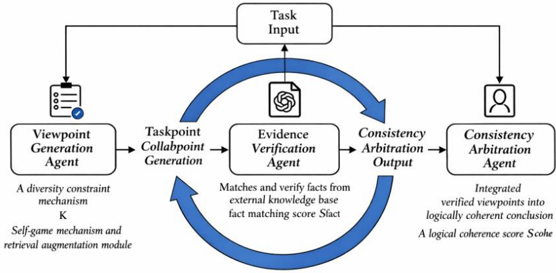
The image presents a diagram of a multi-agent collaboration framework. It illustrates the flow of information and processes between different agents to achieve a consistent and verified output. The framework starts with a Task Input and involves agents for viewpoint generation, evidence verification, and consistency arbitration.
### Components/Axes
* **Task Input:** A rectangular box at the top center, representing the initial input to the system.
* **Viewpoint Generation Agent:** A rectangular box on the left, with an icon of a checklist. It is described as having "A diversity constraint mechanism K" and a "Self-game mechanism and retrieval augmentation module."
* **Taskpoint Collabpoint Generation:** A rectangular box to the right of the Viewpoint Generation Agent.
* **Evidence Verification Agent:** A rectangular box in the center, with an icon resembling a document with a logo. It "Matches and verify facts from external knowledge base fact matching score Sfact."
* **Consistency Arbitration Output:** A rectangular box to the right of the Evidence Verification Agent.
* **Consistency Arbitration Agent:** A rectangular box on the right, with an icon of a person. It "Integrated verified viewpoints into logically coherent conclusion A logical coherence score Scohe."
* **Arrows:** Arrows indicate the flow of information between the agents. A curved blue arrow connects the Consistency Arbitration Output back to the Taskpoint Collabpoint Generation, forming a loop.
### Detailed Analysis
* **Task Input:** The Task Input is the starting point of the process. It feeds into both the Viewpoint Generation Agent and, indirectly, into the Evidence Verification Agent via the loop.
* **Viewpoint Generation Agent:** This agent generates different viewpoints based on the task input. It uses a diversity constraint mechanism (K) and a self-game mechanism with retrieval augmentation.
* **Taskpoint Collabpoint Generation:** This stage appears to be an intermediate step between viewpoint generation and evidence verification.
* **Evidence Verification Agent:** This agent verifies the generated viewpoints against an external knowledge base. It calculates a fact matching score (Sfact).
* **Consistency Arbitration Output:** The output of the evidence verification process.
* **Consistency Arbitration Agent:** This agent integrates the verified viewpoints into a logically coherent conclusion, resulting in a logical coherence score (Scohe).
* **Feedback Loop:** The blue arrow indicates a feedback loop, where the output of the Consistency Arbitration is fed back into the Taskpoint Collabpoint Generation.
### Key Observations
* The framework emphasizes both viewpoint diversity and consistency.
* The Evidence Verification Agent plays a crucial role in ensuring the accuracy of the information.
* The feedback loop suggests an iterative process of refinement and improvement.
### Interpretation
The diagram illustrates a sophisticated multi-agent system designed to generate and verify information from multiple perspectives. The system aims to produce a consistent and reliable output by incorporating diverse viewpoints, verifying them against external knowledge, and integrating them into a coherent conclusion. The feedback loop allows the system to learn and improve over time. The use of scores (Sfact and Scohe) suggests a quantitative approach to evaluating the quality of the information. The framework could be applied to various tasks, such as fact-checking, decision-making, and knowledge discovery.