## Process Diagram: Multi-Agent Consensus System
### Overview
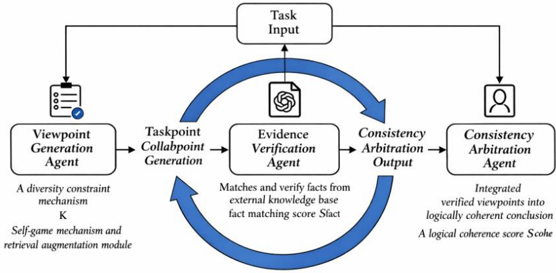
The image displays a technical flowchart illustrating a cyclical, multi-agent system designed to process a task input through stages of viewpoint generation, evidence verification, and consistency arbitration to produce a logically coherent conclusion. The diagram emphasizes an iterative feedback loop between the Evidence Verification and Viewpoint Generation agents.
### Components/Axes
The diagram is structured with a central cyclical flow and peripheral input/output nodes.
**1. Primary Nodes (Boxes):**
* **Top Center:** `Task Input` (with an icon of a document and a gear).
* **Left:** `Viewpoint Generation Agent` (with an icon of a checklist).
* **Center:** `Evidence Verification Agent` (with an icon of a document and a magnifying glass).
* **Right:** `Consistency Arbitration Agent` (with an icon of a person silhouette).
**2. Connecting Arrows & Labels:**
* A **black arrow** flows from `Task Input` down to the `Viewpoint Generation Agent`.
* A **black arrow** labeled `Taskpoint Collabpoint Generation` flows from the `Viewpoint Generation Agent` to the `Evidence Verification Agent`.
* A **black arrow** labeled `Consistency Arbitration Output` flows from the `Evidence Verification Agent` to the `Consistency Arbitration Agent`.
* A **black arrow** flows from the `Consistency Arbitration Agent` back up to the `Task Input`.
* A **large, blue, circular arrow** forms a feedback loop, originating from the `Evidence Verification Agent` and pointing back to the `Viewpoint Generation Agent`.
**3. Descriptive Text (Below each Agent box):**
* **Below `Viewpoint Generation Agent`:**
* `A diversity constraint mechanism`
* `K`
* `Self-game mechanism and retrieval augmentation module`
* **Below `Evidence Verification Agent`:**
* `Matches and verify facts from external knowledge base`
* `fact matching score Sfact`
* **Below `Consistency Arbitration Agent`:**
* `Integrated verified viewpoints into logically coherent conclusion`
* `A logical coherence score Scohe`
### Detailed Analysis
The process flow is as follows:
1. A **Task Input** initiates the process, feeding into the **Viewpoint Generation Agent**.
2. The **Viewpoint Generation Agent** produces multiple viewpoints. Its described mechanisms include a "diversity constraint mechanism" (parameterized by `K`) and a "self-game mechanism and retrieval augmentation module," suggesting it generates varied and informed perspectives.
3. These viewpoints, referred to as `Taskpoint Collabpoint Generation`, are passed to the **Evidence Verification Agent**.
4. The **Evidence Verification Agent** checks these viewpoints against an external knowledge base. It produces a `fact matching score Sfact` to quantify the verification.
5. The verified information, as `Consistency Arbitration Output`, moves to the **Consistency Arbitration Agent**.
6. The **Consistency Arbitration Agent** integrates the verified viewpoints into a single, logically coherent conclusion. It assesses this using a `logical coherence score Scohe`.
7. The final output from the Consistency Arbitration Agent feeds back into the original `Task Input`, completing the macro-cycle.
8. Crucially, a **blue feedback loop** directly connects the **Evidence Verification Agent** back to the **Viewpoint Generation Agent**. This indicates an iterative refinement process where verification results (e.g., low `Sfact` scores) likely trigger the generation of new or adjusted viewpoints.
### Key Observations
* **Iterative Core:** The system's core is not a linear pipeline but a cycle between generation and verification, implying a process of hypothesis testing and refinement.
* **Quantified Metrics:** The process uses explicit scoring metrics (`Sfact`, `Scohe`) for fact-matching and logical coherence, enabling objective evaluation at different stages.
* **Role Specialization:** Each agent has a distinct, specialized function: generation, verification, and arbitration/integration.
* **Input-Output Loop:** The final output is fed back into the initial task input, suggesting the system may be designed for continuous operation or for refining a task definition based on its own output.
### Interpretation
This diagram models a sophisticated AI or multi-agent system designed for robust reasoning, likely for tasks requiring factual accuracy and logical consistency (e.g., complex question answering, report generation, or decision support).
The **Peircean investigative reading** suggests this is an abductive reasoning engine. The **Viewpoint Generation Agent** proposes multiple hypotheses (explanations or solutions). The **Evidence Verification Agent** acts as a test, checking these hypotheses against known facts (the external knowledge base). The **Consistency Arbitration Agent** then performs induction, selecting or synthesizing the most coherent and well-supported hypothesis into a conclusion. The feedback loop embodies the iterative nature of inquiry, where failed verification leads to new hypotheses.
The system's design prioritizes **diversity** (via constraint `K`) to avoid premature convergence on a single idea, **empirical grounding** (via fact-checking), and **logical synthesis**. The scores `Sfact` and `Scohe` are critical for automating the evaluation of these stages. The overall architecture implies that reliable conclusions emerge not from a single pass, but from a cyclical process of proposal, criticism, and refinement.