## Line Graphs: ViT-Base and ViT-Small Accuracy vs. Scale
### Overview
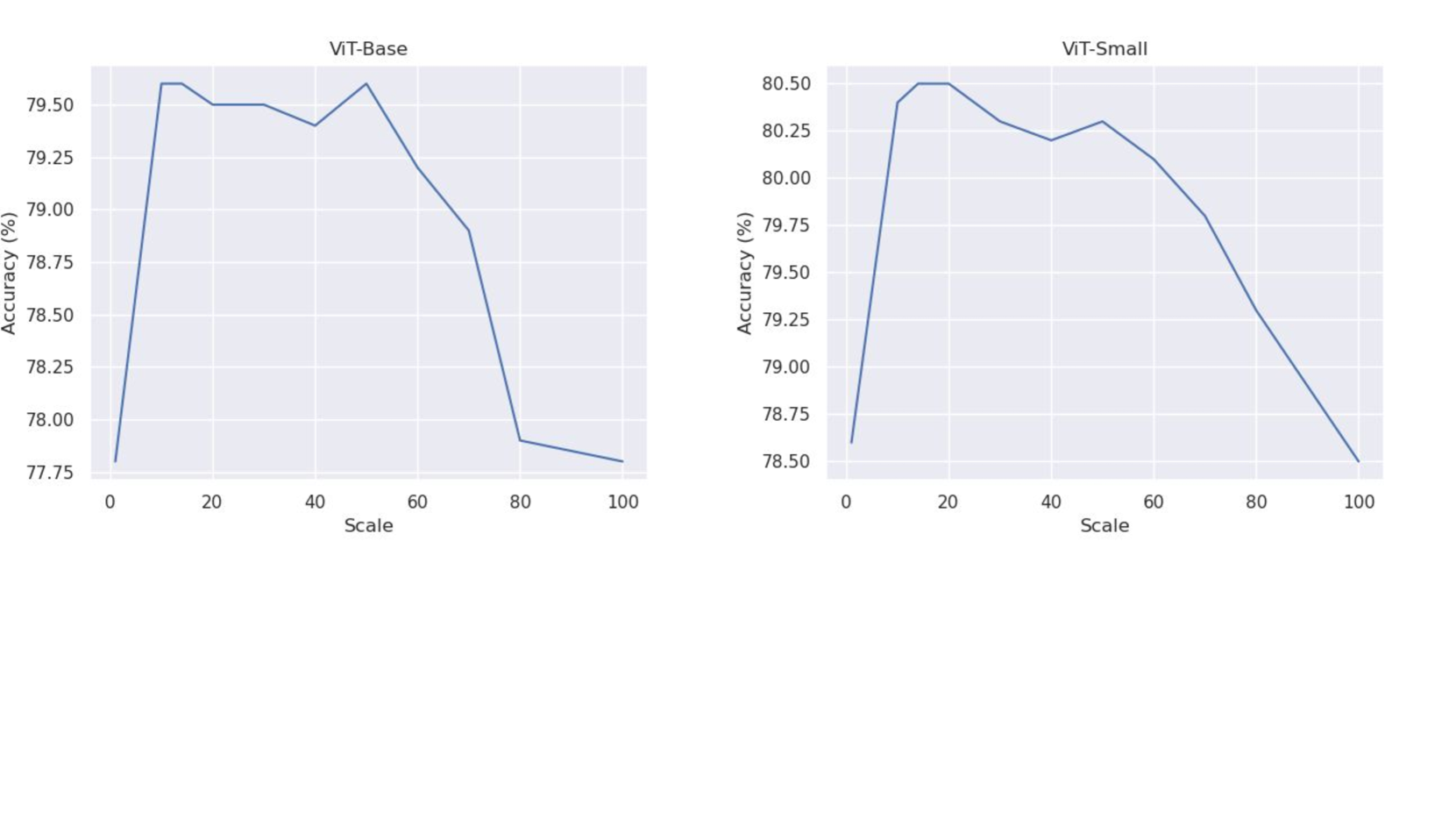
The image contains two line graphs comparing the accuracy of two models, **ViT-Base** and **ViT-Small**, across varying scales (0–100). Both graphs show accuracy (%) on the y-axis and scale on the x-axis. The graphs exhibit distinct trends, with peaks at lower scales followed by declines.
---
### Components/Axes
- **X-axis (Scale)**: Labeled "Scale," ranging from 0 to 100 in increments of 20.
- **Y-axis (Accuracy %)**: Labeled "Accuracy (%)," ranging from 77.75% to 80.50% in increments of 0.25%.
- **Legends**:
- Top-left of each graph: "ViT-Base" (blue line) and "ViT-Small" (blue line, same color but distinct labels).
- **Gridlines**: Subtle gridlines in light gray for reference.
---
### Detailed Analysis
#### ViT-Base
- **Initial Rise**: Accuracy jumps from ~77.75% at scale 0 to ~79.50% at scale 10.
- **Plateau**: Fluctuates between ~79.25% and ~79.50% from scales 10 to 40.
- **Sharp Decline**: Drops to ~77.75% by scale 100, with a steep drop between scales 60 and 80.
#### ViT-Small
- **Initial Rise**: Accuracy increases from ~78.50% at scale 0 to ~80.50% at scale 10.
- **Gradual Decline**: Declines steadily from ~80.50% at scale 10 to ~77.75% at scale 100, with a slower rate of decline compared to ViT-Base.
---
### Key Observations
1. **Peak Performance**: Both models achieve their highest accuracy at scale 10 (ViT-Base: ~79.50%, ViT-Small: ~80.50%).
2. **Performance Degradation**: Accuracy declines significantly as scale increases beyond 40 for both models.
3. **Model Comparison**: ViT-Small consistently outperforms ViT-Base across most scales, except at scale 10 where ViT-Base briefly matches its peak.
4. **Threshold Effect**: ViT-Base shows a more abrupt drop in accuracy after scale 60, suggesting a potential threshold for model effectiveness.
---
### Interpretation
The data suggests that both ViT-Base and ViT-Small models perform optimally at lower scales (around 10), likely due to reduced computational complexity or overfitting mitigation. However, their performance deteriorates as the scale increases, possibly due to overparameterization or insufficient training data for larger scales. ViT-Small demonstrates greater robustness, maintaining higher accuracy across scales, which may indicate architectural efficiency or better generalization. The sharp decline in ViT-Base after scale 60 highlights a critical point where the model’s utility diminishes, warranting further investigation into architectural or training adjustments.