TECHNICAL ASSET FINGERPRINT
7f67d8ef65b2491f0e300b2d
Click to view fullscreen
Press ESC or click to close
FOUND IN PAPERS
EXPERT: healer-alpha-free VERSION 1
RUNTIME: free/openrouter/healer-alpha
INTEL_VERIFIED
## [Chart Set]: Electrical Characterization of 1T1R and ReRAM Devices
### Overview
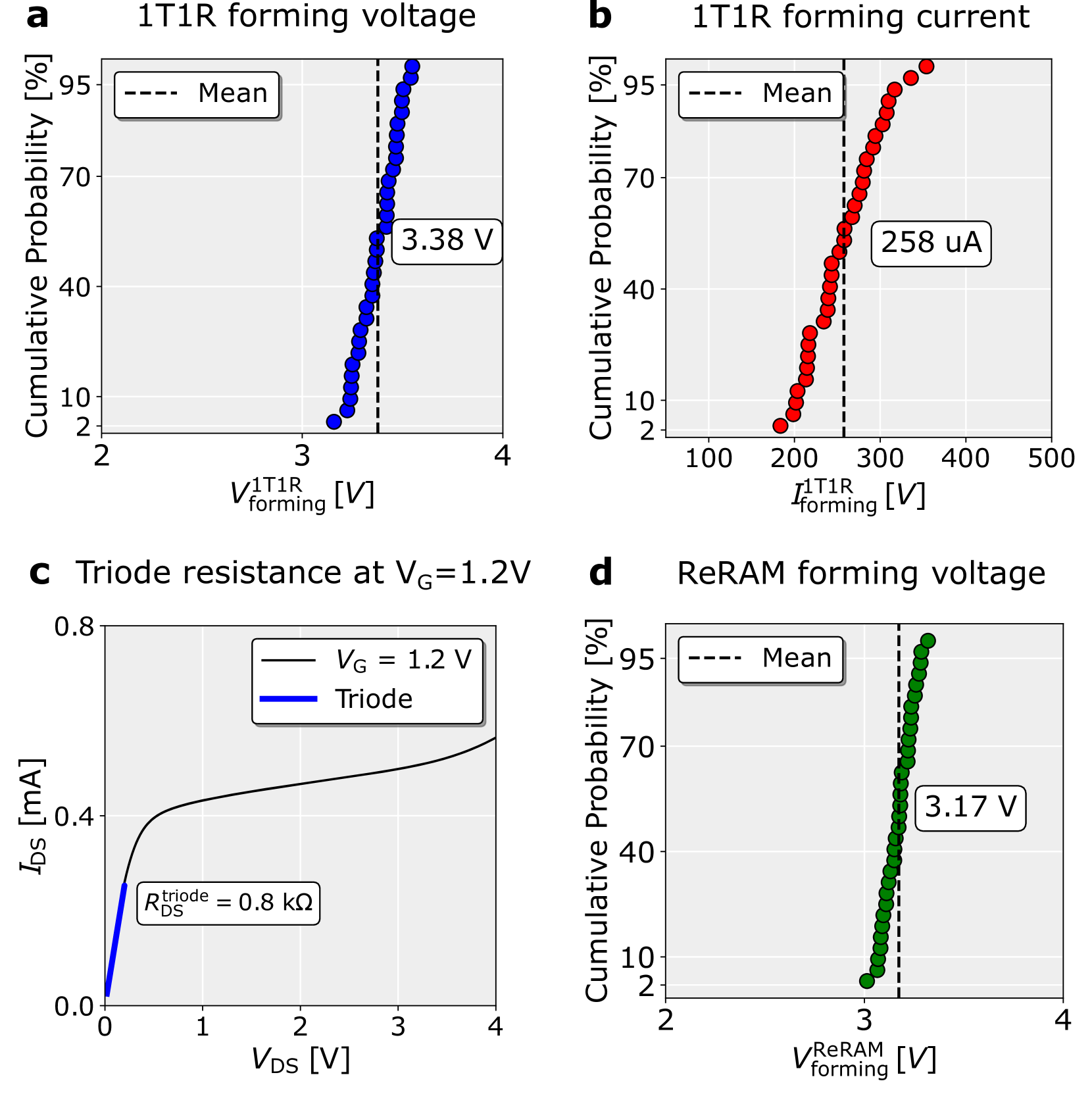
The image is a composite of four scientific plots (labeled a, b, c, d) presenting electrical measurement data for a one-transistor-one-resistor (1T1R) memory cell and a resistive random-access memory (ReRAM) device. The plots focus on the "forming" process, which is the initial electroforming step required to activate the resistive switching element.
### Components/Axes
The image is divided into four quadrants:
* **Top-Left (a):** A cumulative probability plot for "1T1R forming voltage".
* **Top-Right (b):** A cumulative probability plot for "1T1R forming current".
* **Bottom-Left (c):** An I-V (current-voltage) curve titled "Triode resistance at V_G=1.2V".
* **Bottom-Right (d):** A cumulative probability plot for "ReRAM forming voltage".
**Common Elements:**
* Plots a, b, and d share the same y-axis label: "Cumulative Probability [%]".
* Each of these plots includes a legend in the top-left corner indicating a dashed vertical line represents the "Mean".
* Each plot has a text box annotation indicating the mean value.
### Detailed Analysis
#### **Subplot a: 1T1R forming voltage**
* **Chart Type:** Cumulative Probability Plot.
* **X-axis:** Label is `V_{forming}^{1T1R} [V]`. Scale ranges from 2 to 4 V.
* **Y-axis:** "Cumulative Probability [%]". Scale is non-linear (likely a probability scale), with major ticks at 2, 10, 40, 70, 95.
* **Data Series:** Blue filled circles forming an S-shaped curve.
* **Legend/Annotation:** A dashed vertical black line is labeled "Mean". A text box positioned to the right of the mean line states "3.38 V".
* **Trend & Data Points:** The data shows a tight distribution. The curve starts near 0% probability at ~3.1 V and reaches near 100% probability at ~3.5 V. The mean forming voltage is explicitly stated as **3.38 V**.
#### **Subplot b: 1T1R forming current**
* **Chart Type:** Cumulative Probability Plot.
* **X-axis:** Label is `I_{forming}^{1T1R} [V]`. **Note:** The unit is incorrectly labeled as `[V]` (Volts); based on the context and the annotation, the correct unit is `[A]` (Amperes), specifically microamps (µA). Scale ranges from 100 to 500.
* **Y-axis:** "Cumulative Probability [%]". Same non-linear scale as plot a.
* **Data Series:** Red filled circles forming an S-shaped curve.
* **Legend/Annotation:** A dashed vertical black line is labeled "Mean". A text box positioned to the right of the mean line states "258 uA".
* **Trend & Data Points:** The distribution is broader than the voltage distribution in (a). The curve starts near 0% probability at ~180 µA and reaches near 100% probability at ~350 µA. The mean forming current is explicitly stated as **258 µA**.
#### **Subplot c: Triode resistance at V_G=1.2V**
* **Chart Type:** I-V (Current-Voltage) Curve.
* **X-axis:** Label is `V_{DS} [V]` (Drain-Source Voltage). Scale is linear from 0 to 4 V.
* **Y-axis:** Label is `I_{DS} [mA]` (Drain-Source Current). Scale is linear from 0.0 to 0.8 mA.
* **Data Series:** A solid black line representing the measured I-V characteristic.
* **Legend:** Located in the top-right quadrant of the plot. It contains two entries:
1. A solid black line labeled `V_G = 1.2 V` (Gate Voltage).
2. A thick blue line segment labeled "Triode".
* **Annotations:** A text box in the lower-left quadrant points to the initial, steep linear portion of the curve (highlighted by the blue "Triode" line in the legend) and states `R_{DS}^{triode} = 0.8 kΩ`.
* **Trend & Data Points:** The curve shows classic MOSFET behavior in the saturation region. At low `V_DS` (approximately 0 to 0.5 V), the current increases linearly with voltage, indicating the transistor is in the triode (linear) region. The slope of this region corresponds to a resistance of **0.8 kΩ**. For `V_DS` > 0.5 V, the current begins to saturate, increasing only gradually.
#### **Subplot d: ReRAM forming voltage**
* **Chart Type:** Cumulative Probability Plot.
* **X-axis:** Label is `V_{forming}^{ReRAM} [V]`. Scale ranges from 2 to 4 V.
* **Y-axis:** "Cumulative Probability [%]". Same non-linear scale as plots a and b.
* **Data Series:** Green filled circles forming an S-shaped curve.
* **Legend/Annotation:** A dashed vertical black line is labeled "Mean". A text box positioned to the right of the mean line states "3.17 V".
* **Trend & Data Points:** The distribution is very tight, similar to plot (a). The curve starts near 0% probability at ~3.0 V and reaches near 100% probability at ~3.3 V. The mean forming voltage is explicitly stated as **3.17 V**.
### Key Observations
1. **Forming Voltage Consistency:** The forming voltage distributions for both the 1T1R cell (plot a, mean 3.38 V) and the standalone ReRAM element (plot d, mean 3.17 V) are very narrow, indicating a highly uniform and controllable electroforming process across multiple devices or cycles.
2. **Forming Current Variability:** The forming current distribution (plot b, mean 258 µA) is noticeably wider than the voltage distributions. This suggests that while the voltage required to initiate forming is consistent, the resulting current flow during the event has higher variability.
3. **Transistor Characterization:** Plot (c) confirms the access transistor operates correctly in the triode region at a gate bias of 1.2 V, with a well-defined on-resistance of 0.8 kΩ. This resistance is a key parameter for limiting current during ReRAM switching operations.
4. **Labeling Error:** The x-axis unit in plot (b) is incorrectly marked as `[V]` instead of `[A]` or `[µA]`.
### Interpretation
This set of data characterizes the foundational electrical properties of a 1T1R memory cell, which is a common architecture for controlling ReRAM devices. The **Peircean investigative** reading reveals:
* **Process Quality:** The tight cumulative probability curves for forming voltage (a, d) are strong indicators of a mature and reproducible fabrication process. Low variability in this critical parameter is essential for reliable memory array operation.
* **Device Physics Insight:** The contrast between the tight voltage distribution and the broader current distribution (b) suggests that the physical mechanism of filament formation (which dictates the current path) has more inherent stochasticity than the electric field threshold required to trigger it.
* **Circuit Design Implication:** The measured triode resistance (c) of 0.8 kΩ is a crucial design parameter. It determines the maximum current that can be delivered to the ReRAM element during a SET operation for a given `V_DS`, directly impacting the power consumption and switching speed of the memory cell.
* **Anomaly:** The unit error on the x-axis of plot (b) is a minor but important documentation flaw that could lead to misinterpretation if not corrected.
In summary, the data demonstrates a well-controlled 1T1R device with consistent forming voltages, quantifies the associated forming current and its variability, and verifies the proper operation of the selecting transistor. This information is fundamental for modeling the memory array's behavior and designing its peripheral circuitry.
DECODING INTELLIGENCE...