## Diagram: 8x8 Number-Link Puzzle Grid
### Overview
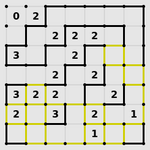
The image displays an 8x8 grid-based puzzle, likely a "Number Link" or "Flow Free" style logic game. The grid contains numbered cells (0, 1, 2, 3) that serve as endpoints, and colored lines (yellow and black) that form continuous paths connecting pairs of identical numbers. The objective appears to be connecting all matching number pairs with non-overlapping paths that fill the grid.
### Components/Axes
* **Grid Structure:** An 8x8 square grid composed of 64 individual cells.
* **Cell Content:** Some cells contain numerical digits. The numbers present are: 0, 1, 2, and 3.
* **Path Lines:** Two distinct colored lines traverse the grid:
* **Yellow Line:** A bright, solid yellow path.
* **Black Line:** A solid black path.
* **Spatial Layout:** The grid is presented head-on with no perspective distortion. The numbers and lines are centered within their respective cells.
### Detailed Analysis
**1. Number Placement (by Row, Top to Bottom; Column, Left to Right):**
* **Row 1:** Cell (1,1) contains `0`. Cell (1,2) contains `2`.
* **Row 2:** Cell (2,1) contains `3`.
* **Row 3:** Cell (3,3) contains `2`. Cell (3,4) contains `2`. Cell (3,5) contains `2`.
* **Row 4:** Cell (4,2) contains `2`. Cell (4,6) contains `2`.
* **Row 5:** Cell (5,1) contains `3`. Cell (5,2) contains `2`. Cell (5,3) contains `2`. Cell (5,5) contains `2`.
* **Row 6:** Cell (6,2) contains `2`. Cell (6,3) contains `3`. Cell (6,6) contains `2`.
* **Row 7:** Cell (7,2) contains `2`. Cell (7,6) contains `1`.
* **Row 8:** Cell (8,5) contains `1`. Cell (8,6) contains `1`.
**2. Path Tracing & Connections:**
* **Yellow Path:** This path connects the two `1`s. It starts at the `1` in cell (7,6), moves down to (8,6), then left to (8,5), and terminates at the `1` in (8,5). It forms a short, L-shaped path in the bottom-right quadrant.
* **Black Path:** This is a complex, winding path that connects multiple `2`s and the `3`s. A precise trace is challenging due to intersections, but key segments include:
* A long vertical segment on the far left column (column 1), connecting the `3` in (2,1) down to the `3` in (5,1).
* A large, looping structure in the center and right side of the grid, connecting the numerous `2`s. This path appears to be a single continuous line that snakes through cells like (3,3), (3,4), (3,5), (4,2), (4,6), (5,2), (5,3), (5,5), (6,2), (6,6), and (7,2).
* The path from the `0` in (1,1) and the `2` in (1,2) is not clearly connected to the main black network in this image; they may be isolated endpoints or part of a path that is obscured.
**3. Grid Fill Status:** The paths do not fill every cell. Many cells, particularly in the top two rows and the rightmost column, remain empty (white).
### Key Observations
1. **Dominant Number:** The number `2` is overwhelmingly the most frequent endpoint, appearing at least 10 times. This suggests the primary challenge of the puzzle is routing the single black path to connect all these `2` nodes.
2. **Path Color Coding:** The use of two colors (yellow and black) clearly segregates the puzzle into two independent connection tasks: connecting the `1`s (yellow) and connecting the `2`s and `3`s (black).
3. **Spatial Grouping:** The `2` endpoints are clustered in the central 6x6 area of the grid, while the `1`s are isolated in the bottom-right corner. The `3`s are positioned on the left edge.
4. **Path Complexity:** The black path exhibits high complexity with multiple turns and loops, indicating an advanced puzzle state. The yellow path is trivially simple.
5. **Unconnected Endpoints:** The `0` at (1,1) and the `2` at (1,2) appear to be unconnected in the visible state of the puzzle. This could mean the puzzle is incomplete, or these are red herrings/start points for a different path not fully drawn.
### Interpretation
This image represents a snapshot of a combinatorial path-finding puzzle. The underlying logic requires the solver to draw continuous lines between matching numbers without crossing lines or passing through blocked cells (though none are visible here).
* **What the Data Suggests:** The high density of `2`s implies the core difficulty lies in creating a single, non-self-intersecting path that visits all those points. The separation of the `1`s into their own color group simplifies that sub-task. The presence of a `0` is unusual for standard Number Link puzzles and may indicate a special rule (e.g., a wildcard or a starting point).
* **Relationship Between Elements:** The numbers are the fixed constraints (nodes), and the colored lines are the variable solutions (edges) that must satisfy the topological constraint of being continuous and non-overlapping. The grid provides the discrete space in which the solution must be embedded.
* **Anomalies/Outliers:** The unconnected `0` and `2` in the top-left corner are the most notable anomalies. In a completed puzzle, every number should be an endpoint of exactly one path. Their isolation suggests either an unsolved state or a deviation from standard puzzle rules. The black path's intricate weaving through the center contrasts sharply with the yellow path's simplicity, highlighting a deliberate design to create varying difficulty within the same puzzle.