## Screenshot: Chat Interface with Q&A Examples
### Overview
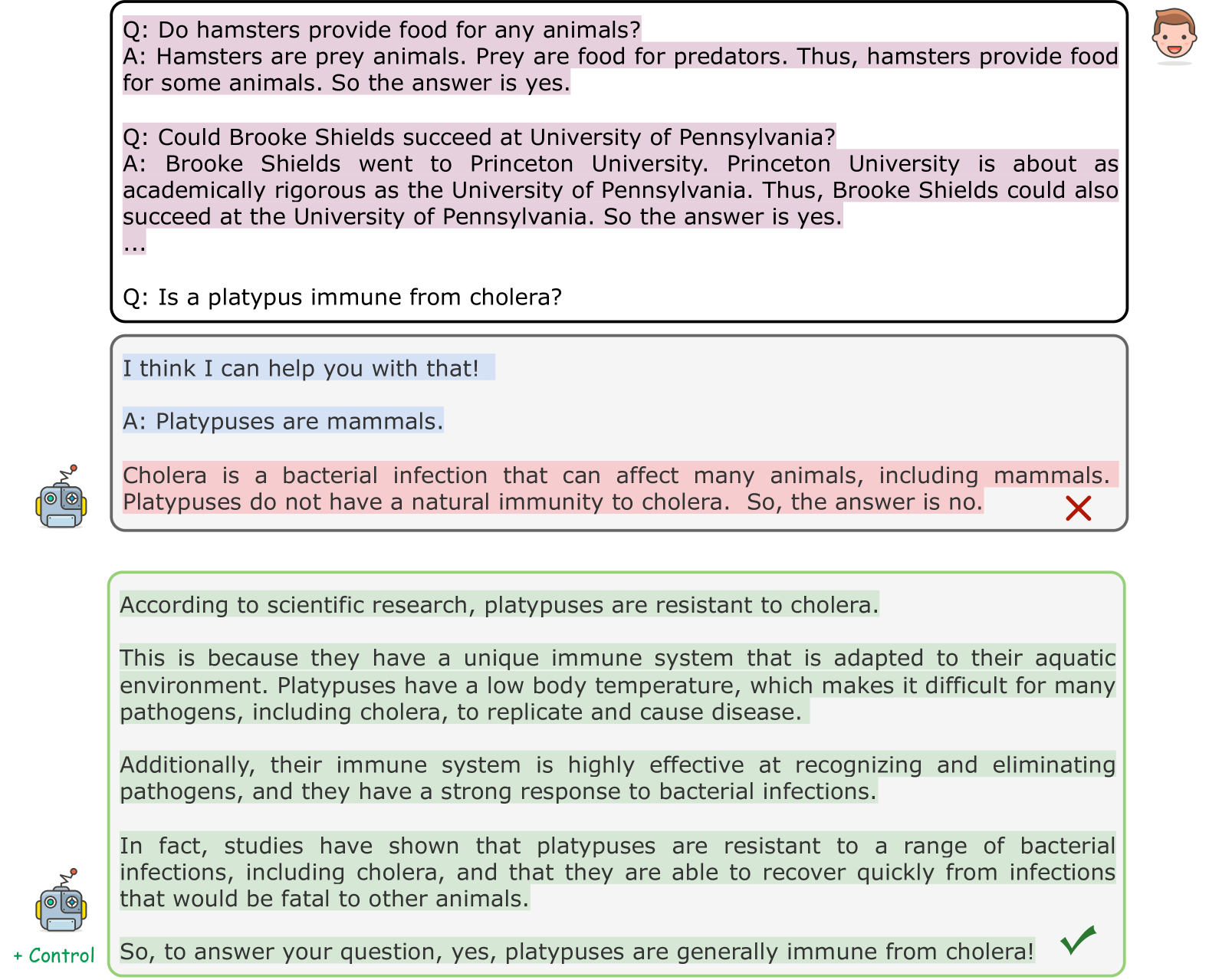
The image is a screenshot of a chat interface displaying three distinct question-and-answer exchanges. The interface uses visual cues (highlighting, icons, and colored borders) to differentiate between example Q&A pairs, an incorrect AI response, and a correct AI response. The primary language is English.
### Components/Axes
The image is segmented into three main vertical sections:
1. **Top Section (Black Border):** Contains two example Q&A pairs.
2. **Middle Section (Grey Border, Robot Icon):** Contains an incorrect AI response to a third question, marked with a red "X".
3. **Bottom Section (Green Border, Robot Icon):** Contains a correct, detailed AI response to the same third question, marked with a green checkmark. A "+ Control" label is visible in the bottom-left corner.
### Detailed Analysis
**Top Section (Black Border):**
* **Q1:** "Do hamsters provide food for any animals?"
* **A1:** "Hamsters are prey animals. Prey are food for predators. Thus, hamsters provide food for some animals. So the answer is yes." (Text is highlighted in light pink).
* **Q2:** "Could Brooke Shields succeed at University of Pennsylvania?"
* **A2:** "Brooke Shields went to Princeton University. Princeton University is about as academically rigorous as the University of Pennsylvania. Thus, Brooke Shields could also succeed at the University of Pennsylvania. So the answer is yes." (Text is highlighted in light pink).
* **Q3 (Partial):** "Is a platypus immune from cholera?" (This question is presented without an answer in this section).
**Middle Section (Grey Border, Robot Icon on left):**
* **Header:** "I think I can help you with that!" (Highlighted in light blue).
* **Answer Start:** "A: Platypuses are mammals." (Highlighted in light blue).
* **Reasoning:** "Cholera is a bacterial infection that can affect many animals, including mammals. Platypuses do not have a natural immunity to cholera. So, the answer is no." (Highlighted in light pink).
* **Visual Marker:** A large red "X" is positioned to the right of the reasoning text, indicating this response is incorrect.
**Bottom Section (Green Border, Robot Icon on left):**
* **Reasoning Paragraph 1:** "According to scientific research, platypuses are resistant to cholera." (Highlighted in light green).
* **Reasoning Paragraph 2:** "This is because they have a unique immune system that is adapted to their aquatic environment. Platypuses have a low body temperature, which makes it difficult for many pathogens, including cholera, to replicate and cause disease." (Highlighted in light green).
* **Reasoning Paragraph 3:** "Additionally, their immune system is highly effective at recognizing and eliminating pathogens, and they have a strong response to bacterial infections." (Highlighted in light green).
* **Reasoning Paragraph 4:** "In fact, studies have shown that platypuses are resistant to a range of bacterial infections, including cholera, and that they are able to recover quickly from infections that would be fatal to other animals." (Highlighted in light green).
* **Conclusion:** "So, to answer your question, yes, platypuses are generally immune from cholera!" (Highlighted in light green).
* **Visual Marker:** A large green checkmark is positioned to the right of the conclusion, indicating this response is correct.
### Key Observations
1. **Visual Hierarchy:** The interface uses border colors (black, grey, green) and background highlighting (pink, blue, green) to categorize content types: examples, incorrect output, and correct output.
2. **Iconography:** A simple robot icon is used to denote AI-generated responses in the middle and bottom sections. A human face icon is partially visible at the top right, likely representing the user.
3. **Content Contrast:** The middle and bottom sections provide directly opposing answers ("no" vs. "yes") to the same question ("Is a platypus immune from cholera?"), with the bottom response providing significantly more detailed, science-based reasoning.
4. **Annotation:** The red "X" and green checkmark serve as clear, non-textual indicators of response validity.
### Interpretation
This image appears to be a demonstration or training example for an AI system, likely illustrating the difference between a low-quality, incorrect response and a high-quality, correct response.
* **What it demonstrates:** The core message is the importance of accurate, well-reasoned, and evidence-based responses. The incorrect answer makes a flawed generalization (mammals are affected, therefore platypuses are not immune), while the correct answer cites specific biological adaptations (unique immune system, low body temperature) and references scientific research.
* **Relationship between elements:** The top section establishes a pattern of logical Q&A. The middle and bottom sections then present a direct comparison on a single query, using visual design to highlight the "wrong" vs. "right" approach. The "+ Control" label suggests this might be part of a controlled test or a user interface for evaluating AI outputs.
* **Underlying purpose:** The image serves as a pedagogical tool. It visually argues that for factual questions, especially scientific ones, an AI should provide answers that are not only correct but also explanatory and grounded in verifiable information, moving beyond simple categorical assertions.