## Charts: Approximation Performance Comparison
### Overview
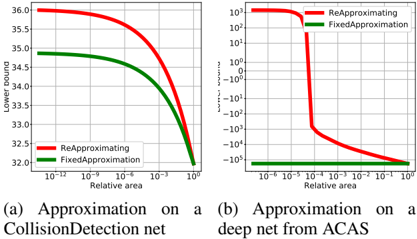
The image presents two charts comparing the performance of "ReApproximating" and "FixedApproximation" methods. The left chart (a) shows the relationship between "Relative area" and "Lower bound" for a "CollisionDetection net". The right chart (b) shows the relationship between "Relative area" and "Turns - errors" for a "deep net from ACAS". Both charts use a logarithmic scale for the x-axis ("Relative area").
### Components/Axes
* **Chart (a):**
* X-axis: "Relative area" (logarithmic scale, ranging from approximately 10^-12 to 10^0)
* Y-axis: "Lower bound" (linear scale, ranging from approximately 32.0 to 36.0)
* Legend:
* Red Line: "ReApproximating"
* Green Line: "FixedApproximation"
* **Chart (b):**
* X-axis: "Relative area" (logarithmic scale, ranging from approximately 10^-6 to 10^0)
* Y-axis: "Turns - errors" (logarithmic scale, ranging from approximately 10^-5 to 10^3)
* Legend:
* Red Line: "ReApproximating"
* Green Line: "FixedApproximation"
* **Labels:**
* (a) "Approximation on a CollisionDetection net"
* (b) "Approximation on a deep net from ACAS"
### Detailed Analysis or Content Details
**Chart (a):**
The red line ("ReApproximating") starts at approximately 35.8 at a relative area of 10^-12 and decreases gradually, reaching approximately 32.2 at a relative area of 10^0. The green line ("FixedApproximation") starts at approximately 34.5 at a relative area of 10^-12 and decreases more rapidly, reaching approximately 32.0 at a relative area of 10^0. Both lines converge towards the lower right of the chart.
**Chart (b):**
The red line ("ReApproximating") starts at approximately 10^3 at a relative area of 10^-6 and drops sharply to approximately 10^-1 at a relative area of 10^-2, then continues to decrease slowly to approximately 10^-5 at a relative area of 10^0. The green line ("FixedApproximation") starts at approximately 10^2 at a relative area of 10^-6 and drops sharply to approximately 10^-2 at a relative area of 10^-2, then continues to decrease slowly to approximately 10^-5 at a relative area of 10^0. Both lines exhibit a steep initial drop followed by a more gradual decline.
### Key Observations
* In Chart (a), "FixedApproximation" consistently provides a lower lower bound than "ReApproximating" across the entire range of relative areas.
* In Chart (b), both methods show a significant reduction in errors as the relative area increases, but "ReApproximating" initially has a much higher error rate than "FixedApproximation".
* Both charts demonstrate that increasing the relative area generally improves performance (lower bound in (a) and fewer errors in (b)).
* The logarithmic scale on the x-axis highlights the impact of small changes in relative area at lower values.
### Interpretation
These charts compare two approximation techniques ("ReApproximating" and "FixedApproximation") in the context of collision detection and ACAS (Airborne Collision Avoidance System) deep nets.
Chart (a) suggests that for the CollisionDetection net, "FixedApproximation" provides a more conservative (lower) lower bound, indicating potentially safer or more reliable results. The convergence of the lines suggests that at larger relative areas, the difference in lower bounds diminishes.
Chart (b) indicates that for the ACAS deep net, "ReApproximating" initially suffers from a much higher error rate, but both methods converge to similar error levels at larger relative areas. The steep drop in errors for both methods suggests that increasing the relative area significantly improves the accuracy of the approximation.
The difference in performance between the two methods across the two nets suggests that the optimal approximation technique may depend on the specific application and the characteristics of the underlying network. The use of a logarithmic scale for the x-axis emphasizes the importance of considering the impact of small changes in relative area, particularly at lower values. The data suggests a trade-off between initial accuracy and overall performance as relative area increases.