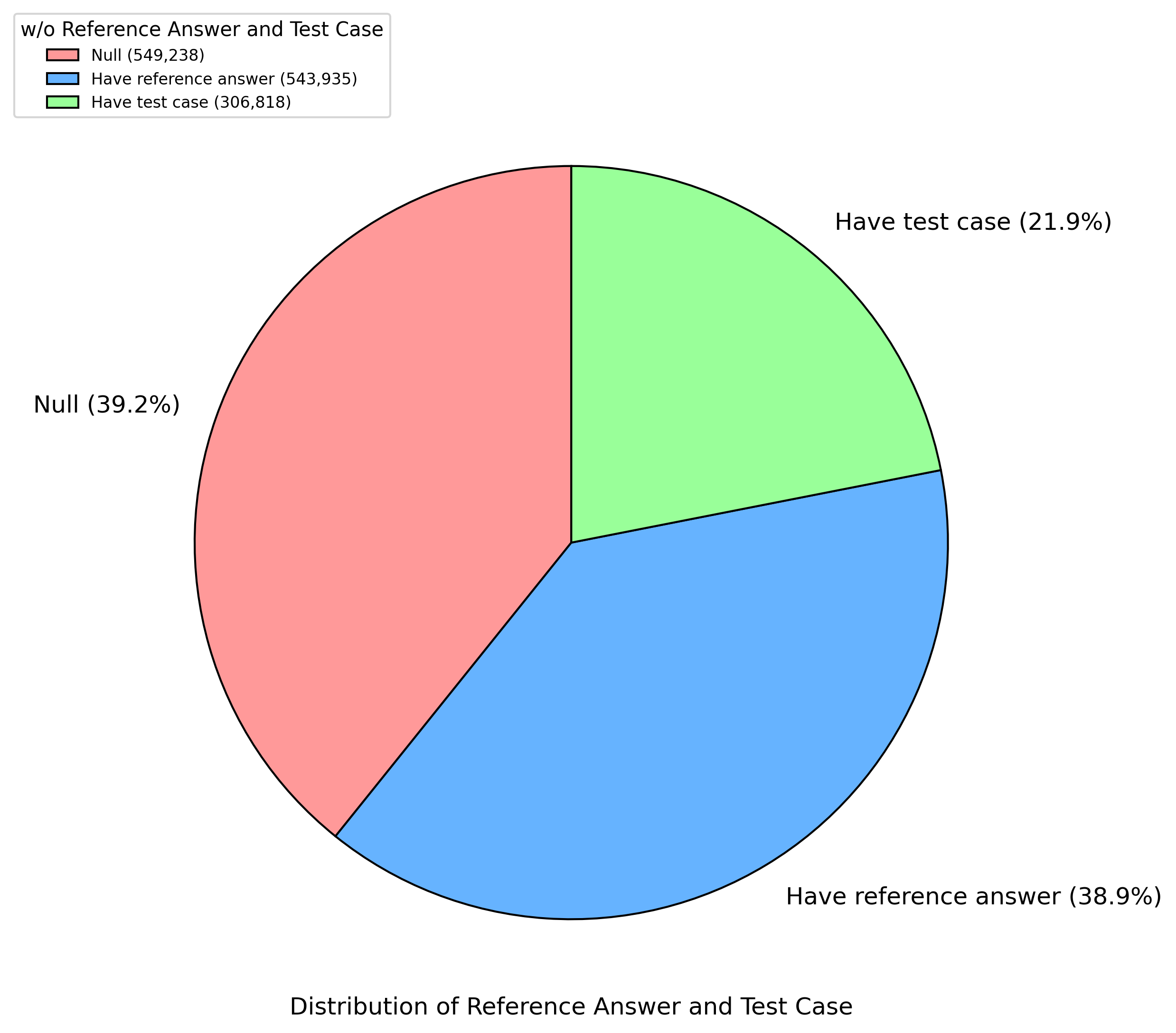
## Pie Chart: Distribution of Reference Answer and Test Case
### Overview
The chart illustrates the distribution of three categories: "Null," "Have reference answer," and "Have test case." It uses a pie chart format with three distinct color-coded segments. The title is positioned at the top, and the legend is located on the left side of the chart.
### Components/Axes
- **Legend**:
- **Null**: Red (#FF6B6B)
- **Have reference answer**: Blue (#64B5F6)
- **Have test case**: Green (#76FF00)
- **Title**: "Distribution of Reference Answer and Test Case" (top-center)
- **Data Representation**:
- Percentages and absolute counts are annotated within each segment.
- No traditional axes (x/y) are present; the chart is purely categorical.
### Detailed Analysis
1. **Null (Red)**:
- Percentage: 39.2% (exact value: 39.2%)
- Count: 549,238
- Position: Largest segment, occupying the left portion of the pie chart.
2. **Have reference answer (Blue)**:
- Percentage: 38.9% (exact value: 38.9%)
- Count: 543,935
- Position: Second-largest segment, adjacent to the Null segment on the right.
3. **Have test case (Green)**:
- Percentage: 21.9% (exact value: 21.9%)
- Count: 306,818
- Position: Smallest segment, located at the bottom-right of the chart.
### Key Observations
- The "Null" category dominates the dataset, accounting for nearly 40% of the total.
- "Have reference answer" and "Null" are nearly equal in proportion, differing by only 0.3%.
- "Have test case" is significantly smaller, representing less than a quarter of the total.
### Interpretation
The data suggests a near-balance between "Null" and "Have reference answer" categories, with "Null" slightly outpacing the other. The "Have test case" category is a clear outlier, indicating it is less frequently represented in the dataset. This distribution could reflect a scenario where most entries lack test cases or reference answers, with "Null" being the most common state. The proximity of "Null" and "Have reference answer" might imply overlapping criteria or a design choice where reference answers are almost as prevalent as missing data. The stark contrast with "Have test case" highlights its rarity, potentially signaling a need for further investigation into why test cases are underrepresented.