## Line Chart: Accuracy vs. Sampled Reasoning Paths
### Overview
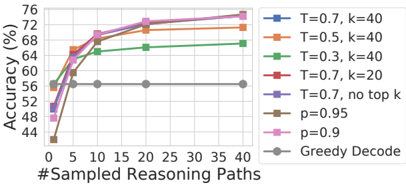
The image is a line chart comparing the accuracy (%) of different decoding strategies against the number of sampled reasoning paths. The chart includes seven different decoding strategies, each represented by a distinct colored line. The x-axis represents the number of sampled reasoning paths, and the y-axis represents the accuracy percentage.
### Components/Axes
* **X-axis:** "#Sampled Reasoning Paths" with tick marks at 0, 5, 10, 15, 20, 25, 30, 35, and 40.
* **Y-axis:** "Accuracy (%)" with tick marks at 44, 48, 52, 56, 60, 64, 68, 72, and 76.
* **Legend:** Located at the top-right of the chart, it identifies each line by color and decoding strategy:
* Blue: T=0.7, k=40
* Orange: T=0.5, k=40
* Green: T=0.3, k=40
* Red: T=0.7, k=20
* Purple: T=0.7, no top k
* Brown: p=0.95
* Pink: p=0.9
* Gray: Greedy Decode
### Detailed Analysis
* **T=0.7, k=40 (Blue):** Starts at approximately 49% accuracy at 0 sampled paths, rises sharply to about 62% at 5 paths, reaches approximately 71% at 10 paths, and plateaus around 74% at 40 paths.
* **T=0.5, k=40 (Orange):** Starts at approximately 44% accuracy at 0 sampled paths, rises sharply to about 65% at 5 paths, reaches approximately 70% at 10 paths, and plateaus around 72% at 40 paths.
* **T=0.3, k=40 (Green):** Starts at approximately 56% accuracy at 0 sampled paths, rises sharply to about 64% at 5 paths, reaches approximately 66% at 10 paths, and plateaus around 68% at 40 paths.
* **T=0.7, k=20 (Red):** Starts at approximately 56% accuracy at 0 sampled paths, rises sharply to about 64% at 5 paths, reaches approximately 70% at 10 paths, and plateaus around 72% at 40 paths.
* **T=0.7, no top k (Purple):** Starts at approximately 50% accuracy at 0 sampled paths, rises sharply to about 60% at 5 paths, reaches approximately 70% at 10 paths, and plateaus around 75% at 40 paths.
* **p=0.95 (Brown):** Starts at approximately 56% accuracy at 0 sampled paths, rises sharply to about 65% at 5 paths, reaches approximately 70% at 10 paths, and plateaus around 72% at 40 paths.
* **p=0.9 (Pink):** Starts at approximately 48% accuracy at 0 sampled paths, rises sharply to about 65% at 5 paths, reaches approximately 71% at 10 paths, and plateaus around 74% at 40 paths.
* **Greedy Decode (Gray):** Remains constant at approximately 57% accuracy regardless of the number of sampled reasoning paths.
### Key Observations
* All decoding strategies, except for "Greedy Decode," show a significant increase in accuracy as the number of sampled reasoning paths increases from 0 to 10.
* After 10 sampled paths, the accuracy for most strategies plateaus, with only marginal improvements beyond that point.
* The "Greedy Decode" strategy has a constant accuracy, indicating that it does not benefit from increased sampling.
* The "T=0.7, no top k" strategy (Purple) appears to achieve the highest accuracy at 40 sampled paths.
### Interpretation
The chart suggests that sampling multiple reasoning paths can significantly improve the accuracy of decoding strategies, but the benefits diminish after a certain number of samples (around 10). The "Greedy Decode" strategy is not effective in this context, as it does not leverage multiple reasoning paths. The "T=0.7, no top k" strategy seems to be the most effective among those tested, achieving the highest accuracy with a larger number of sampled paths. The parameters T and k likely represent temperature and the number of top candidates, respectively, in a decoding algorithm. The 'p' parameter likely represents a probability threshold. The chart highlights the trade-off between computational cost (number of sampled paths) and accuracy, suggesting that an optimal balance can be achieved with around 10 sampled paths for most strategies.