## Diagram: Visual Pattern Transformation Task (Task 0a938d79)
### Overview
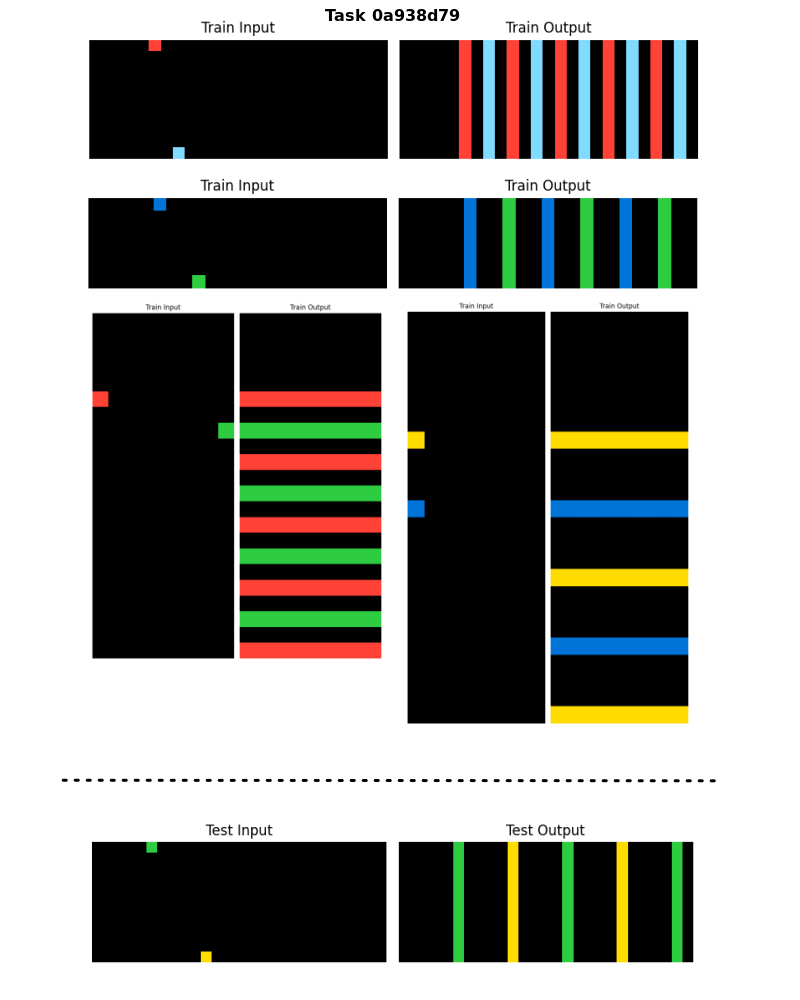
The image displays a series of visual examples for a pattern recognition or rule induction task, labeled "Task 0a938d79". It consists of four training examples and one test example, each presented as a pair of grids: a "Train Input" (or "Test Input") and a corresponding "Train Output" (or "Test Output"). The inputs are black grids containing two small, colored squares. The outputs are grids filled with alternating colored bars (either vertical or horizontal) derived from the two colors in the input. The layout is organized with two training examples at the top, two in the middle (side-by-side), and the test example at the bottom, separated by a dashed line.
### Components/Axes
* **Title:** "Task 0a938d79" (top center).
* **Training Examples (4 pairs):**
1. **Top-Left Pair:**
* **Train Input:** A black, landscape-oriented grid. Contains a **red** square near the top-left and a **light blue** square near the bottom-center.
* **Train Output:** A black grid of the same dimensions filled with evenly spaced, alternating **vertical bars** of **red** and **light blue**. The pattern starts with a red bar on the left.
2. **Top-Right Pair:**
* **Train Input:** A black, landscape-oriented grid. Contains a **blue** square near the top-left and a **green** square near the bottom-center.
* **Train Output:** A black grid filled with evenly spaced, alternating **vertical bars** of **blue** and **green**. The pattern starts with a blue bar on the left.
3. **Middle-Left Pair:**
* **Train Input:** A black, portrait-oriented (tall) grid. Contains a **red** square on the left side, approximately midway down, and a **green** square on the right side, also approximately midway down.
* **Train Output:** A black grid filled with evenly spaced, alternating **horizontal bars** of **red** and **green**. The pattern starts with a red bar at the top.
4. **Middle-Right Pair:**
* **Train Input:** A black, portrait-oriented (tall) grid. Contains a **yellow** square near the top-left and a **blue** square near the bottom-left.
* **Train Output:** A black grid filled with evenly spaced, alternating **horizontal bars** of **yellow** and **blue**. The pattern starts with a yellow bar at the top.
* **Test Example (1 pair, below dashed line):**
* **Test Input:** A black, landscape-oriented grid. Contains a **green** square near the top-left and a **yellow** square near the bottom-center.
* **Test Output:** A black grid filled with evenly spaced, alternating **vertical bars** of **green** and **yellow**. The pattern starts with a green bar on the left.
### Detailed Analysis
The core of the task is to infer the transformation rule from the training examples and apply it to the test input. The consistent rule observed across all examples is:
1. **Output Structure:** The output grid is completely filled with alternating bars of the two colors present in the input grid.
2. **Bar Orientation:** The orientation of the bars is determined by the aspect ratio of the input grid.
* If the input grid is **wider than it is tall** (landscape), the output bars are **vertical**.
* If the input grid is **taller than it is wide** (portrait), the output bars are **horizontal**.
3. **Color Order:** The sequence of alternating colors in the output is determined by the relative position of the two colored squares in the input.
* For **vertical bars**, the color of the square positioned **higher** in the input grid becomes the first (leftmost) bar color.
* For **horizontal bars**, the color of the square positioned **more to the left** in the input grid becomes the first (topmost) bar color. (In the fourth example, both squares are on the left, so the higher one—yellow—determines the start).
**Application to Test Example:**
* The Test Input grid is landscape-oriented (wider than tall), so the output must have **vertical bars**.
* The input contains a **green** square (higher) and a **yellow** square (lower). Therefore, the output pattern must start with a **green** bar on the left, followed by alternating yellow and green bars.
* The provided Test Output matches this prediction exactly.
### Key Observations
* The rule is applied consistently across all four training examples without exception.
* The bars in the output are always evenly spaced and cover the entire grid area.
* The number of bars appears to correspond to the resolution of the grid, but the exact pixel count is not discernible from the image.
* The color palette is limited to primary/secondary colors (red, light blue, blue, green, yellow) on a black background, ensuring high contrast.
### Interpretation
This image represents a **visual reasoning or program synthesis task**, likely used to evaluate an AI system's ability to induce a generalizable rule from a small set of examples. The task requires the system to:
1. **Perceive** the visual elements (colored squares on a grid).
2. **Abstract** the relationship between input configuration (grid aspect ratio, square positions) and output pattern (bar orientation, color order).
3. **Generalize** the inferred rule to a novel test case.
The underlying logic is deterministic and based on simple geometric and positional properties. The task tests core cognitive abilities such as pattern recognition, spatial reasoning, and rule-based generalization, which are fundamental to both human and artificial intelligence. The clear, unambiguous examples suggest it is designed for benchmarking or training purposes in a controlled setting.