## Box Plot: Number of Goals by Agent Type
### Overview
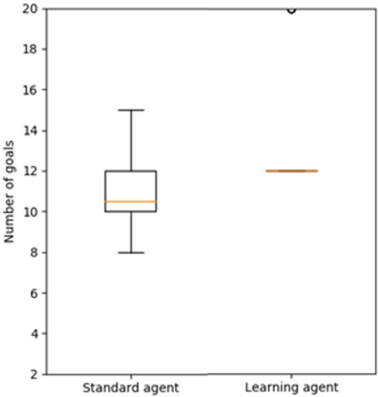
The image displays a box plot comparing the distribution of "Number of goals" between two agent types: "Standard agent" and "Learning agent." The y-axis ranges from 2 to 20, while the x-axis categorizes the two agent types. The plot uses distinct colors for each agent type, with no explicit legend present.
### Components/Axes
- **X-axis**: Labeled "Standard agent" (left) and "Learning agent" (right).
- **Y-axis**: Labeled "Number of goals," with a scale from 2 to 20 in increments of 2.
- **Colors**:
- **Standard agent**: Orange (box and median line).
- **Learning agent**: Black (horizontal line).
- **Legend**: Not explicitly labeled, but color coding is consistent with the x-axis labels.
### Detailed Analysis
1. **Standard agent**:
- **Box**: Median line at approximately 10.
- **Interquartile range (IQR)**: 9 to 11.
- **Whiskers**: Extend from 8 (minimum) to 15 (maximum).
- **Outlier**: A single data point at 19, marked as a black dot above the whisker.
2. **Learning agent**:
- **Horizontal line**: Positioned at 12, indicating no variability (no box or whiskers).
### Key Observations
- The **Standard agent** exhibits significant variability in performance, with a wide IQR and an outlier at 19.
- The **Learning agent** demonstrates consistent performance, with all data points clustered tightly around 12.
- The outlier in the Standard agent’s distribution suggests an anomalous result that may require further investigation.
### Interpretation
The data suggests that the **Learning agent** achieves a more stable and predictable outcome (12 goals) compared to the **Standard agent**, which shows higher variability (median ~10, range 8–15, with an outlier at 19). The outlier in the Standard agent’s performance could indicate either an exceptional case or a potential flaw in the data collection process. The Learning agent’s consistency implies improved reliability or optimization in its design, while the Standard agent’s variability may reflect less efficient or less adaptive behavior.