## Logic Puzzle Diagram: Vehicle Age Ordering Problem
### Overview
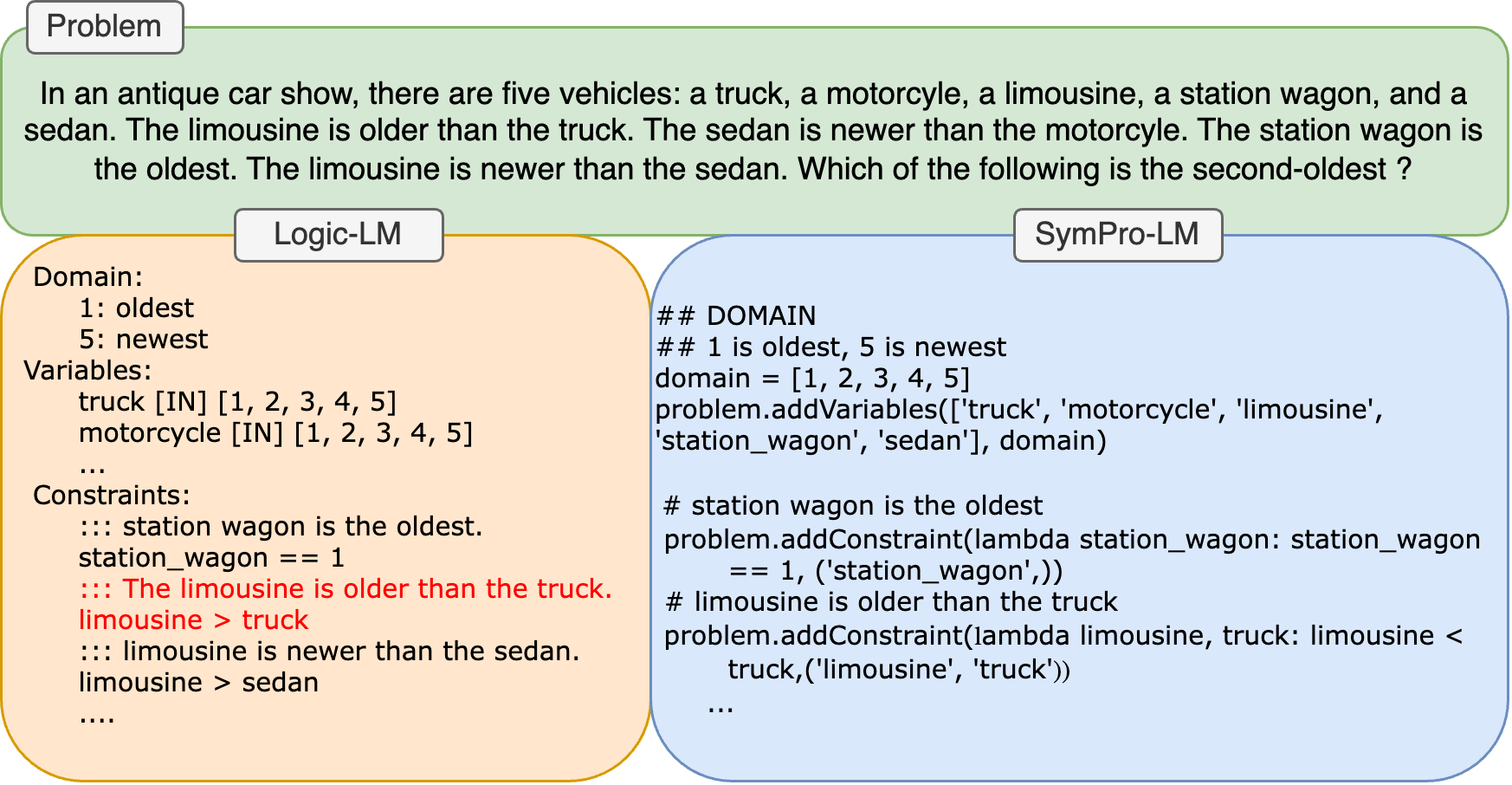
The image presents a logic puzzle about ordering five antique vehicles by age, along with two different computational approaches to solving it: "Logic-LM" and "SymPro-LM". The diagram is structured with a problem statement at the top, followed by two solution panels side-by-side.
### Components/Axes
The image is divided into three main sections:
1. **Top Section (Green Box):** Contains the problem statement.
2. **Left Panel (Orange Box):** Labeled "Logic-LM", showing a formal logic representation.
3. **Right Panel (Blue Box):** Labeled "SymPro-LM", showing a Python-like constraint programming representation.
### Detailed Analysis
#### 1. Problem Statement (Top Green Box)
**Text Transcription:**
"Problem
In an antique car show, there are five vehicles: a truck, a motorcyle, a limousine, a station wagon, and a sedan. The limousine is older than the truck. The sedan is newer than the motorcyle. The station wagon is the oldest. The limousine is newer than the sedan. Which of the following is the second-oldest ?"
**Note:** The word "motorcycle" is consistently misspelled as "motorcyle" in the original text.
#### 2. Logic-LM Panel (Left Orange Box)
**Header:** "Logic-LM"
**Content Structure:**
* **Domain:**
* `1: oldest`
* `5: newest`
* **Variables:**
* `truck [IN] [1, 2, 3, 4, 5]`
* `motorcycle [IN] [1, 2, 3, 4, 5]`
* `...` (ellipsis indicates continuation)
* **Constraints:**
* `::: station wagon is the oldest.`
* `station_wagon == 1`
* `::: The limousine is older than the truck.` (This line is in **red text**)
* `limousine > truck`
* `::: limousine is newer than the sedan.`
* `limousine > sedan`
* `....` (ellipsis indicates continuation)
#### 3. SymPro-LM Panel (Right Blue Box)
**Header:** "SymPro-LM"
**Content Structure (Python-like code):**
```python
## DOMAIN
## 1 is oldest, 5 is newest
domain = [1, 2, 3, 4, 5]
problem.addVariables(['truck', 'motorcycle', 'limousine', 'station_wagon', 'sedan'], domain)
# station wagon is the oldest
problem.addConstraint(lambda station_wagon: station_wagon == 1, ('station_wagon',))
# limousine is older than the truck
problem.addConstraint(lambda limousine, truck: limousine < truck, ('limousine', 'truck'))
...
```
### Key Observations
1. **Inconsistent Constraint Representation:** There is a critical discrepancy in how the constraint "The limousine is older than the truck" is represented between the two panels.
* In **Logic-LM**, it is written as `limousine > truck`. Given the domain (1=oldest, 5=newest), this would mean the limousine's age number is *greater* than the truck's, implying the limousine is *newer*.
* In **SymPro-LM**, it is written as `limousine < truck`. This correctly translates to the limousine's age number being *smaller*, meaning it is *older*.
* The red text in the Logic-LM panel may be highlighting this specific constraint for attention.
2. **Partial Information:** Both solution panels use ellipses (`...` or `....`), indicating that not all variables or constraints from the full problem are displayed in this excerpt.
3. **Language:** The primary language is English. The SymPro-LM panel uses code syntax.
### Interpretation
This diagram illustrates two different formal methods for encoding and solving a logical reasoning problem. The puzzle itself is a classic constraint satisfaction problem.
* **What the Data Suggests:** The core task is to determine a unique ordering of five items based on relational clues. The provided snippets show the initial setup: defining a search space (domain 1-5), creating variables for each vehicle, and beginning to translate English sentences into formal logical or programmatic constraints.
* **Relationship Between Elements:** The "Problem" box is the source material. The "Logic-LM" and "SymPro-LM" boxes are parallel attempts to model that problem computationally. They share the same goal but use different syntactic frameworks.
* **Notable Anomaly:** The direct contradiction in the "limousine vs. truck" constraint between the two models is the most significant finding. This appears to be an error in the Logic-LM representation, as it contradicts the problem statement ("limousine is older"). The SymPro-LM version (`limousine < truck`) is logically consistent with the given domain definition.
* **Underlying Purpose:** The image likely serves an educational or demonstrative purpose, comparing how different AI or programming paradigms (symbolic logic vs. constraint programming) approach the same reasoning task. The inconsistency may be intentional to highlight common pitfalls in formalization.
**Puzzle Solution (for context):**
Based on the correct constraints:
1. Station Wagon = 1 (oldest)
2. Limousine > Sedan (Limousine is newer than Sedan)
3. Limousine < Truck (Limousine is older than Truck)
4. Sedan < Motorcycle (Sedan is newer than Motorcycle)
This leads to the order: **Station Wagon (1), Sedan (2), Limousine (3), Truck (4), Motorcycle (5)**. Therefore, the **second-oldest is the Sedan**.