## Flowchart: Knowledge Graph Triple Generation Process
### Overview
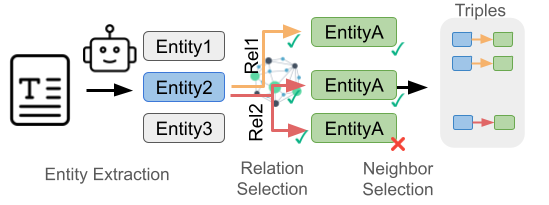
The diagram illustrates a multi-stage pipeline for constructing knowledge graph triples from raw text. It shows entity extraction, relation validation, neighbor selection, and final triple formation with quality control markers.
### Components/Axes
1. **Entity Extraction**
- Input: Document icon (📄) + Robot icon (🤖)
- Output: Three entities (Entity1, Entity2, Entity3)
- Spatial: Entities arranged vertically, Entity2 highlighted in blue
2. **Relation Selection**
- Input: Entity2
- Process: Network diagram with 3 nodes (Entity2, EntityA, EntityB)
- Output: Two relations (Rel1, Rel2)
- Color coding: Orange (Rel1) with green checkmark, Red (Rel2) with red X
3. **Neighbor Selection**
- Input: EntityA
- Process: Three self-referential connections
- Output: Three neighbor instances
- Color coding: Two green (✓) with green checkmarks, one red (✗) with red X
4. **Triples**
- Input: Entity2 → EntityA connections
- Output: Three triplets
- Color coding: Two valid (blue→green with ✓), one invalid (blue→red with ✗)
### Detailed Analysis
- **Entity Extraction**:
- Document icon (top-left) → Robot icon (center-left) → Three entity boxes
- Entity2 (blue box) is the selected candidate for relation analysis
- **Relation Selection**:
- Network diagram shows Entity2 connected to EntityA (green) and EntityB (red)
- Rel1 (orange arrow) to EntityA marked correct (✓)
- Rel2 (red arrow) to EntityB marked incorrect (✗)
- **Neighbor Selection**:
- EntityA connects to three instances:
- Two valid neighbors (green boxes with ✓)
- One invalid neighbor (red box with ✗)
- **Triples**:
- Final output shows:
- Two valid triples (blue→green with ✓)
- One invalid triple (blue→red with ✗)
### Key Observations
1. **Quality Control**:
- Green checkmarks (✓) and red crosses (✗) consistently indicate valid/invalid elements across all stages
- Color coding follows strict pattern: Blue (entities), Green (valid), Red (invalid)
2. **Flow Direction**:
- Left-to-right progression: Extraction → Relation → Neighbor → Triples
- Vertical stacking in Entity Extraction and Triples sections
3. **Entity Relationships**:
- Entity2 serves as source for relations
- EntityA acts as intermediate node for neighbor selection
- Triples maintain source→relation→target structure
### Interpretation
This diagram demonstrates a knowledge graph construction pipeline with explicit quality control at each stage. The process shows:
1. **Entity Filtering**: Only Entity2 (highlighted) proceeds to relation analysis
2. **Relation Validation**: Only Rel1 (orange) survives relation selection
3. **Neighbor Pruning**: Two out of three neighbors are rejected
4. **Triple Integrity**: Final output maintains 2:1 valid:invalid ratio
The use of consistent color coding and symbolic validation markers suggests an automated quality assurance system. The pipeline's structure implies that:
- Entity extraction is the most permissive stage (3 entities selected)
- Relation selection is moderately selective (1/2 relations kept)
- Neighbor selection is most restrictive (2/3 neighbors rejected)
- Final triple formation maintains moderate quality standards
The robot icon suggests AI/ML involvement in the extraction process, while the network diagram indicates complex relationship analysis between entities. The systematic filtering at each stage ensures only high-confidence triples reach the final output, demonstrating a robust knowledge graph construction methodology.