## Diagram: 4x4 Grid with Numeric States and Transition Arrows
### Overview
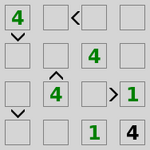
The image depicts a 4x4 grid of squares, each containing either a numeric value (1 or 4) or being empty. Arrows indicate directional transitions between squares. The grid is structured with black borders, and numeric values are primarily green, except for the bottom-right "4," which is black.
### Components/Axes
- **Grid Structure**:
- 4 rows (top to bottom) and 4 columns (left to right).
- Each square is a node with potential numeric labels and directional arrows.
- **Arrows**:
- Black directional arrows (up, down, right) indicate transitions between nodes.
- No explicit legend for arrows; directionality is visually encoded.
- **Numeric Labels**:
- Values "1" and "4" are embedded in specific nodes.
- No explicit legend for numeric values; color coding (green vs. black) may imply significance.
### Detailed Analysis
1. **Top-Left Node (Row 1, Column 1)**:
- Contains "4" (green) with a downward arrow pointing to Row 2, Column 1.
2. **Row 2, Column 3**:
- Contains "4" (green) with no arrows.
3. **Row 3, Column 2**:
- Contains "4" (green) with an upward arrow pointing to Row 2, Column 2.
4. **Row 3, Column 4**:
- Contains "1" (green) with a rightward arrow pointing outside the grid (no adjacent node).
5. **Bottom-Right Node (Row 4, Column 4)**:
- Contains "4" (black), distinct from other "4"s.
### Key Observations
- **Transition Paths**:
- The top-left "4" (green) initiates a downward transition to an empty node (Row 2, Column 1).
- The "4" in Row 3, Column 2 transitions upward to an empty node (Row 2, Column 2).
- The "1" in Row 3, Column 4 has a rightward arrow with no target node, suggesting an incomplete or terminal transition.
- **Color Significance**:
- The black "4" in Row 4, Column 4 may denote a terminal or special state.
- **Empty Nodes**:
- Most nodes are empty, implying sparse connectivity or undefined transitions.
### Interpretation
This diagram resembles a **state transition system** or **flowchart**, where:
- Numeric values ("1," "4") represent states or conditions.
- Arrows define permissible transitions between states.
- The black "4" in the bottom-right corner could signify a final or absorbing state.
- The sparse population of nodes and incomplete transitions (e.g., the rightward arrow from Row 3, Column 4) suggest either an unfinished diagram or a system with limited state interactions.
The structure implies a hierarchical or sequential process, with the top-left "4" acting as a starting point. However, the lack of clear pathways to the bottom-right "4" (black) raises questions about system completeness or intentional design choices. Further context is needed to confirm the purpose of empty nodes and color-coded values.