## Diagram: Unmasked Previous-Row Attention Visualization
### Overview
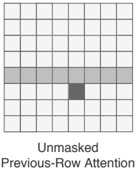
The image displays a 7x7 grid representing an attention mechanism matrix. It highlights specific patterns of connectivity between tokens or hidden states, labeled as "Unmasked Previous-Row Attention."
### Components/Axes
* **Grid Structure:** A 7x7 square matrix.
* **Text Label:** Located directly below the grid, reading: "Unmasked Previous-Row Attention".
* **Visual Encoding (Color Legend):**
* **White:** Represents no attention or masked connections.
* **Light Gray:** Represents a row-wide attention connection.
* **Dark Gray:** Represents a specific, localized attention connection.
### Detailed Analysis
* **Grid Dimensions:** 7 rows by 7 columns.
* **Row 4 (from top):** All 7 cells in this row are filled with light gray. This indicates that the attention mechanism is attending to the entire previous row simultaneously.
* **Row 5 (from top):** Only the cell at Column 4 is filled with dark gray. This indicates a specific, point-to-point attention connection within the current row.
* **Remaining Cells:** All other cells in the 7x7 grid are white, indicating no attention is being paid to those specific positions.
### Key Observations
* **Asymmetry:** The pattern is not uniform. It combines a "global" row-level attention (the light gray horizontal band) with a "local" point-specific attention (the dark gray cell).
* **Unmasked Nature:** The label "Unmasked" is significant. In standard Transformer architectures, attention is typically "masked" to prevent the model from looking at future tokens. This diagram illustrates a mechanism where that constraint is lifted for the previous row, allowing the model to access information from the entire previous row of hidden states.
### Interpretation
This diagram is a schematic representation of a specific attention mechanism used in advanced neural network architectures, such as **Transformer-XL** or similar recurrent transformer models.
* **Contextual Flow:** The "Previous-Row Attention" suggests that the model is processing data in segments or blocks. Instead of only attending to the current sequence, the model is designed to "look back" at the hidden states of the previous segment (the light gray row).
* **Why it matters:** Standard Transformers have a fixed context window. By allowing "Unmasked" attention to the previous row, the model can maintain long-term dependencies across segment boundaries without needing to recompute the entire history. The dark gray cell likely represents the standard causal attention (attending to the current token or previous tokens in the current sequence), while the light gray row represents the recurrent memory mechanism.