## Screenshot: Functional Programming Theorem Proofs
### Overview
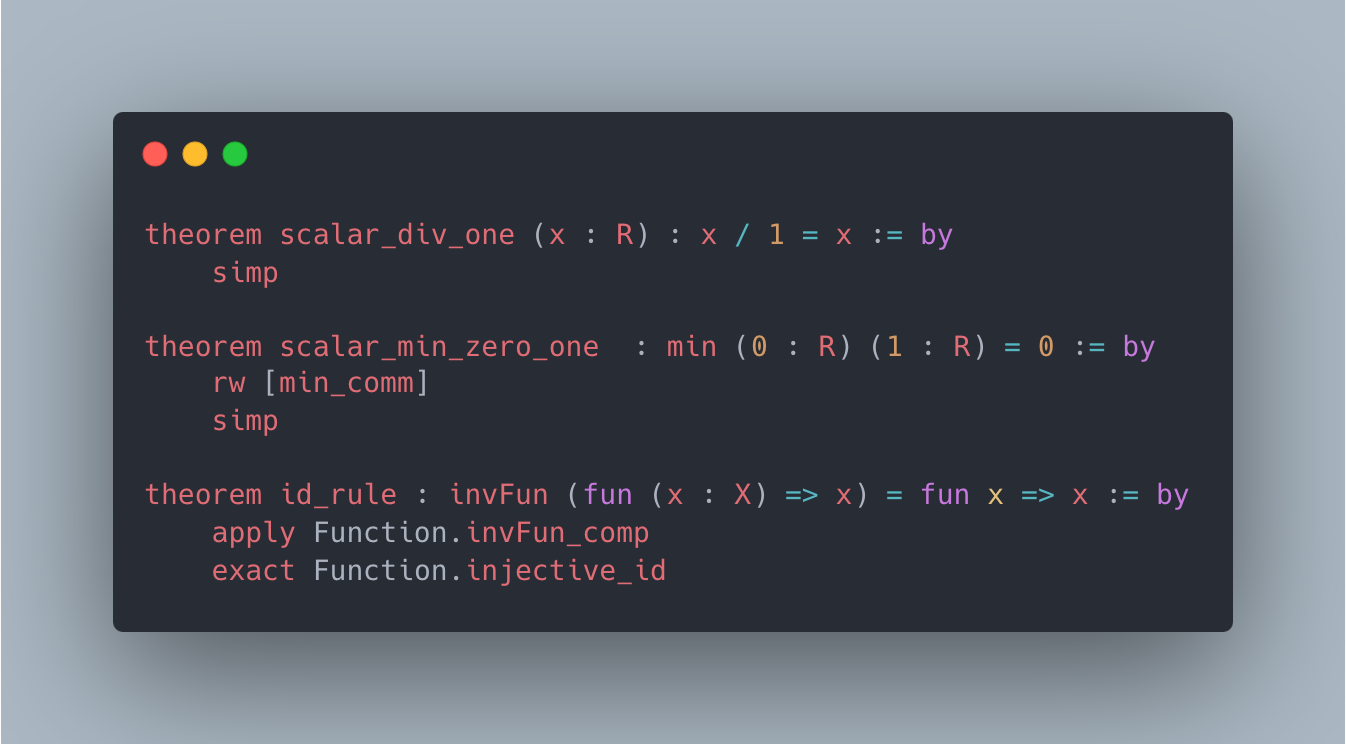
The image shows a code editor displaying three formal theorem proofs written in a functional programming or proof assistant language (likely Lean or Coq). The code uses syntax highlighting with red, yellow, green, purple, and pink colors. The theorems involve mathematical properties of functions and their implementations.
### Components/Axes
- **Header**: Three colored dots (red, yellow, green) in top-left corner (standard window control buttons)
- **Main Content**: Three theorem blocks with:
1. **Theorem Statements** (red text)
2. **Proof Tactics** (purple text)
3. **Function References** (pink text)
4. **Equality Operators** (`=>`, `=`, `:=`) in purple
5. **Function Application** (`.`) in green
- **Syntax Highlighting**: Color-coded elements for different language constructs
### Detailed Analysis
1. **Theorem: scalar_div_one**
- Statement: `theorem scalar_div_one (x : R) : x / 1 = x := by`
- Proof: `simp` (simplification tactic)
2. **Theorem: scalar_min_zero_one**
- Statement: `theorem scalar_min_zero_one : min (0 : R) (1 : R) = 0 := by`
- Proof:
- `rw [min_comm]` (rewrite using commutativity of min)
- `simp`
3. **Theorem: id_rule**
- Statement: `theorem id_rule : invFun (fun (x : X) => x) = fun x => x := by`
- Proof:
- `apply Function.invFun_comp` (apply inverse function composition)
- `exact Function.injective_id` (use exact match for injective identity)
### Key Observations
- All theorems use the `by` keyword to introduce proof tactics
- `simp` appears twice as a simplification tactic
- `rw` (rewrite) is used once with `min_comm` lemma
- `invFun` and `injective_id` suggest working with function inverses
- Type annotations (`: R`, `: X`) indicate a statically typed language
- Equality operators use both `=` (definition) and `=>` (proof relevance)
### Interpretation
This code demonstrates formal verification of three mathematical properties:
1. **Division Identity**: Division by 1 preserves value
2. **Minimum Property**: Minimum of 0 and 1 in any ordered ring is 0
3. **Function Identity**: The inverse of the identity function is itself
The proofs use a combination of:
- Simplification (`simp`)
- Lemma rewriting (`rw`)
- Function composition (`invFun_comp`)
- Exact matching (`exact`)
The color coding helps distinguish between:
- Theorem declarations (red)
- Type annotations (yellow)
- Proof structure (purple)
- Function application (green)
- Equality operators (pink)
This appears to be a formal proof assistant implementation verifying properties of basic arithmetic operations and function theory, likely part of a larger mathematical library or educational tool.