\n
## Text Block: Questions Regarding Hybrid Offspring
### Overview
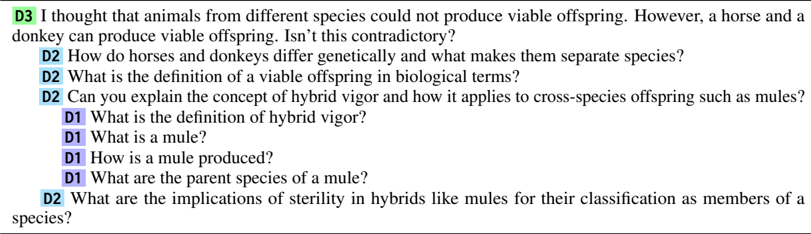
The image presents a list of questions, likely from a student or user interacting with an educational system or chatbot. The questions center around the topic of hybrid offspring, specifically mules, and the biological concepts related to species, viability, and hybrid vigor. Each question is prefaced with a code (D1, D2, D3) which likely represents a difficulty level or question ID.
### Content Details
Here's a transcription of each question, along with its associated code:
* **D3:** I thought that animals from different species could not produce viable offspring. However, a horse and a donkey can produce viable offspring. Isn’t this contradictory?
* **D2:** How do horses and donkeys differ genetically and what makes them separate species?
* **D2:** What is the definition of a viable offspring in biological terms?
* **D2:** Can you explain the concept of hybrid vigor and how it applies to cross-species offspring such as mules?
* **D1:** What is the definition of hybrid vigor?
* **D1:** What is a mule?
* **D1:** How is a mule produced?
* **D1:** What are the parent species of a mule?
* **D2:** What are the implications of sterility in hybrids like mules for their classification as members of a species?
### Key Observations
The questions progress from broad conceptual inquiries (D3) to more specific, definitional questions (D1). The difficulty level appears to be indicated by the codes, with D1 representing the simplest questions and D3 the most complex. The repeated focus on mules suggests they are being used as a case study for understanding hybridisation.
### Interpretation
The questions demonstrate a learner grappling with the complexities of species definitions and the exceptions to general biological rules. The questions reveal a need to understand the genetic basis of species differentiation, the meaning of "viable offspring," and the phenomenon of hybrid vigor. The inclusion of questions about sterility highlights the challenges in classifying hybrids within traditional species concepts. The progression of questions suggests a guided learning path, starting with an observation and moving towards a deeper understanding of the underlying biological principles. The codes (D1, D2, D3) likely represent a scaffolding approach to learning, where simpler concepts are addressed before more complex ones.