## 3D Spatial Reasoning Diagram: T-Block Rotation Puzzle
### Overview
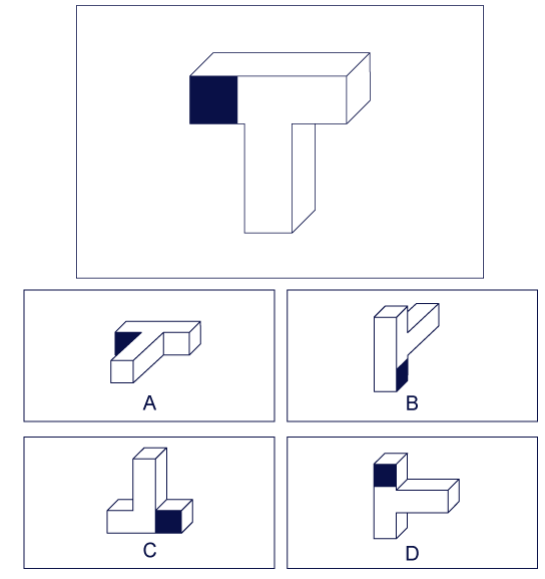
The image presents a visual spatial reasoning puzzle. It consists of a primary reference diagram at the top and four candidate answer diagrams (labeled A, B, C, D) below. The puzzle challenges the viewer to identify which of the four smaller diagrams represents the same three-dimensional T-shaped block as the main reference, but rotated to a different orientation. The only distinguishing feature is a single face of the block shaded in dark blue.
### Components/Axes
* **Main Reference Diagram (Top):** A 3D isometric line drawing of a T-shaped block. The block is composed of two rectangular prisms: a horizontal top bar and a vertical stem centered beneath it. One specific face is shaded dark blue.
* **Answer Options (Bottom):** Four smaller boxes, each containing a 3D isometric line drawing of a similar T-shaped block in a different orientation. Each is labeled with a capital letter in a sans-serif font, centered beneath its respective diagram.
* **Label A:** Positioned below the top-left answer box.
* **Label B:** Positioned below the top-right answer box.
* **Label C:** Positioned below the bottom-left answer box.
* **Label D:** Positioned below the bottom-right answer box.
* **Color Legend:** The only color used is a solid dark blue (approximate hex: #000033) applied to one face of the block in each diagram. This blue face is the key feature for matching the reference to the correct answer.
### Detailed Analysis
**Main Reference Diagram:**
* **Orientation:** The T-block is viewed from a front-right angle. The top bar extends left-to-right, and the stem extends downward.
* **Shaded Face Location:** The dark blue shading is applied to the **left-most face of the horizontal top bar**. This face is oriented toward the front-left of the viewer's perspective.
**Answer Option A:**
* **Orientation:** The T-block is rotated so the top bar is angled, running from the front-left to the back-right. The stem points downward and slightly to the left.
* **Shaded Face Location:** The dark blue shading is on the **top surface of the left end of the horizontal bar**. This appears to be the same physical face as in the reference, now viewed from above due to the rotation.
**Answer Option B:**
* **Orientation:** The T-block is rotated so the stem is vertical and the top bar is angled, running from the front-right to the back-left.
* **Shaded Face Location:** The dark blue shading is on the **right-side face of the vertical stem**, near its base. This is a different face than the one shaded in the reference diagram.
**Answer Option C:**
* **Orientation:** The T-block is in a similar upright orientation to the reference, but viewed from a front-left angle.
* **Shaded Face Location:** The dark blue shading is on the **right-side face of the vertical stem**, near its base. This is the same face as in Option B, and different from the reference.
**Answer Option D:**
* **Orientation:** The T-block is rotated so the stem is vertical and the top bar extends to the right. The view is from a front-left angle.
* **Shaded Face Location:** The dark blue shading is on the **left-side face of the vertical stem**, at the very top where it joins the horizontal bar. This is a different face than the one shaded in the reference diagram.
### Key Observations
1. **Consistent Feature:** All five diagrams (reference + four options) depict the same fundamental T-shaped block geometry.
2. **Critical Variable:** The sole differentiating element is the location of the dark blue shaded face on the block's surface.
3. **Spatial Transformation:** The puzzle requires mentally rotating the 3D object to track which face is which through different viewpoints.
4. **Labeling:** The only text present are the single-letter labels (A, B, C, D) identifying the answer choices.
### Interpretation
This diagram is a classic non-verbal reasoning test item, specifically a **3D mental rotation or spatial visualization task**. The objective is to determine which of the four options (A, B, C, D) shows the *exact same object* as the reference diagram, merely turned to a new position.
* **What the data suggests:** The puzzle tests the ability to maintain object constancy across transformations. The correct answer will be the option where the blue-shaded face corresponds to the *same physical face* of the block as in the reference, not just a similarly positioned face in the new view.
* **How elements relate:** The reference sets the rule ("this specific face is blue"). The options present hypotheses. The solver must reject options where the blue face is on a different part of the object's geometry (e.g., the stem instead of the top bar).
* **Analysis of Options:** Based on the detailed analysis, only **Option A** appears to show the blue shading on the same physical face (the end of the top bar) as the reference, just viewed from a different angle. Options B, C, and D all show the blue shading on a face of the vertical stem, which is a different part of the object.
* **Purpose:** Such puzzles are used in aptitude testing, cognitive assessments, and design/engineering evaluations to measure spatial intelligence, a key skill for fields like architecture, mechanical engineering, surgery, and chemistry.